

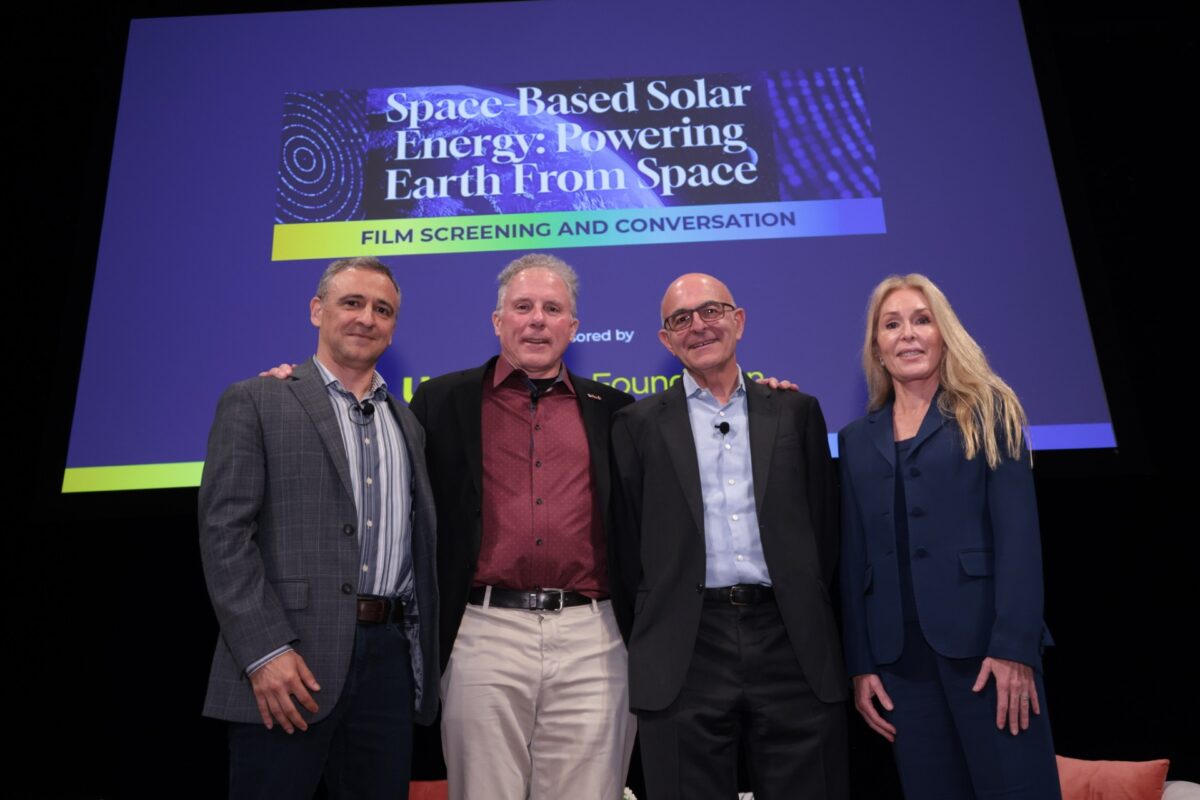
Editor’s note: Brigitte Bren has extensive experience in international business, corporate governance and entertainment law. A trustee of the California Institute of Technology, she works at the intersection of law, philanthropy and emerging innovations, with a focus on advancing space-based solar energy power from research to real world deployment. She produced the 2025 documentary “Bright Harvest: Powering Earth from Space.”
Space-based solar energy is no longer a theoretical exercise. It is now a strategic race.
For decades, the idea of collecting solar power in space and transmitting it wirelessly to Earth lived in the margins of serious energy policy. That is beginning to change.
Multiple countries are investing in the technology not as a distant experiment but as a long-term solution to energy security, resilience and decarbonization.
China has announced plans for orbital solar power stations and dedicated research programs. Japan has spent years advancing wireless power transmission. The European Space Agency is actively studying space-based solar as part of its future energy portfolio, and the United Kingdom is also exploring commercial pathways through public-private partnerships.
Against that backdrop, the question is not whether space-based solar energy will advance, but where will it take root?
The SoCal Advantages
Southern California enters the conversation with unusual advantages.
At the California Institute of Technology, three scientists—Harry Atwater, Ali Hajimiri and Sergio Pellegrino—had a breakthrough and beamed measurable energy from space to the rooftop of Caltech’s Moore Lab.
The scientists demonstrated key elements of the system, high-efficiency photovoltaics, ultralight flexible solar structures, deployable architectures and wireless microwave power transmission in space. Their work represents a convergence of disciplines that had long been pursued separately.
By solving these problems together, they have shifted space-based solar from an abstract ambition to an emerging engineering reality.
That shift becomes more consequential when paired with economics. Research published in the journal Joule outlines a pathway toward delivering electricity at 9.4 cents per kilowatt-hour for a 10-gigahertz orbital power station. That target places space-based solar within reach of existing energy markets and suggests that at scale, it could compete rather than simply complement. It also offers something increasingly difficult to achieve: continuous, carbon-free energy at a scale that can be deployed wherever and whenever it is needed.
Producing Engineers at Scale
Proximity matters in moments like this. A short distance from Caltech is the Jet Propulsion Laboratory, an institution with decades of experience designing and operating complex systems in space.
The challenges associated with space-based solar—precision deployment, long-duration reliability and systems integration—align closely with the capabilities where JPL excels. Few regions have access to that level of engineering depth in such close coordination with academic research.
The same is true of the region’s universities, which together form one of the most concentrated talent ecosystems in the country. Caltech, UCLA, USC, UCSD, Harvey Mudd and UCI are producing engineers, physicists and systems thinkers at scale. Just as important, they operate within a network where collaboration is possible and increasingly necessary.
The Aerospace Infrastructure
Southern California also benefits from an aerospace infrastructure that was built over generations. The region’s supplier base, manufacturing capability and specialized workforce provide a foundation that can be adapted to new applications. That foundation is now being extended by a new generation of companies.
Less visible, but equally important, is Southern California’s strength in advanced electronics and semiconductor-adjacent industries. Space-based solar systems depend on high-efficiency photovoltaics, power conversion and wireless transmission technologies —all areas where the region has deep expertise rooted in aerospace and defense.
This capability strengthens Southern California’s position not just as a center of research but as a place where complex energy systems can be designed, integrated and ultimately manufactured.
Relativity Space is rethinking how rockets are manufactured, using additional processes to reduce cost and increase speed. Rocket Lab is expanding launch flexibility, which is essential for iterative deployment. Hermeus has announced a new base in El Segundo, reinforcing the region’s role in next-generation aerospace development.
All these elements form something more than competitive advantage. They are the early architecture of an industry. And this is where timing matters.
Energy systems, once built, tend to persist. Supply chains settle, talent pools cluster and capital follows established pathways. If space-based solar reaches commercial scale elsewhere first, those patterns will begin to lock-in, making it significantly more difficult for any other region to displace that leadership. This is not just a question of who innovates first but rather who builds the ecosystem that others must then plug into.
For Southern California, the economic implications are substantial. Becoming the national hub for space-based solar energy would not be limited to research leadership. It would extend into advanced manufacturing, satellite production, launch integration, ground infrastructure and long-term operations. It would create demand for skilled labor across multiple disciplines and reinforce the region’s position as a center of high-value engineering and technology development.
It would also build upon something that Southern California understands very well: how to scale complex industries. Aerospace, entertainment and technology have each followed that path here, starting with innovation, then expanding into full economic ecosystems that generate jobs and attract capital.
Energy Security for SoCal
Another reason Southern California is an ideal hub for this new technology is that it would provide California with energy security, thereby incentivizing state investment in the new industry.
Leadership and a coherent strategy are needed if we aim to become the national hub of this sustainable energy industrial complex.
For Southern California, that alignment would require coordination across research institutions, industry and government. It means moving beyond demonstration toward early deployment, supported by clear regulatory frameworks and sustained investment. It requires space-based solar energy to be viewed as a core economic opportunity for our energy infrastructure.
Skepticism remains appropriate. Space-based solar energy still faces real challenges including technical and economic hurdles. However, launch costs are no longer the constraint they once were because of reusable launch systems developed by SpaceX. The costs are declining and the core technologies do work. What matters now is timing.
Industries concentrate where early decisions are made.
Southern California is well-positioned. The question is whether we choose to act with the coordination and intent required to lead.
