Why create a Walt Disney Studies Center?
Walt Disney was an astounding American whose creations facilitate happiness for literally hundreds of millions of people worldwide! He’s won the greatest number of Academy Awards, created the most visited places, received more than 600 honors and citations from throughout the world, and at age 37 — this farm-boy high-school dropout — was awarded honorary graduate degrees from Harvard, Yale and USC.
Walt Disney is one of the most recognized names in the world and is considered one of the 100 most influential people of the last millennium. Walt’s happily-ever-after films and television productions are iconic. His places of happiness have successfully spread around the globe. All the parks started with Walt’s Disneyland in Orange County — having more than half a billion visits, including Nobel laureates, presidents, kings, queens and other royalty from around the planet.
The renowned biographer Neal Gabler — often referred to as one of America’s most important public intellectuals — pens that “Arguably, no single figure has so bestrode American popular culture as Walt Disney” and that “He had changed the world.” The list of Walt’s accolades and accomplishments goes on and on.
What We Can Learn
It would take books of space to answer what people can learn from Walt Disney. Nevertheless, if we examine all the many creations of Walt Disney and ask what they are good for, the answer is clear: by and large, they are good for making us feel happy. And with gross national happiness being just as — or more important than — gross national product, learning how to better facilitate happiness is paramount.
Because Disney’s achievements are indisputable, his astonishing legacy would seem self-evident to everyone, and thus widely taught in higher education. Nevertheless, in today’s academia, he is underestimated and misjudged, and his creations and their far-reaching significance underappreciated. And worse, it seems that universities are largely antagonistic towards Walt Disney.
Academia should be no more hostile to Walt Disney than William Shakespeare; and should be just as academicized. However, within universities, Walt is typically reduced to some sophomoric summarization of his professional life. You would likely never hear at a university the following summary of Shakespeare’s professional life: A popular entertainer for the middle class, who wrote plays and poems, and did some acting.
Consider this dismaying observation: universities have long had William Shakespeare centers, institutes, journals and majors — but not so for Walt Disney. Furthermore, many universities have professors whose primary expertise concerns William Shakespeare and his creations — and countless other professors whose secondary and tertiary specialties are in Shakespeare.
The subject matter is rigorously studied, journal articles authored, conferences convened, courses designed and taught, majors created, and more. In the last quarter century, Shakespearean studies have increasingly drawn interdisciplinary attention.
It took a long time to academicize Shakespeare. Prior to academization, Shakespeare was read by many people, and the plays performed in theatres. About three centuries went by before the first professors of William Shakespeare had academic appointments in any university.
It should not take anywhere near that long for Walt Disney. Actually, the time has come! As Victor Hugo said, “Nothing is more powerful than an idea whose time has come.”
10 Faculty Members
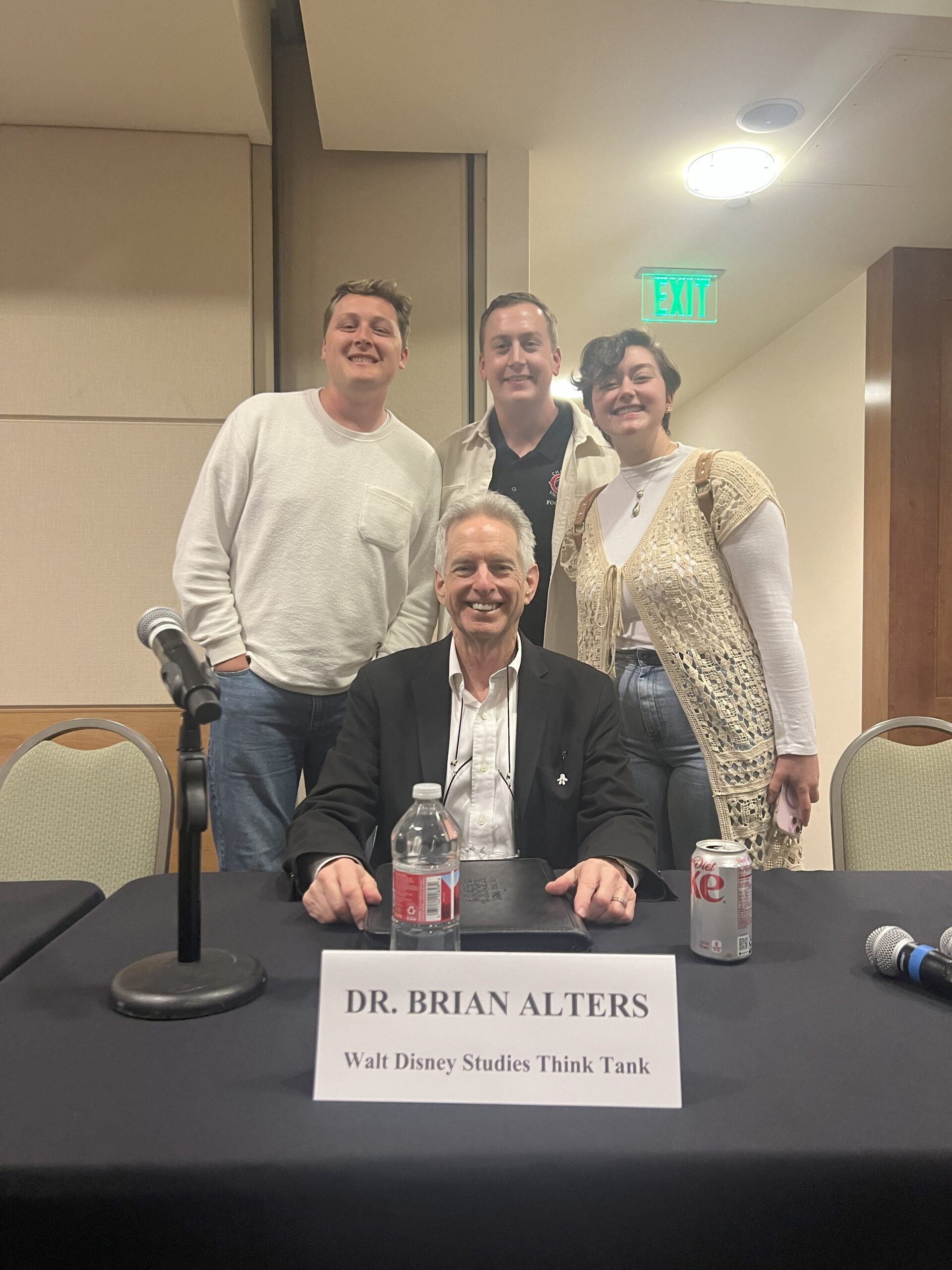
Insightfully, last summer, Chapman University (a significantly ranked research university) created a Walt Disney Studies Project. Within only nine months, it grew into the first Walt Disney Studies Think Tank at a research university — already consisting of 10 Chapman University faculty members in 11 different subject areas from film and theater to science and math.
Some of these faculty teach courses at Chapman involving Disney. For example, as the director of the think tank, I have taught thousands of students a course titled “The Pursuit of Happiness and Knowledge: Walt Disney and Charles Darwin”; Stephanie Takaragawa teaches a course titled “The Anthropology of Space and Place: Disneyland”; and Dawn Fratini teaches a course titled “Disney from Animation Studio to Empire.”
The think tank currently has a modest budget — okay, microscopic. Nonetheless, in appropriate blue-sky thinking, the next big dream is to create at a research university the first “Walt Disney Studies Center” – naturally at Chapman University. And maybe even an endowed Chair of Walt Disney Studies (another first!), and a Walt Disney bust on campus (another first!).
The Center will conduct in-depth scholarly research, publish academic journal articles, convene intellectual conferences, design university courses, appoint scholars-in-residence, bring credentialed academics together worldwide and more; all with the goal to academicize Walt Disney and his creations — just as William Shakespeare is academicized. Thus, the Center would create knowledge at the university-research level, trickling to K-12 and the public; often proceeding in a path roughly resembling the following: novel idea to research to peer review to scholarly consensus to classrooms, textbooks and general public.
Being in California, the Center would be in close proximity to Disneyland in Anaheim, Walt Disney Studios (which includes the Walt Disney Archives) in Burbank, Walt Disney Imagineering in Glendale, the Walt Disney Family Museum in San Francisco, and the large number of Disney Imagineers living in Orange County. Plus, Chapman University has the 4th ranked film school in the nation!
The timing is opportune as it’s Orange County’s Disneyland’s 70th anniversary – with the theme of “Celebrate Happy,” and the first audio-animatronic Walt Disney anywhere is being inaugurated into – the park! (It’s like Disneyland’s attraction Great Moments with Mr. Lincoln but with Walt. Another great honor!)
Happiness is vital.
Today, with so many people being emotionally depleted, the idea of elevating the notion of personal and social happiness into our higher academics is appropriate. It’s hard to hate others when you are happy. The scholarship and advancement of happiness has conceptual depth and historical importance in our country – “Life, Liberty, and the pursuit of Happiness.”
Thus, the long-range goal is to fully academicize the great facilitator of happiness — Walt Disney — with the beginning goal of creating the first “Walt Disney Studies Center” at Chapman University!