

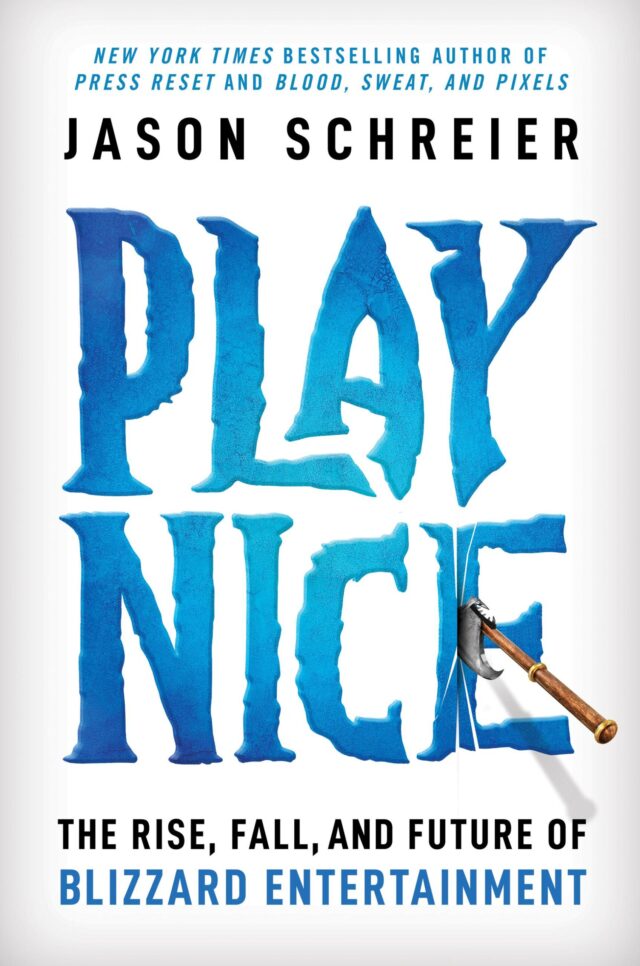
Editor’s Note: Irvine-based Blizzard Entertainment became famous for games like StarCraft, Diablo, Overwatch, Hearthstone and World of Warcraft. While it’s now a unit of Microsoft, Blizzard remains the largest software company in Orange County, with 1,260 employees. What follows is an excerpt from the first chapter of Jason Schreier’s 2024 book about Blizzard’s beginnings, reprinted by permission from Grand Central Publishing/Hachette Book Group.
Before he’d even graduated high school, Allen Adham knew he wanted to make video games. It was Southern California in the 1980s and gaming was morphing from a curious pastime into a lucrative business.
Arcades were booming, cheap home computers like the Commodore 64 were becoming living room centerpieces, and the song “Pac-Man Fever” was cresting to #9 on the Billboard Hot 100.
During lunch breaks, Adham would head to his local arcade and blast through aliens in games like “Asteroids” and “Space Invaders.” At home, he and his brother convinced their dad to buy an Apple II computer, which Adham could use both to play games and to create them.
Born Ayman Adham to Egyptian parents—an engineer and a preschool administrator—he grew obsessed with how video games worked and how they made people feel.
“He’d talk about how gaming would be the new form of entertainment, synonymous with movies and stuff like that,” said a college friend. “I thought he was smoking dope.”
To Adham, interactivity made video games capable of evoking an unparalleled adrenaline rush: instead of just watching something happen, you could actually feel it play out.
UCLA Connection
During his sophomore year at UCLA, Adham designed and programmed his first game: Gunslinger, a rudimentary graphical text adventure set in the Wild West. A small company called Datasoft printed the game and distributed it to stores, where prospective buyers had no idea it had been coded by someone who wasn’t yet old enough to legally drink.
Gunslinger didn’t get much attention but to Adham it was proof that he could finish and release a video game of his own—a feat about which he bragged to anyone who would listen.
One day at the UCLA computer lab, Adham took a seat next to a skinny, curly-haired student named Mike Morhaime. The two men, both bookish and soft-spoken, had shared some classes but hadn’t talked much. ‘
Adham stepped out of the room, locking his computer before he left. When the computer timed out and unlocked itself a few minutes later, Morhaime decided to prank his seatmate, swinging over and typing in his own password to relock the device.
Adham returned, clacked a few letters on the keyboard, and somehow unlocked the computer. Morhaime, stunned, asked Adham just how the heck he’d pulled that off. It turned out the two young computer geeks had both used the same simple password, “Joe”—a meet-cute that sparked a lasting friendship.
Morhaime, too, obsessed over video games. As a kid, he was fascinated by the insides of machinery: radios, televisions, microwaves. Whenever his family would get new electronics, he’d ignore the hardware and instead pore over the manual, curious to know the exact purpose of each port on the back of the VCR.
In middle school, he and his siblings pooled together their savings to buy the Bally Astrocade, a game system that included a cartridge with the BASIC programming language on it, allowing Morhaime to write simple software and slowly figure out how games functioned.
The jolt of excitement from taking things apart and reassembling them pushed him to study electrical engineering at UCLA, where he sat in the front row of every class, asking questions and trying to absorb as much as possible.
The Successful Pitch
In 1990, as Adham was finishing his degree, he suggested to Morhaime that they team up and start a video game company. But Morhaime, who had graduated a few months earlier, was reluctant.
He’d snagged a job writing test software at Western Digital, a stable computer technology company that offered him a salary and benefits with little risk, and he specialized in hardware, not video game development.
Adham persisted, laying out a lengthy case and even setting up a meeting with Morhaime’s skeptical father. As computer engineers in their 20s, Adham argued, this was the best possible time to take a risk.
If it didn’t work out, no big deal—they could all get jobs at IBM or Microsoft. There were very few other industries in which a couple of guys could go into business with a small amount of seed money and make something that hordes of people enjoyed.
It was clear that Adham had a gift for persuasion. “People said he had Jedi powers,” said one person who worked with him. “He was always calm, listening, not aggressive. Always unassuming. Then he’d start to talk and you’d get all charged up: ‘Yes, I will follow you.’”
After some hemming and hawing, Morhaime agreed to take the plunge. In February 1991, the pair founded Silicon & Synapse, meant to represent a sort of synergy between computer parts (sili-con) and the human brain (synapse).
Each of them invested around $10,000—Adham from his college fund, Morhaime through a loan from his grandmother—and they rented out a tiny office in Irvine. They couldn’t afford new computers, so they brought in the ones they had at home, and Adham recruited one of his other UCLA friends, Frank Pearce, to be their first employee.
Contract Gaming
Morhaime and Adham planned to one day design their own software, but to start, Silicon & Synapse would take on contract work as the company tried to make a name for itself.
This was where Adham’s relationship with Brian Fargo started to pay dividends: Fargo, who had received a 10% stake in Silicon & Synapse as an advisor (Adham had 60% and Morhaime had 30%), began giving the company a slew of these conversion contracts starting with a Windows version of Battle Chess, which transformed the rooks and knights into medieval warriors.
When they weren’t completing work-for-hire projects, Silicon & Synapse’s employees were fantasizing about the original games they’d make.
Inspired by Adham’s lofty rhetoric, they thought they could conquer the video game industry—not just because they were good programmers but because they understood video games.
The industry’s rapid growth had drawn interest from suited businessmen with expertise in spreadsheets and selling boxes, but not in the products themselves. In contrast, Adham and crew didn’t need focus groups or market research to discern if a game was good—they could just make games they wanted to play.
Adham decided that anyone who didn’t play games wasn’t welcome at Silicon & Synapse. Prospective employees would be asked their favorite video games, then quizzed extensively to gauge their depth of knowledge.
The team would write code in the mornings, battle one another in Magic: The Gathering card matches during lunch and spend evenings playing games on the office television.
All of Silicon & Synapse’s employees were men, and these design meetings, fueled by caffeine and testosterone, could get rowdy. Sometimes there was screaming; sometimes there were fistfights.
They called it management by chaos: finding the best possible option through debate. The process worked in large part because Adham was so persuasive, earning him the nickname “Velvet Hammer” for his understated yet forceful approach.
The development of The Lost Vikings would establish design principles that the company would follow for decades to come.
Everyone at Silicon & Synapse was tasked with playing the game so they all had a deeper understanding of how it functioned, and when they’d played too much and lost their sense of objectivity about what worked, they brought in external playtesters.
To add levity, they gave the Vikings cartoonlike animations and added cheeky dialogue for when players died and had to restart. Both Rock N’ Roll Racing and The Lost Vikings were critical hits, leading one video game magazine to name Silicon & Synapse “Best Software Developer of the Year” in 1993.
Interplay, which had published both games, was thrilled with the reception and hungry for more.
“They were clearly one of the better developers I worked with,” said Interplay producer Alan Pavlish. “They understood game design, they worked hard, and they took the time and effort to do the little bit extra that takes a game from a B or a B+ into an A or an A+.”
