

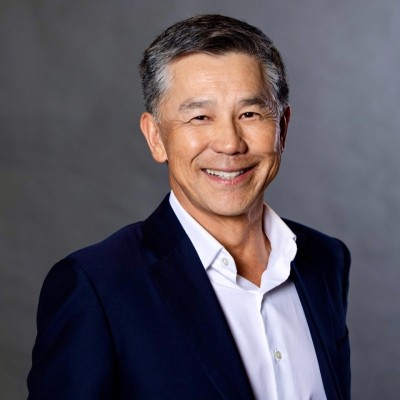
Editor’s Note: Quang X. Pham has a long history in Orange County, dating back to his time as a Marine Corps helicopter pilot flying out of the former Tustin and El Toro bases, his service in the first Gulf War and Somalia, and his run for Congress. He was active in the OC business circle in the 2000s as the founder of MyDrugRep.com and CEO of Lathian Systems. His most recent role is founder and CEO of Cadrenal Therapeutics Inc., a late-stage biopharmaceutical company developing innovative therapies for life-threatening immune and thrombotic conditions (Nasdaq: CVKD). What follows are edited excerpts from his second book, “Underdog Nation,” which was published last year.
Two decisions by my parents in April 1975 would forever alter the course of my life.
The first decision was by my father, a senior pilot in the South Vietnamese Air Force. At the time, I was 10 years old and had just finished fifth grade, with French as my second language.
All I had ever known was life in a country at war. Like many little boys, I considered my father as my role model, my hero. My parents, my three sisters and I lived on the military air base in Saigon. He would be with us one day, then go fly missions for several days. But he always came back. On the night of April 21, my father woke my three sisters and me.
“Grab your clothes,” he said in a hushed and hurried tone. “We’re headed to the airport. You’re leaving the country.”
Under the cover of darkness, our family of six rode on a Lambretta scooter to the airport with the little we could carry. We left our dog behind.
We boarded a U.S. C-130 aircraft piloted by my father’s American advisor, along with some other families, the fear and despair palpable on their faces. And then my father made the first decision that changed my life. He stayed behind.
A week later, in a refugee camp on Guam island, we heard the news crackle over the radio. Saigon had fallen. The new South Vietnamese president had surrendered. The war was finally over, and we had lost. South Vietnam was no more. Losers left town. The life I had known for 10 years was forever gone.
We had no news of my father. Whether he had lived, been captured or died—no way for us to know. I wouldn’t see my father for 17 years when he was finally released from the prison camps and came to the U.S. in 1992.
France or America?
The second important decision was made by my mother, a middle school teacher, who was left alone with four young children—where were we to go?
Though my father had learned English from his military training in the U.S., we knew none.
We were bilingual, but in Vietnamese and French. Some of my mother’s family had already fled to Paris, so one of our options—the obvious, safe and logical option—was to join them.
At least then we would know the language and have a support system of family already in place to help us resettle.
Instead, my mother decided on America. A week later, we were in the refugee resettlement camp at Fort Chaffee in Arkansas. We might as well have been on another planet. The air was different. The language. The food. The bigger people.
Years later, when I asked my mother why she chose the unknowns of America over France, her answer was simple and direct: “Because I believed you would have more opportunities in America.”
Turns out, she was right. There would be many opportunities for this new underdog in America.
Nearly 48 years later, I would find myself with our team ringing the Nasdaq bell at market close to celebrate the initial public offering (IPO) of my latest venture, Cadrenal Therapeutics.
We were another underdog trying to be the newest darling on Wall Street amid the worst biotech financing climate.
The Life of an Underdog
To be clear, this book is not a pure memoir. I’ve already done that with my first book, “A Sense of Duty,” detailing the influence of my father on my life and my journey in the U.S. Marine Corps.
Going from war to Wall Street in a span of nearly 50 years is essential for the substance of this book.
My life has largely been marked as one of being the perpetual underdog. Therefore, it’s with nothing but gratitude and awe that I can reflect on the unlikely way I ended up in the U.S., a country known for loving a good underdog story, and the only country where an underdog can go from surviving to thriving.
There’s a lot in life you can’t control. If my childhood didn’t teach me this enough, then my time in the Marine Corps certainly did. You can have all the best training, the best discipline in the world, the best weapons, but when you get into the combat zone, you don’t control which way the wind is blowing smoke into your face. Or when the enemy pulls the trigger.
Or when the politicians say enough is enough.
What you can control is your approach. In recent years, business and personal development books have made much use of the term mindset. But mindset is only one piece of the equation. The best mindset in the world won’t help you if you don’t pair it with action.
And that’s what approach is—mindset plus action. Or to put it another way, your efforts.
Adjusting the Results
When I look back at my life, from the decisions my parents made that fateful April, to my choice to join the Marines, to my choice to go into pharmaceutical sales, to my choice to become an entrepreneur, I see that two simple ideas have always been at play: effort and results.
My efforts have been based on quick decision-making skills like what my parents showed under the immense pressure of losing our country. And then further ingrained in me by Marine training.
Quick decision-making spurs on effort. You only get results with effort. It starts the cycle. Because once you have results, then you know how to adjust your efforts.
Look at any underdog, and this has also been their approach, whether they realize it or not. They put in the effort. They looked at the results. And then they adjusted their efforts until they finally achieved the results they wanted.
Being an underdog means people don’t expect much from you—certainly not a success story. You’re too much of a risk for them to place their bets on. You’re starting from behind.
You’ve got the highest handicap on the golf course. People don’t really care about you.
Most people are looking for the “sure thing,” the “best bet.” They want to back the top dog.
So, I’ll let you in on a little secret: Don’t try to be like most people when you are not like most people. Be your underdog self.
Where top dogs expect success, underdogs earn it. The goal of this book is to teach you how to harness the scrappy strength of the underdog through your effort and results.
