

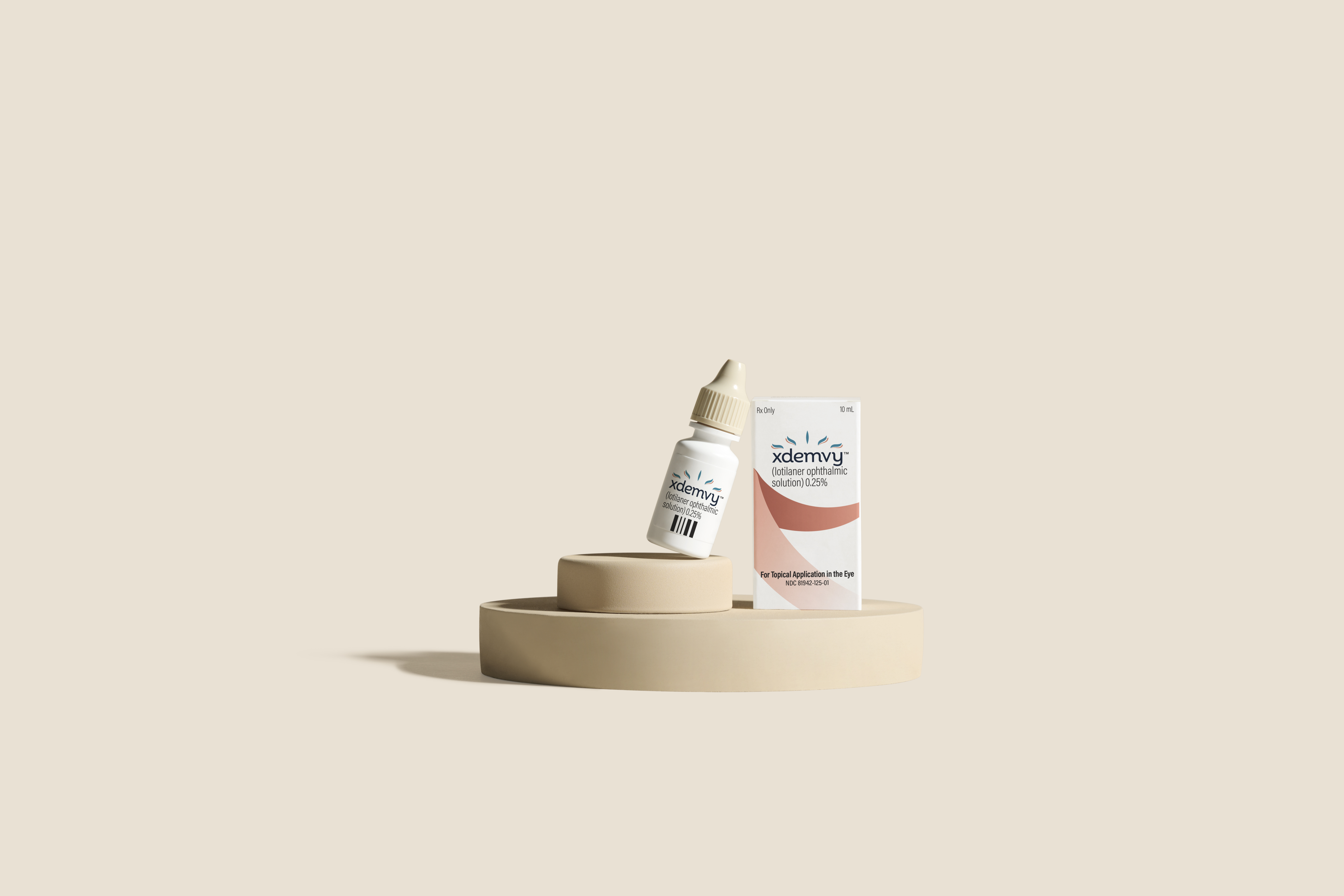
Tarsus Pharmaceuticals Inc. delivered higher-than-expected fourth quarter revenue driven by surging demand for its eyedrop Xdemvy.
More than two years into commercial launch, sales of Xdemvy, the first and only FDA-approved treatment for inflammatory eye disease Demodex blepharitis, grew 128% to $151.7 million and 150% to $451.4 million in the fourth quarter and full year, respectively. The $151.7 million for the fourth quarter came in above the $144.6 million analysts expected.
Officials now estimate Xdemvy’s sales peak will exceed $2 billion, supported by higher market penetration in what they say is a largely untapped addressable market.
“What we see are two plus years into the launch, and we have seen continued incredible growth, and we continue to see no slowing of that growth,” Tarsus Chief Executive Bobak “Bobby” Azamian said in the company’s Feb. 23 earnings call.
Azamian said that Xdemvy has been used by half a million patients living with Demodex blepharitis, which is less than 10% of the 25 million total Americans with the condition. He said that while it’s “a little early” to say when the company will hit the peak, Azamian estimates that Tarsus is “a couple years” from hitting more than a billion in sales.
In addition to the peak sales target, the company provided annual guidance for the first time. It’s expecting sales of $670 million to $700 million for the full year. Tarsus also reported a quarterly loss of 20 cents per share, missing the 19 cents expected by analysts.
Shares rose 7.8% to $75.01 in the subsequent trading session following earnings. The company had a $3.2 billion market cap at press time (Nasdaq: TARS).
The company will soon double its office space in Irvine by relocating to a new 60,000-square-foot corporate headquarters currently under construction at Spectrum Terrace, home to Amazon, Boot Barn, Apple and foodservice supplier Ventura Foods.
Pipeline Push into Ocular Rosacea, Lyme Disease
Azamian said that the company is applying its commercial playbook to other diseases with clear root causes.
Tarsus is expanding its pipeline by developing an ophthalmic gel for ocular rosacea and an oral tablet designed to kill ticks and potentially prevent Lyme disease.
Both currently have no FDA-approved therapies, according to Tarsus.
“Ocular rosacea is a natural extension of our Demodex expertise,” Tarsus Chief Operating Officer Seshadri Neervannan told analysts during the company’s earnings call. “Like DB, it is driven by Demodex mites and can significantly impact how patients look, feel, and see.”
The company initiated what it says is the first-ever Phase 2 trial for the treatment of ocular rosacea, an inflammatory eye condition, last December, and plans to launch another Phase 2 trial for the Lyme disease treatment which is expected to enroll 700 participants.
Topline data for the ocular rosacea trial and Lyme disease trial are expected in 2027.
Azamian said that Tarsus intends to expand its pipeline by targeting one to two new programs per year.
To help achieve this, the company last month appointed former Allergan Chairman and CEO David Pyott to its board of directors.
Pyott led Allergan for 17 years, transforming it from a roughly $1 billion eye care company into a global specialty pharmaceutical and medical device maker generating more than $7 billion in revenue.
Global Expansion Progress
The company is also focused on Xdemvy’s global expansion.
It’s targeting countries with dynamics similar to those in the U.S., according to Neervannan.
One of the markets they’re looking to enter is Europe, where the company anticipates getting regulatory approval in 2027.
“The treatment paradigm is very similar to what we saw in the U.S. prior to launch of XDEMVY, where doctors are aware, they are typically using palliative approaches, and are really eager to have a definitive cure or treatment for the disease,” Neervannan said.
Tarsus said it’s also having ongoing discussions with regulatory authorities in Japan while its partner in China, Grand Pharmaceutical Group Ltd., expects approval in 2026.
