

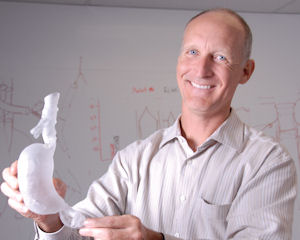
Medical device maker Endologix Inc.—a self-described “one blood-vessel company”—has seen its Wall Street profile rise quietly this year, while its share price has climbed notably.
The Irvine-based company makes catheter-delivered stents used to repair ruptured or ballooning segments of the abdominal aorta.
“We focus exclusively on the aorta and believe that by focusing and channeling all our resources into those clinical problems, we can provide better solutions faster than our competitors,” Chief Executive John McDermott told the Business Journal.
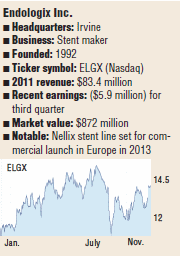
Endologix’s shares are up 20% since the beginning of 2012. The company had a recent market value of about $872 million, putting it in the middle tier of publicly traded companies based in Orange County.
The company relies on research and development to compete in its field, which includes several larger companies. Its analyst coverage has expanded in recent months, while Endologix execs have stumped the industry-conference circuit tirelessly.
Abdominal aortic aneurysms are found in about 1.7 million Americans, primarily adult men over 65 years of age. Sufferers have a 70% mortality rate if the problem isn’t repaired, according to Endologix.
“We are a smaller company relative to our competitors, and our strategy has been over the last several years very clear—that we will grow and take market share through innovation,” McDermott said. “So far, that’s working well for us.”
Pipeline
Endologix’s new product pipeline has gained attention in the investor and clinical communities. Its devices include mainstay stent line Powerlink and newer offerings such as Nellix—set for commercial launch overseas in the second quarter—and Ventana, which is under development.
Endologix acquired Nellix Endovascular Inc. in 2010. The deal—valued at $15 million, based on stock and milestone payments—gave it the Nellix line of aneurysm sealers under development.
“[It] is a very novel and eventually game-changing way to repair aneurysms that’s got a lot of interest with clinicians,” McDermott said.
A Food and Drug Administration filing for Nellix is expected in the first quarter.
Ventana targets what McDermott called “more complex anatomies,” aimed at the 20% of abdominal aortic aneurysm patients who require open surgical procedures or go untreated. Ventana is likely to get European approval by the end of the year, McDermott said.
Cleveland Clinic recently cited Ventana as a top medical device innovation set for 2013. Endologix plans to launch a U.S.-based clinical trial for Ventana midyear.
Endologix spent $16.7 million, or 20% of its 2011 revenue, on research and development. Fifty or more of Endologix’s 376 workers are involved in developing new technologies.
The company’s market—endovascular aortic repair—is “a growth opportunity with limited exposure to macro headwinds due to the non-elective nature of the procedure,” analysts Brooks West and Thomas Gunderson of Minneapolis-based Piper Jaffray wrote in a research report.
Endologix could continue to take market share from competitors, they added. The analysts also noted that the company is set to redesign Nellix for future applications, including its percutaneous use, or insertion under the skin.
Endologix goes up against companies such as Minneapolis-based Medtronic Inc., Cook Medical Inc. of Bloomington, Ind., and W.L. Gore & Associates Inc. of Newark, Del., in the abdominal aortic aneurysm market.
Endologix expects to transition into positive cash flow in 2013, McDermott said.
As for this year, Wall Street consensus sees $14.3 million in 12-month red ink on $105 million in revenue. Endologix will release its 2012 results on Feb. 20.
McDermott said he felt that Endologix is positioned for “financial independence, and as long as we’re not relying on the capital markets or outsiders for capital, we’re in a position to just execute our strategy.”
Part of that strategy includes making sure that its professionals are knowledgeable about how the devices work.
“We focus a lot on the quality of our clinical and sales professionals,” McDermott said.
Clinical professionals must go through training before they work with Endologix’s doctor clients. The process includes certification by two physicians.
Customers
Endologix’s devices primarily are sold to vascular surgeons. Medicare is the primary insurance coverage for Endologix’s devices, because of the age of patients with abdominal aortic aneurysms.
As for whether Endologix is a takeover target, McDermott said, “As a public company, we’re always going to be keen to do what’s in the best interest of the shareholders.”
But he added the company has “tremendous growth opportunity ahead of us for many, many years” and plans for a long-term future as an independent company.
Endologix makes all of its products in a clean room at its corporate headquarters building in the Irvine Spectrum area.
“We plan to keep it here; we don’t have any plans to move it,” said McDermott, who ran the peripheral vascular business of Murray Hill, N.J.-based device maker C.R. Bard Inc. before coming to Endologix in 2008.
Endologix has a “well-developed and a well-established work force,” McDermott said.
“It takes years to get the right people and the right training,” he said. “It’s not worth it to us to disrupt that.”
