

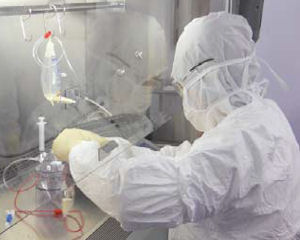
Drug maker Dendreon Corp.’s manufacturing plant in Seal Beach is open for business.
The Seattle-based company makes a highly specialized prostate cancer drug called Provenge in Seal Beach and has plants in Georgia and New Jersey.
Seal Beach is “commercially operational and producing now,” said Heidi Hagen, Dendreon’s senior vice president of operations.
The plant is in the Pacific Gateway Business Center near the Garden Grove (22) Freeway. The drug developer signed a 10-and-a-half-year lease valued at $13.6 million for 184,000 square feet there two years ago.
The plant received Food and Drug Administration approval on June 29 and started operating shortly after, Hagen said.
Analysts expect Dendreon to show a loss of $103.3 million on revenue of $58.6 million when it reports second-quarter financial results on Aug. 3.
The company’s shares are up 7% so far this year with a market value of $5.6 billion.
Provenge treatments cost $93,000.
Dendreon got a boost at the end of June, when the Centers for Medicare and Medicaid Services said they would cover Provenge for on-label use, meaning the main treatment for which it has been approved.
Provenge is on its way to becoming a “blockbuster product,” Ying Huang, an analyst with New York investment bank Gleacher & Co., wrote in a client note.
Provenge is designed for men whose prostate cancer has spread and is resistant to chemical castration hormone therapy, which is used because prostate cancer feeds off testosterone. Chemical castration is the conventional way to fight advanced prostate cancer. It comes with unpleasant side effects, including the development of menopause-like symptoms.
A Gleacher survey of doctors indicates “40% to 50% of castration-resistant prostate cancer patients will be treated with Provenge,” Huang said.
Dendreon makes the medication from white blood cells harvested from individual patients.
After each patient’s cells are taken, they are sent to Dendreon’s plants, which convert them to Provenge and return them to the doctor’s office for custom treatment.
Provenge works by spurring white blood cells to attack cancerous cells in the prostate gland.
Prostate cancer affects some 2 million men annually and is the most common non-skin cancer found among men.
Blue-Ribbon Opening
A blue-ribbon opening is expected next month to show off the Seal Beach plant, which Dendreon executives said will have the capacity to make as much as $750 million worth of Provenge annually.
Dendreon declined to say how many workers have been hired at the plant in advance of second-quarter results.
Previously, Chief Financial Officer Greg Schiffman said the company would hire “several hundred” workers for Seal Beach.
“The bulk of our work force is actually hired from the local area,” Hagen said. “There (are) plenty of biotech, pharmaceutical, medical device (workers), and we have a lot of entry-level positions.”
A few workers transferred from Dendreon’s other operations in Atlanta and New Jersey.
Dendreon considerered the local real estate market and transportation links before deciding on Seal Beach, according to Hagen.
Air Links
The company ships much of its product by air and Seal Beach is about 25 miles from Los Angeles International Airport—its main link for air shipments—and about 20 from John Wayne Airport in Santa Ana.
“One of the most important things about our product is that it is a personalized medicine with a short shelf life,” Hagen said. “All three of our facilities are placed in locations that are very specific to meet the needs of the customer base.”
Hagen travels frequently to Seal Beach and Dendreon’s other plants.
“It’s important that I spend time with the employees there, so I actually spend quite a bit of time at each of the facilities,” she said.
The Seal Beach plant is similar in size to Dendreon’s plant in Georgia and smaller than the manufacturing operation in New Jersey.
