

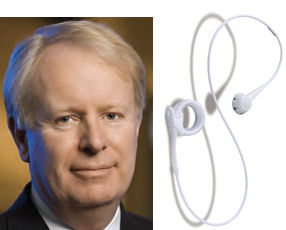
Irvine-based drug maker Allergan Inc. is sticking to its guns when it comes to expectations for its business units.
And it’s sitting on a pile of cash as it considers adding to its portfolio.
Allergan has some $2.7 billion in cash and cash equivalents and has generated more than $1 billion in free cash flow this year, Chief Executive David Pyott said last week when the company announced its third-quarter earnings and a deal to sell its Lap-Band business.
Pyott said Allergan would “prefer to buy technology” in the form of licenses, products, or entire companies with the company’s cash rather than doing share buybacks or “leaving the money sitting in the bank earning next to nothing.”
The Lap-Band sale reflects Allergan’s high expectation for its product lines. The weight-loss device, once a substantial grower, has seen sales slow dramatically in recent years. Lap-Band also drew legal scrutiny based on the marketing and medical practices of some physicians who used the device.
“Anything that doesn’t grow substantially does not belong in the Allergan portfolio,” Pyott said last week after the company signed a deal to sell its obesity intervention business, made up of the Lap-Band and Orbera devices, for $75 million to Texas-based Apollo Endosurgery Inc.
Decline
Lap-Band’s sales have declined steeply in recent years—from a peak of $296 million in 2008 to $159.5 million last year. Sales fell 22% in the fourth quarter of 2012, the last period before Allergan put the business in its discontinued operations category.
“Prerecession, I think we hadn’t fully realized how much of [Lap-Band] was cash-pay versus pay with insurance—and that market has virtually gone away,” Pyott said. “The overall market, sadly, given the demand there for surgical obesity intervention, is scarcely growing.”
Surgeries with Lap-Band generally cost between $15,000 and $20,000, and they often aren’t completely covered by health insurance.
Allergan got Lap-Band in 2006, when it paid $3 billion for Santa Barbara-based Inamed Corp. That purchase also brought Allergan the Juvéderm line of lower-face skin fillers and silicone breast implants, the latter of which were just making their way back to the market after a Food and Drug Administration ban on them was lifted in 2006. The sales for the units Allergan got in the Inamed deal have helped it notch steady increases over the year, and it ranks No. 11 on this week’s Business Journal list of fastest-growing large public companies based in OC (see Special Report, page 37; related stories throughout issue).
The news on Lap-Band came as Allergan reported third-quarter results that included an adjusted profit of $369.9 million, beating analysts’ estimates of $363.9 million.
Third-quarter revenue came in at $1.56 billion, up 13% from 2012’s third quarter and surpassing Wall Street’s consensus estimate of $1.53 billion.
“This was the strongest growth quarter since 2008,” Pyott said, adding that the growth has been fueled by 11 Food and Drug Administration approvals since 2010.
Botox sales grew 13% to $485 million.
“Probably at the top of [the analysts’] pack was what is going on with the Botox franchise,” Pyott said.
Allergan introduced a new direct-to-consumer campaign for Botox in the migraine headache field.
On the Botox Cosmetic side, Pyott said that it holds about 82% of the market.
He also mentioned two competitors: Xeomin, a rival product by Germany-based Merz Pharma GMBH, and Dysport, which comes from Valeant Pharmaceuticals International Inc., a Canadian drug maker with Orange County roots.
“In the prior years, Xeomin scarcely existed, so they picked up a tiny bit of share, but it all came from Dysport, which is kind of cool for us,” Pyott said.
Eye drugs, which are Allergan’s bellwether, posted an 8% growth rate in the quarter to $717.1 million, but some on Wall Street raised concern, particularly about the potential threat of generic competition to glaucoma medication Lumigan and Restasis, its dry eye drug.
“While we acknowledge that the negatives are relatively well known (Restasis and Lumigan generic risk), continued underperformance seems to reflect shareholders’ desire for a more aggressive capital allocation stance,” Seamus Fernandez, an analyst with Boston-based Leerink Swann, said in a research note.
Allergan has fought vigorously against the FDA’s contention that a generic form of Restasis can be approved without testing.
“I was pretty firm about saying that Allergan is committed to upholding good science and patient safety,” Pyott said, adding that “no less than 22” ophthalmic medical societies, patient groups and consumer groups commented to the agency in support of its position.
Allergan also continued its tradition of conservative forecasting last week.
The drug maker said its profit for the current quarter, excluding nonrecurring items, could come in at $393.9 million to $399.9 million.
Analysts expect Allergan’s profit to be $405.9 million.
Allergan said it saw its net product sales, which are slightly less than total sales, for the current quarter to be between $1.585 billion and $1.66 billion.
Analysts didn’t blink an eye with the forecast.
“That’s pretty standard for us,” Pyott said. “It’s characteristic of us for over a decade; we don’t let the earnings run away. We do what we say we’re going to do.”
Pipeline
Pyott also touched on Allergan’s pipeline progress.
He confirmed that Allergan will file a complete data package for Levadex, the inhaled migraine drug Allergan got in its $958 million buy of Mountain View-based Map Pharmaceuticals Inc., by year-end. Regulators declined to approve Levadex in April, citing manufacturing issues.
The package “should address all of the questions raised by FDA in their last response, which should in turn lead to approval” in 2014’s second quarter, according to Pyott.
