

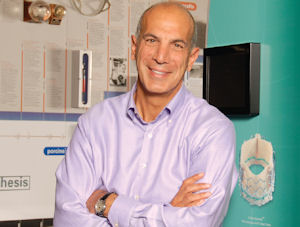
Michael Mussallem is sitting on something most chief executives at mature companies only dream about—a potentially industry-changing product that’s generating big buzz for his Edwards Lifesciences Corp.
The company’s Sapien heart valve is inserted via a catheter and doesn’t require open-heart surgery, like traditional heart valves do.
It and similar devices are seen as the biggest advance in heart valves in years and could open up the market to millions who aren’t candidates for major surgery.
Sapien “has not only big growth potential, but potentially changes the landscape for a very long time,” said Mussallem, chief executive of Irvine-based Edwards.
Sean Lavin, an analyst with Lazard Capital Markets LLC, called Sapien and other catheter valves “one of the most compelling new medical technologies since the launch of robotic surgery.”
Edwards is in a major U.S. trial of Sapien and could see Food and Drug Administration approval late next year.
The device already is sold in Europe, where sales are small but fast growing.
Mussallem said he’s pleasantly surprised with Sapien’s European sales.
“We thought with all the government-funded healthcare in Europe that they would have been slow adopters of new technology,” he said. “But I think it’s surprised many.”
Sapien’s early European growth and U.S. prospects have spurred Edwards.
The company’s shares are up 60% in the past 12 months on a recent market value of $5.8 billion. The shares, which trade at about $100 apiece, are set for a 2-for-1 split at the end of the month.
“We’ve been a believer that if we could invest more in R&D, invest more in innovation and really change the way medicine is practiced in a positive way, that would be rewarded,” Mussallem said.
A Chicago Cubs fan, Mussallem uses a sports analogy to describe Edwards’ strategy.
“You need a certain number of shots on goal,” he said. “Unless you’re really trying a number of things, you’re not likely to hit.”
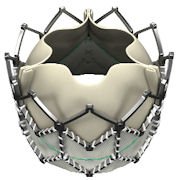
Sapien appears to have hit.
The valve, which started selling in Europe in 2007, saw first-quarter sales there rise 60% from a year earlier to nearly $40 million.
Sapien is a fraction of Edwards’ $1.5 billion in yearly sales but is seen as becoming a bigger part of the company’s business.
Edwards and analysts have projected that catheter valves could see $2 billion in yearly sales by 2014. The company now has about half of the early market in Europe, alongside rival Medtronic Inc. of Minnesota, which has played catch-up to Edwards.
Medtronic’s CoreValve was developed in Irvine and has won over some doctors with its smaller size, which makes insertion easier. But it’s not expected to be approved in the U.S. until 2015 at the earliest.
Edwards’ early lead has allowed it to set the pace in Europe, where it recently launched a smaller version of its valve, Sapien XT.
The smaller design is aimed at making Sapien easier to insert through a patient’s femoral artery in the leg.
“Now, you should have all of the same ease of use characteristics with what we believe is a much better valve,” Mussallem said.
Sapien XT should help Edwards “take share” from CoreValve, said Larry Biegelsen, an analyst with Wells Fargo & Co.’s Wells Fargo Securities, in a research note.
History
Edwards made its big push into less-invasive heart valves at the end of 2003, when it bought New Jersey startup Percutaneous Valve Technologies Inc. for $125 million.
Before Edwards decided to buy Percutaneous, it had been working on a similar valve since 1999, before the company spun off in 2000 from Baxter International Inc., based in the Chicago area.
Sapien “looks like an overnight success, but we’ve been working on this for more than 10 years,” Mussallem said.
The company was divided about buying Percutaneous, according to Mussallem. The prevailing attitude inside Edwards was that its valve “was better than PVT’s—we had great debates at the time.”
“But, to our chagrin, PVT was the first to have a valve implanted in humans” in 2002, Mussallem said.
Percutaneous’ early implant and patents led Edwards to buy the smaller company in order to be first to market, according to Mussallem.
“We felt that being a leader in heart valves is so core to Edwards’ existence that it had to be us,” he said.
Edwards traces its roots to Miles “Lowell” Edwards, an electrical engineer and heart valve pioneer.
The company set up separate development groups for catheter valves after buying Percutaneous and eventually made a group decision to move forward with Sapien, according to Mussallem.
Training
Edwards has set up training programs that entire surgical teams, including cardiologists and surgeons, go through before the valve’s sold to them.
“I probably spend more time talking to customers on why they shouldn’t have the valve than why they should,” Mussallem said.
Edwards is careful about which doctors use Sapien because it wants “great results (and) great clinical success” to ensure adoption of the valve, he said.
Mussallem said he’s on a first-name basis with doctors taking part in the U.S. trial of Sapien.
The company also is looking at Sapien as the basis for developing other less-invasive valves for treating different forms of heart disease, he said.
Progress with Sapien comes after some on Wall Street expressed concerns about Edwards’ focus and slowing growth last decade.
The company made some attempts to broaden its device lineup, including a biotechnology play and a treatment for ballooning blood vessels. It ultimately dropped those in favor of its longstanding focus on heart valves.
“We have continually searched for innovative ideas that change the way that medicine’s practiced, and they all haven’t worked,” Mussallem said.
Sapien has served to revive chatter about Edwards being a takeover target, something the company’s seen off and on since breaking from Baxter.
Edwards’ plan is to stay independent, Mussallem said.
“We’re very happy with our stand-alone strategy,” he said. “We don’t feel the need to be owned by a larger company to be successful.”n
