

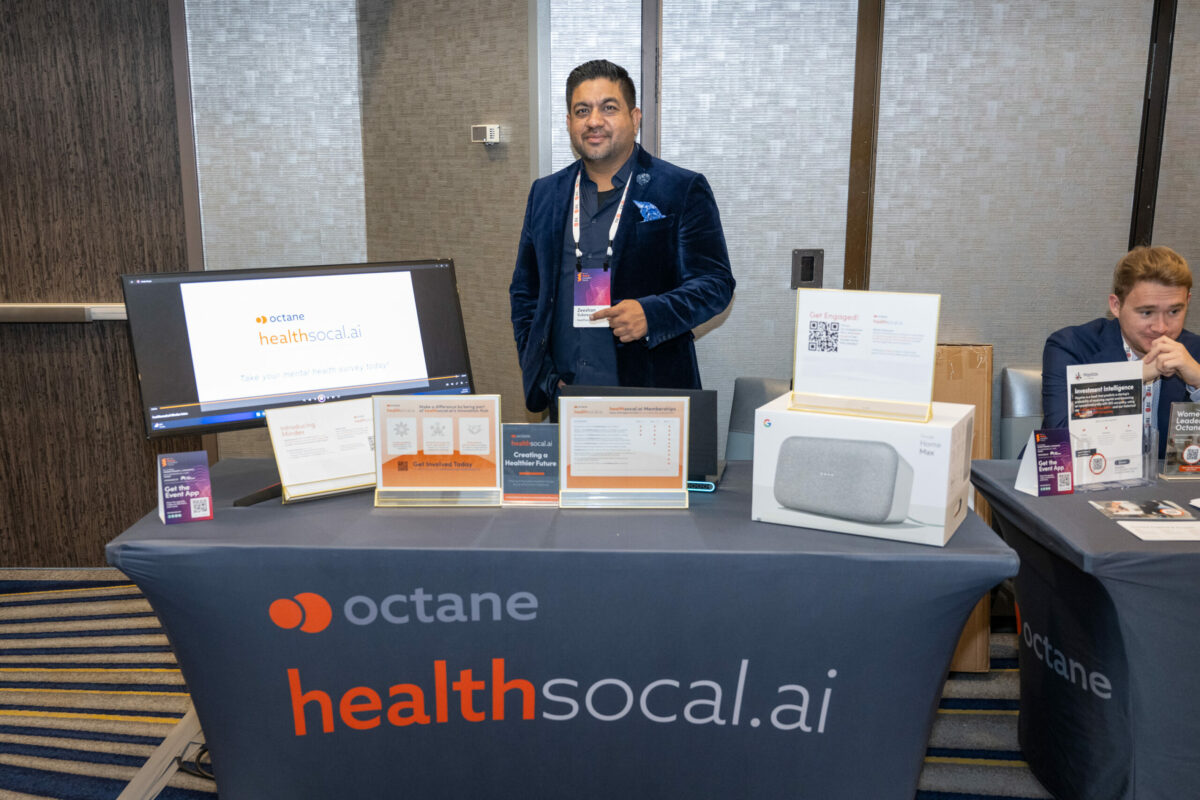
Healthsocal.ai, the nonprofit wing of local business accelerator Octane, is developing Mindex, a credit-like score for mental health.
“Mindex was created to give people an easy tool that provides personalized recommendations to improve a person’s mental health,” Zeeshan Subzwari, managing director of Healthsocal.ai, told the Business Journal.
“Think of it like a FICO score for mental health—that’s what we’re trying to do.”
Concerns about mental health have increased in recent years, particularly because COVID-19 caused closure of schools and a loss of social interaction among all ages.
About 1 in 5 OC residents are affected with symptoms that range from anxiety to substance abuse to schizophrenia, according to Be Well OC, another local nonprofit looking to address the growing problem.
Be Well OC in September broke ground on its 150-bed Irvine Health and Wellness Campus that will be dedicated for mental health illnesses. It already operates a 92-bed campus in Orange.
Samueli Partnership
The same team at the accelerator that backs thousands of entrepreneurs a year is developing Healthsocal.ai as part of Octane’s Foundation for Innovation.
Octane has used its infrastructure such as its Launchpad Accelerator service, its partners and its events to develop Healthsocal.ai.
Octane Chief Executive Bill Carpou announced Mindex’s proof of concept during Octane’s Medical Innovation Forum on Oct. 25.
Healthsocal.ai chose to initially focus on mental health because it became akin to an epidemic during the COVID-19 shutdown, Subzwari said. This initiative was made possible with a $1 million gift and close partnership with the Samueli Foundation.
Subzwari, who was the global head of AI and Analytics and Strategic Alliances at the giant technology firm Cognizant, arrived at Octane about 18 months ago.
A Mindex user takes a self-assessment survey by answering 30 questions on subjects such as whether they feel useful or respected. After the 5-minute survey, the assessment provides a chart showing seven different areas—from confidence level to problem solving to social engagement—which are then ranked on a scale from 1 to 5.
“You can rate yourself—it gives you your own core fundamental health, a sense of where you are,” Subzwari said. “The idea is that your mental health will be compared to your habits and lifestyle.”
A second component of Mindex is to compare the self-assessment to known problems in the person’s geographical area. The five most important factors affecting mental health in Orange County are vehicle ownership, internet access, non-treatable diseases, alcoholism and lack of exercise, the website says.
“Vehicle ownership is the No. 1 factor that affects mental health,” Subzwari said. “I think it’s access to care and nutrition or lifestyle choices. It’s not like New York where you can hop on a bus.”
The OC city ranking the worst for mental health is Laguna Woods, where about 91% of its 17,644 residents are over 60 years old.
Lead Generator
The third part of Mindex will provide links where users can get help if they so desire. Mindex could very well be a lead generator for mental health experts at clinics, hospitals or schools, Subzwari said.
“Our vision is that based on your community level insights and your personal screening, we will have intelligent links to mental health care that are customized to you.”
Mindex is currently in a proof-of-concept stage where it’s being used in initial studies with OC school districts. Its next release, called Minimal Viable Product, is scheduled for next summer.
“Our goal is to incentivize people to take care of their mental health before it’s a problem,” he said. “We want to help with mental health early on in the life cycle.”
