

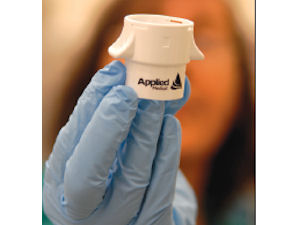
Applied Medical Resources Corp., a Rancho Santa Margarita medical device maker, continues to gain business as some buyers seek less expensive products and others diversify from the big names that dominate the industry.
Privately held Applied’s sales last year rose nearly 25% to $232 million and are expected to grow to about $280 million this year, according to Chief Executive Said Hilal.
Applied Medical is a niche player in an industry dominated by big companies, including rivals Johnson & Johnson and Covidien Ltd.
The company makes a range of devices, including ones used in laparoscopic surgeries as well as catheters, clamps, stents and guide wires.
Applied Medical’s pitch, according to Hilal, is responsiveness and lower costs.
“The economic duress many hospitals are going through these days” has helped drive the company’s growth, he said.
Reduced reimbursements, Wall Street investment losses and more patients who don’t have health insurance or not enough insurance have prompted some hospitals to seek out “reliable savings” on medical devices, he said.
Hard times “actually helped drive our message even deeper,” Hilal said.
The company’s products are used in various surgeries, but the majority of its business is in laparoscopic surgeries, which are minimally invasive procedures through small incisions. The market for those surgeries is $2 billion, according to Hilal.
Applied’s GelPoint device is used by surgeons to remove gall bladders or appendixes through a single, scarless incision, said Gary Johnson, president of the device maker’s general surgery division.
The company comes out with about 10 products a year, according to Johnson.
Applied’s growth has brought hiring.
The company’s local workforce grew by 17% to 1,015 people in the 12 months through April. Overall employment grew 24% to 1,672 workers.
“Our hiring has been a continuation of what we’ve been doing all along,” Hilal said.
The job growth was in all areas, he said.
Made Locally
Applied makes all of its devices in Rancho Santa Margarita.
Hilal said his goal is to drive down prices on quality devices, similar to what’s happened with cell phones, computers and cameras.
Applied is big on research and development, according to Hilal. The device maker invests 15% to 20% of its revenue into research and development, he said.
“And 20 out of the 22 years of our history, we were north of 20%,” Hilal said.
Johnson & Johnson, which is based in New Jersey, spends about 11% of its $62 billion in revenue on research and development. Covidien, which operates out of Massachusetts, spends 4% of its $11 billion in annual revenue on research and development.
Applied’s product development pipeline is “absolutely full,” Hilal said.
The company has tangled in court on antitrust and patent matters with Johnson & Johnson and Covidien.
Covidien won a nearly $5 million verdict against Applied earlier this year over patents covering devices used in laparoscopic surgeries. Applied said it plans to appeal.
Applied also bumps up against its big rivals in selling its devices through hospital buying companies, which buy in bulk for hospitals that sign up for their services.
Smaller device makers such as Applied and Masimo Corp., an Irvine maker of patient monitoring devices, gained some ground selling to hospitals after Congress and the media started scrutinizing hospital buying companies a few years ago.
Critics contended buying companies favor big medical device makers such as Covidien and Johnson & Johnson.
The scrutiny led Premier Inc., a Charlotte, N.C.-based nonprofit that helps its member hospitals buy supplies and equipment, and Novation LLC, a rival buying group out of suburban Dallas, to change their practices and award contracts to smaller players.
Future
In an industry known for consolidation, Applied plans to remain independent, according to Hilal.
“We do not believe our business model is congruent or amenable to combining with large companies,” he said.
The company generates cash and is self-sufficient, according to Hilal. So it’s not in need of a private equity investment, he said.
Applied could consider a public offering to finance future growth but not merely as “an exit strategy,” Hilal said.
