

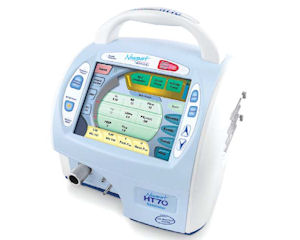
Newport Medical Instruments Inc.’s ventilation devices help patients breathe easier.
Now it has some breathing room of its own after doubling its space with a recent lease of 34,886 square feet in an industrial building near its Costa Mesa headquarters.
The company plans to keep its executive offices, research and manufacturing at its main building on Sunflower Avenue and shift sales and most administrative work to the new space on Scenic Avenue.
Newport’s products help patients “have a better life, instead of laying in bed 24/7,” President Hong-Lin Du said.
The company is considered the largest privately held ventilator maker.
Du said he expects sales of about $50 million this year. The company has some 160 workers here.
Some of Newport’s ventilators, including its e360, are used by hospitals to help people with pneumonia or chronic obstructive pulmonary disease.
Smaller, portable models, such as Newport’s HT-50 and HT-70, are used by patients who receive them through home healthcare companies.
The company’s smaller ventilators help patients maintain normal activities and “go to the park, to Disneyland, to school,” Du said.
Smaller models also are used by hospitals, such as Massachusetts General Hospital and Children’s Hospital of Los Angeles, when transporting patients.
Government Use
Government agencies stockpile Newport’s ventilators for use in emergencies. The company recently signed a $6.7 million, three-year contract to provide advanced portable ventilators to the federal government’s Biomedical Advanced Research and Development Authority.
Newport sells its products through its own sales force as well as distributors and independent sales representatives.
The company also works with large hospital buying groups, including Irving, Texas-based Novation, Premier Inc. of Charlotte, N.C. and Atlanta-based MedAssets, among others.
As a smaller company, Newport has been able to get into the buying groups with relative ease because the cost-effectiveness of its machines is “very good,” Du said.
He said the company’s ventilators used in hospitals sell for about $16,000 on average, compared to the $30,000 range of competitors.
The lower price has helped Newport break through a field of several larger competitors, including Covidien Ltd., a diversified medical business that operates from Massachusetts with a tax-friendly headquarters in Bermuda, and CareFusion Corp., a San Diego company that was spun off from Dublin, Ohio-based Cardinal Health Inc. in 2009 and has an operation in Yorba Linda.
Newport also competes with two German ventilator makers—Drägerwerk AG and Maquet GMBH—and Philips Respironics, a unit of the Netherlands’ Royal Philips Electronics NV.
“We are the new kid in that hospital segment,” Du said. “We are fighting uphill.”
Much of the fight comes in global markets, where Newport gets 80% of its revenue through sales in more than 100 countries.
Most of the international sales stem from smaller, portable ventilators going to hospitals. “Internationally, home care is not as popular, especially in developing countries—there’s no concept of home care,” Du said.
Research and development is big at Newport, according to Du.
On average, the company takes about three years to develop a ventilator, compared to five to eight years for most medical devices.
“We have very seasoned engineers, and our clinical team is very strong,” he said.
Du said he spends about 30% of his daily time working with a research and development team of about 30.
Newport recently has drawn engineers from information technology and video game software, he said.
Local Production
The company assembles its ventilators at its Sunflower Avenue facility with components from subcontractors.
“I always like to have manufacturing and R&D stay together,” Du said.
Quality control is easier when the two are together, according to Du. That’s a chief reason the device maker never has thought of moving production overseas, he said.
Newport has “people knocking (on) our door all the time” about possible deals but isn’t interested in selling because being private allows the company greater leeway to act strategically, Du said.
“We enjoy this way,” he said. “Wall Street doesn’t like to hear ‘every three years’—they like to hear ‘every three months.’ Staying private, we can afford to invest our money for three years later, not for next quarter.”
A doctor by training, Du became Newport’s director of clinical research in 1997. In 2000, he became vice president of medical affairs and was promoted to president in 2001.
