

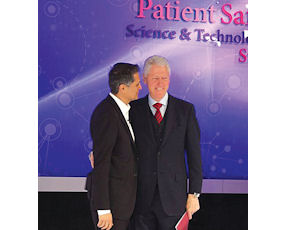
Joe Kiani is doing more than talking about the estimated 200,000 Americans who die each year from infections and other complications that start with hospital stays.
The cofounder and chief executive of Irvine-based medical device maker Masimo Corp. is out to build a movement. He wants his industry to begin sharing data gleaned from the plethora of devices used in hospitals to help avoid the sort of small errors—conflicting medications or wrong dosages, for example—that are often behind the grim statistics on what are generally regarded as preventable patient deaths.
“I don’t think there’s anything that I’ve done in the past 25 years that I’m so passionate about,” Kiani said.
The movement began earlier this year under the banner of the Masimo Foundation for Ethics, Innovation and Competition in Healthcare. The foundation held an inaugural patient-safety summit at the Ritz-Carlton in Laguna Niguel, where it boldly announced its goal: zero preventable patient deaths in hospitals by 2020.
Former President Bill Clinton delivered the keynote address to members of the medical device industry who gathered for the event. Clinton also signed on to come back next year—and invited Kiani to take part in the annual meeting of his Clinton Global Initiative later this year in New York.
Clinton’s star power will help, but Masimo will need more as it flies in the face of long-standing business practices. Medical device makers, like other companies, tend to view the data their products gather as proprietary. There’s obvious monetary and practical value in some data and potential in the rest.
Companies also have concerns about what any data might reveal to a competitor.
“Everyone’s thinking ‘data is king, it’s a gold mine, [and] one day I’m going to figure out how to use my data to boost my earnings, boost my revenue,” said Kiani, who started Masimo in 1989. It’s a mindset that “has been out there since I’ve been in this industry.”
Yet, when it comes to basic data on vital signs and other health indicators that many device makers gather, “I haven’t seen anyone yet take advantage of the data,” he said.
Kiani aims to break through with an appeal that’s part altruistic and part pragmatic.
“The only way for us to prosper individually is to prosper collectively—at some point, the best thing to do for everybody is to share data,” he said. “Some will benefit more from it—but if we don’t do it, no one’s going to benefit from it. It’s the totality of the data that can really help figure things out.”
There’s been some progress.
• Headquarters: Irvine
• Business: Medical device maker
• Founded: 1989
• Ticker symbol: MASI (Nasdaq)
• 2012 revenue: $493.2 million
• Recent earnings: $15 million for Q4
• Market value: About $1.13 billion
• Notable: Company foundation seeks to foster data-sharing standard for industry in a bid to prevent estimated 200,000 deaths
Masimo began approaching other companies about sharing data about nine months ago, prior to the patient safety summit at the Ritz-Carlton.
It started slow.
“Except for one company, they said, ‘Why would I want to do that?’” Kiani said.
But the patient-safety summit saw the start of some momentum. Several more device makers pledged to share data, including Cerner Corp., a maker of software for electronic medical records in Kansas City, and GE Healthcare, a U.K.-based unit of Stamford, Conn.-based General Electric Co.
They joined Dräger Medical Inc., a maker of patient monitors that is a unit of Lübeck, Germany-based Drägerwerk AG & Co. KGaA, in the effort.
Dräger Medical, whose U.S. base is in Telford, Pa., “got it from day one,” Kiani said.
Dräger has “long been committed to open standards in product development, so we feel we are sacrificing nothing” by participating in the effort, said Claudia Dräger, a corporate director who traveled from Germany for the patient-safety summit.
“Any company whose products can contribute to this goal should put all efforts into it in order to avoid such a dreadful event for the victims and the people who love them,” she said via email.
Almost all of Dräger Medical’s devices already provide data directly to hospitals and health systems, and it offers the service free of charge.
Business Potential
There is business potential to be found in the sharing of data, which will beg for ever-better programs and a system to distill and put the information to use.
Kiani doesn’t shy from the possibilities for Masimo, which ranks No. 15 on this week’s Business Journal list of the largest public companies based in Orange County, with a market value of $1.13 billion (list starts on page 10; related stories throughout issue).
“Masimo may become the lucky company that figures out how to use the data to [get] the best algorithm … After all, that’s what we’re good at,” Kiani said.
“The problem is these machines are not communicating in a real-time fashion [to] a central device that takes all that data with some predictive algorithm and says, ‘Oh, all these things are occurring, let me connect the dots, this is where the patient’s going,” Kiani said.
Meanwhile, he said, making the data available would hold the potential to immediately reduce preventable deaths because many patient safety problems “have solutions today—it’s not like they need to go find a cure for any of them.”
