

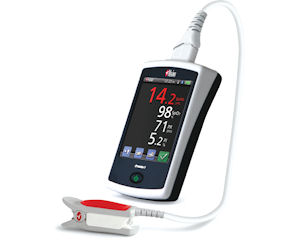
Masimo Corp.’s new distribution deal with Henry Schein Inc. holds growth prospects for the Irvine-based company’s Rainbow technology brand.
Masimo announced earlier this month that Schein Medical, a division of Melville, N.Y.-based Henry Schein, would distribute Masimo’s new Pronto-7 handheld monitor.
The device is used for non-invasive hemoglobin-level spot checks among other things and sometimes incorporates Masimo’s Rainbow monitoring technology.
Schein Medical will sell the device to its domestic customer base of doctor’s offices, community health facilities, medical clinics and ambulatory surgical centers.
Jon Coleman, Masimo’s president of worldwide sales, marketing and clinical research, said in a release that his company can use Schein Medical’s 400-plus field salespeople and 200 telesales people “to drive awareness of noninvasive hemoglobin technology.”
That will happen with Schein, according to analyst Matt Dolan of Newport Beach investment bank Roth Capital Partners LLC.
“Around half of all hemoglobin tests are run outside of the office setting, and hemoglobin is a primary reason for blood tests in the office setting, opening up a large opportunity for [Masimo’s] rainbow business going forward,” Dolan said in a client note.
Masimo’s deal with Schein came within an expected time range “as the company had previously stated it hoped to be shipping Pronto-7 via a distributor by mid-2012,” the analyst wrote.
Masimo is selling Pronto-7 through its direct, acute-care sales force, and a 20-person physician practice team is targeting U.S. doctors’ offices, Dolan said.
Dolan said the company’s deal with Schein appears to be non-exclusive, which could lead to more distribution partners for Masimo. Likely candidates include San Francisco-based McKesson Corp. and Dublin, Ohio-based Cardinal Health Inc.
Masimo hasn’t ruled out the possibility of more Pronto-7 distributors.

Edwards’ Path
Irvine-based Edwards Lifesciences Corp.’s Edwards Sapien replacement heart valve looks like it’s on a path to wider usage.
A Food and Drug Administration panel earlier this month recommended approval of Edwards Sapien, which is inserted via catheter, for high-risk patients who have symptomatic aortic stenosis.
The FDA panel voted 11-0 with one abstention.
The FDA generally follows the recommendation of its advisory panels when deciding whether to approve medical devices.
Edwards is “very encouraged” by the panel’s action, Chief Executive Michael Mussallem said in a statement.
Mussallem added that a broader indication for high-risk patients would enable heart teams to choose the approach best suited to their patients’ needs.
Edwards’ stock closed up 7% to a market value of $11.1 billion on June 14, a day after Edwards released the news of the FDA panel’s decision.
Edwards Sapien has been sold in Europe since 2007 and in the U.S. since last November.
It’s currently approved for people who have a lower risk of dying from open-heart surgery.
CardiAQ Valve
Irvine-based startup CardiAQ Valve Technologies Inc. said that a bioprosthetic mitral heart valve was successfully transplanted into an 86-year-old man who was suffering from severe mitral regurgitation.
The transplant was performed at the Rigshospitalet University Hospital, The Heart Centre, in Copenhagen, Denmark.
CardiAQ noted in its release that the valve is in its early development phase and won’t be available in the United States for clinical trials “until further notice.”
ICU Infection Rates
San Clemente device maker ICU Medical Inc. said a clinical case study from Women & Infants Hospital in Providence, R.I., showed a custom intravenous system featuring its MicroClave needle-free, neutral displacement connector helped reduce neonatal intensive-care unit infection rates and medication errors.
Researchers examined what happened when a task force at Women & Infants came together after a spike in infection rates and an increase in reported medication errors in the hospital’s NICU.
Women & Infants’ task force decided to replace a needle-free connector with MicroClave, citing the connector’s design. The federal Centers for Disease Control and Prevention have noted designs such as MicroClave are preferred for needleless connectors.
The number of reported medication errors and infection rates decreased 60%—from five infections per 1,000 line days in 2008 prior to implementation, to two infections per 1,000 line days in 2011.
Results from the study were published in Neonatal Intensive Care magazine.
