

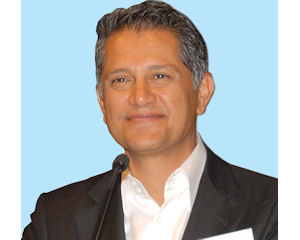
A high-profile executive in Orange County’s medical device industry has stepped away from conventional wisdom on a tax that’s part of federal healthcare reform recently upheld by the U.S. Supreme Court.
Joe Kiani, chief executive and cofounder of Irvine-based patient-monitor maker Masimo Corp., recently suggested that the industry become more practical in its fight against the 2.3% tax on device makers’ revenue.
The tax is scheduled to go into effect in January, and is billed as a way to raise $29 billion over 10 years to help pay for healthcare reform.
Kiani has suggested limiting the tax to companies with more than $100 million in annual revenue. He said most medical device companies don’t turn profits until they reach the $100 million mark.
“Ultimately, a repeal would be best, but until then, we can’t afford to lose companies because of this,” Kiani told MassDevice, an industry newsletter. “I still support the position that, until the tax is repealed, it should be staged fairly so that small companies won’t have their entire profit wiped out.”
Earlier Concerns
Kiani has often expressed concerns about the device tax and its potential effects on smaller enterprises. In an earlier Business Journal interview, he said the tax—which was being proposed at a 4% rate at the time—stood to cut medical device makers’ profits by 10% to 100%, depending on the company.
Kiani was chairman of the Medical Device Manufacturers Association, a Washington, D.C., trade group when he first weighed in on the tax. He more recently has emphasized that his suggestion to limit the tax to bigger companies would not offer any break for Masimo, which has about $440 million in annual revenue.
Other Orange County-based device companies with more than $100 million in revenue are Irvine-based heart valve maker Edwards Lifesciences Corp. (about $1.7 billion); and ICU Medical Inc. in San Clemente, which makes needle-less intravenous connectors ($302 million).
Several companies with large Orange County units also are beyond the $100 million mark in annual revenue. They include Abbott Park, Ill.-based Abbott Laboratories, which owns eye device maker Abbott Medical Optics Inc. in Santa Ana.
Minneapolis-based Medtronic Inc., which employs about 700 people in Santa Ana, Irvine and Lake Forest, has said it expects to pay $125 million to $175 million in device revenue taxes starting in 2013.
Irvine-based Allergan Inc. has more than $5 billion in annual revenue but derives only a small portion from medical devices. Lap-Band, a weight-loss device, and Natrelle breast implants fall under the category for Allergan.
“Whispers”
Kiani addressed what MassDevice termed as “whispers in the wind that it might be beneficial for big companies to have the tax around.”
His suggestion of exempting smaller companies came in response to a question about whether larger device companies might want the tax around to “help stifle competition from innovative startups.”
Large companies “understand their growth relies on smaller, innovative companies coming together, creating new innovations—and then they sell to those [larger] companies,” Kiani said.
Kiani seems to be alone in his willingness to openly discuss the tax with media outlets. Spokespersons for Edwards and Abbott Medical referred questions about the tax to various industry advocacy groups.
Continued Push
The California Healthcare Institute, a San Diego-based industry group, said it would continue to work to support a repeal of the device tax in spite of the recent U.S. Supreme Court decision that largely upheld the Obama Administration’s healthcare reform law, including the medical device tax. Institute President David Gollaher said in a statement that the device tax “would threaten payroll reductions and slash R&D investments.”
The institute’s directors include Michael Mussallem, Edwards’ chief executive, and David Pyott, Allergan’s chief executive.
Lobbying group AdvaMed said in a statement that it is “heartened by the number of senators who have said they oppose the tax. We will continue to work with policymakers on both sides of the aisle to achieve this goal.”
The Republican-controlled U.S. House of Representatives voted in early June to repeal the device tax. The vote came largely along party lines a few weeks before the Supreme Court upheld healthcare reform.
The effort to repeal the legislation seems to have little chance in the Senate, and President Obama has threatened to veto any attempt to repeal the device tax.
Mixed View
Some on Wall Street believe the consequences of the device tax at its current rate of 2.3% will be mixed.
Leerink Swann LLC, a Boston-based investment bank, said in a note that it believed the tax would be especially rough for smaller device makers with thin margins and greater exposure to the domestic market.
The bank also said that the expansion of health insurance coverage to include more than 30 million previously uninsured Americans means that the number of surgical procedures would grow, bringing gains for some device makers and hospital supply businesses.
Leerink has forecast a 32% drop on 2013 profits for smaller device makers, but only 4% for larger companies.
