

Dr. Jennifer Tseng watched a robot help doctors perform a mastectomy at a hospital in Milan in 2018.
Now, the surgeon is leading the first clinical trial in the U.S. for robotic mastectomies, with the goal of bringing the technology to Orange County.
“I could see it’s the future,” Tseng told the Business Journal. “It’s really exciting to bring this to the U.S. with FDA approval.”
Last month, the surgeon conducted her first robotic surgery at City of Hope’s main campus in Duarte as part of the clinical trial.
“The patient is doing incredibly well.”
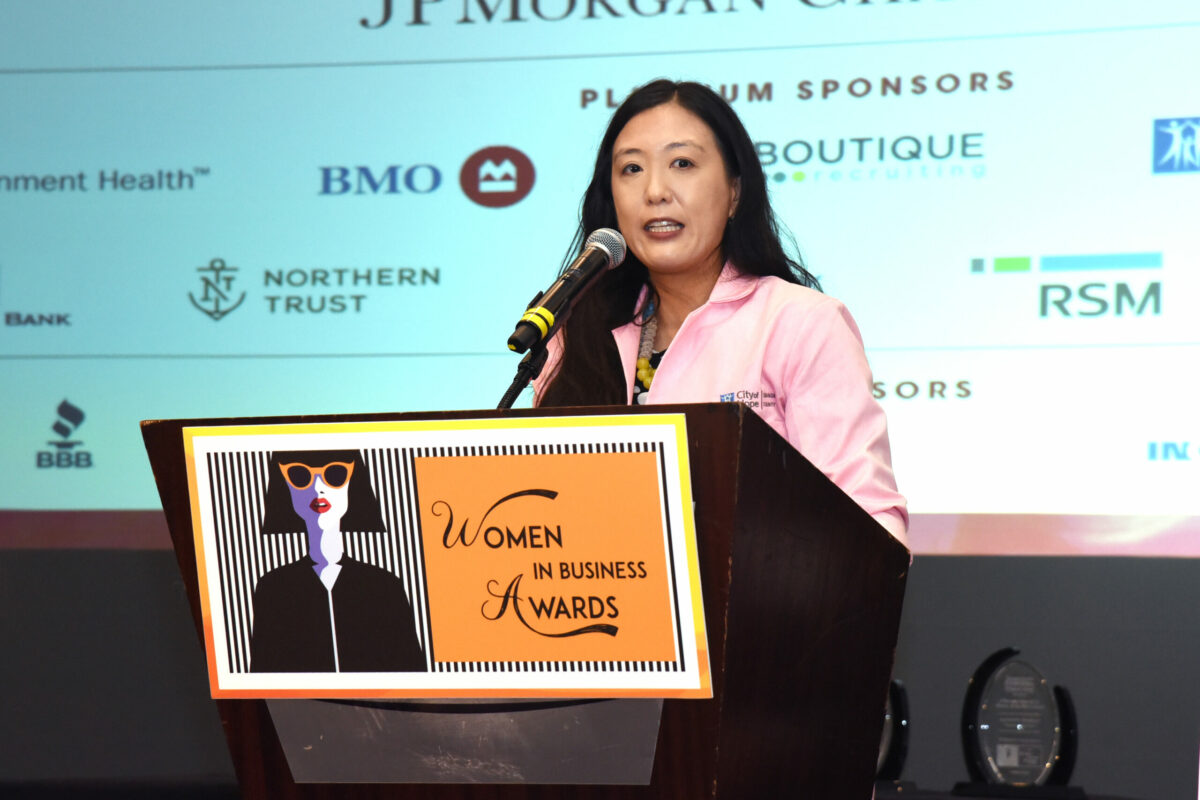
This groundbreaking trial is one reason Tseng, medical director of breast surgery at City of Hope Orange County, won a Women in Business Award at the Business Journal’s 29th annual event on Oct. 5 at the Irvine Marriott.
“This remarkable woman has conducted numerous pioneering research studies and has authored more than 100 peer-reviewed research publications,” Denise Scott, a client and community relations director at PNC Bank, said when announcing the award in front of 750 people.
“She further strengthens Orange County’s reputation for medical innovations.”
Advances
Breast cancer is one of the most common malignant tumors occurring in women and considered to be the leading cause of mortality compared to other cancers in gynecology and obstetrics.
The global five-year incidence of breast cancer is more than 43 million cases, according to the National Institutes of Health.
Mastectomies have changed dramatically in recent decades as it’s often no longer necessary to remove the entire breast, Tseng said.
Nowadays, techniques exist for nipple sparing surgeries, and only the cancerous portions are removed, she said.
About 99% of patients with Stage 1 or 2 breast cancer can stay cancer free, a dramatic change from 30 years ago, she said.
“There’ve been quite a few advances to get there,” Tseng said.
In the past two decades, cancer research has changed to become more personalized.
“We think about surgeries differently,” she said. “There are different technologies to treat it, options that we didn’t have in the past. Often, breast cancer can be beatable.
“When I see a patient, he or she is devastated. I tell them that there is so much hope to come.”
Robotic Surgery
Historically, cuts were made at the bottom of the breast to take out cancerous tissues. The new, robotic surgery allows a single-incision, minimally invasive mastectomy at the side of the breast, reducing the scar from 4 inches long to 1 inch long.
“When a woman holds her arm down, you cannot see the scar,” Tseng said. “We can gently remove the breast in a much less traumatic fashion.”
For the robotic-assisted procedure, surgeons are using a single-port da Vinci SP robotic-assisted surgical system, manufactured by Intuitive Surgical, the study sponsor.
City of Hope has conducted about 16,000 robotic procedures that weren’t for mastectomies.
It’s been more difficult to use robots for mastectomies because FDA approval is first needed. The clinical trial that City of Hope has opened will help compare outcomes between open versus robotic mastectomies to hopefully allow this advanced technique for patients that is routinely offered in Europe and Asia.
The U.S. is five years behind Europe for robotic mastectomies because “new devices are looked at more suspiciously,” she said.
In countries like Italy, “there are less barriers to implementation.”
The FDA has approved a clinical trial involving 200 patients across 15 cancer centers.
The robotic surgery doesn’t mean the machine is in charge of the operation, Tseng said.
“The surgeon controls the robot at all times,” Tseng said. “We control every single movement of the robot. Robotic surgery isn’t like a self-driving vehicle.”
She anticipates the clinical trial will last two to three years, as long as safety markers are met. Women who want to try this surgery are welcomed to contact City of Hope, she said.
Family Doctors
Tseng’s parents immigrated from Taiwan, where both her father and maternal grandfather were pharmacists. She has six cousins who are also doctors.
While growing up in Fountain Valley, she became passionate about history, particularly the American Civil War. Then while in college, she had an opportunity to volunteer at Children’s Hospital of Orange County, where she was inspired to become a doctor.
“I fell in love with it,” she recalled. “I was pre-law at Berkely and changed gears to pre-med.”
She earned a degree in cell biology as well as history at the University of California, Berkeley, and earned a Doctor of Medicine at the University of California, Davis.
Her degree in history wasn’t a waste because it has helped her to know the backgrounds on her patients.
“I joke that I’m a daily historian. I’m not a historian at the Smithsonian like I thought I’d be.”
Her résumé includes a residency at the Oregon Health and Science University and fellowships at the National Cancer Institute and University of Chicago.
Tseng “is widely regarded as one of the nation’s foremost experts in breast cancer surgery,” the City of Hope said in a statement.
The City of Hope Orange County, which is spending $1.5 billion on a new clinic, hospital and other facilities in Irvine, has been recruiting specialists from across the country.
In 2022, Tseng left the University of Chicago where she was an assistant professor in the Department of Surgery.
“With COVID—I realized that I was too far from home. This was an opportunity that I couldn’t pass up. Our center is quite amazing.”
Why pursue cancer?
“There’s so much hope with cancer care these days,” she said. “We have so much promise for cures and better quality of life.
“It’s the most exciting time to be in this field.”
