

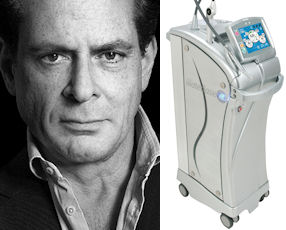
Irvine-based Biolase Inc. is the latest Orange County healthcare company to fight back against short sellers.
“I don’t want to be the hero—I simply want to be the reasonable guy to invite other companies to follow our example,” Federico Pignatelli, chief executive of the medical device maker, told the Business Journal last week.
“Unfortunately, many small companies, they have been attacked by shorts and naked short sellers in maneuvering their stock,” Pignatelli said.
Biolase, which makes lasers used in dentistry and other applications, is firing back in the wake of a share collapse it contends short selling caused after the company disclosed in a regulatory filing that it wasn’t in compliance with a provision in its bank loan.
Its shares fell 34% on Aug. 14, a day after it said lender Comerica Bank agreed to waive the company’s noncompliance with a condition in the loan agreement. That condition said Biolase could not have earnings before interest, taxes, depreciation and amortization of less than $500,000.
Biolase’s Securities and Exchange Commission filings don’t break down that figure. They do show, however, that the company has posted five consecutive quarters of losses before provision for income taxes since the loan deal was signed in May 2012.
Biolase and Comerica now have to agree by Sept. 13 on a further amendment to the loan deal containing revised financial covenants. Pignatelli said he couldn’t comment on that subject.
Biolase’s revelations prompted a pair of critical articles published on the Seeking Alpha investor website by Richard Pearson, a former investment banker and writer of the Mox Reports blog who divides his time between Los Angeles and China.
“What has happened is that details given in the [quarterly report] and the earnings call have revealed that Biolase is now in the middle of a near-term solvency crisis,” Pearson wrote in an article published on Aug. 14.
Pearson’s 1st Article
Pearson’s first article contended that Biolase owed at least $6 million to Comerica and didn’t have the money to repay the bank, giving Comerica “no choice but to waive the default for Biolase for several weeks.” He noted that the bank reduced the line of credit from $10 million to $7.5 million.
Pearson said in an article posted Aug. 16 that Biolase “took the unusual step of halting its own stock while it arranged to put out a series of positive press releases to boost the price back up.”
He listed several “facts which indicate a liquidity crisis,” including continuing losses and a cash burn rate that he claimed was $3 million per quarter.
“Each of these facts clearly supports the notion that there is a severe liquidity crunch and solvency crisis,” Pearson said.
Biolase didn’t take kindly to the articles.
“Last week, two articles written by Richard Pearson, who appears to be a blogger and occasional contributor to SeekingAlpha.com, made several inaccurate and therefore misleading statements on [the] website about Biolase and its current financial position, including assertions that Biolase has historically burned cash at a $3 million per quarter [equal to $12 million annually] and is on the brink of insolvency,” Pignatelli said in a news release issued Aug. 19. “I believe these comments were intentionally directed to create uncalled-for anxiety amongst our shareholders with the intent to drive our stock price down.”
Pignatelli said in the news release that he believes there was a large amount of “naked shorting” that’s currently taking place in Biolase’s stock. Naked shorting is when investors sell stocks without first borrowing the shares or ensuring that they can be borrowed, the latter step of which is part of conventional short selling. Both conventional and naked short sellers do what they do in the hope of making a profit if the share price later declines.
The SEC banned what it called “abusive naked short selling” in 2008.
“Short selling is a legitimate activity when you actually borrow stock,” Pignatelli told the Business Journal. “Who buys the shares from a naked short does not know that he has been sold shares that don’t exist.”
Biolase, in the same statement that contained Pignatelli’s comments on the articles, said it was going to use $3.5 million to $4.5 million in net cash for operations this year, compared to $1.7 million in 2012.
Pignatelli declined to answer a question on whether he planned to take legal action against Seeking Alpha.
Pearson on Management
Pearson on Aug. 21 called out Biolase management about the short-selling allegations:
“It is clear that short sellers are not the ones causing these declines. It is even more clear that ‘illegal naked short selling’ has precisely nothing to do with the declines,” Pearson said. “The current selling is the result of continued disappointment by long shareholders and it will continue until Biolase begins to take steps to fix the company’s very obvious problems.”
Biolase “has refused to even acknowledge the severity of its liquidity positions,” Pearson continued. “Management has also refused to acknowledge its own role in directly creating this crisis. Instead, Biolase has wasted time and effort in blaming the false scapegoat of ‘illegal naked short sellers’ when there is not even any naked short selling happening whatsoever.”
Biolase’s shares are down 8% since the start of the year, with a market value of $60.1 million as of late last week.
The company has filed with the SEC to sell $5 million worth of common stock, preferred stock and warrants. It said in its registration statement that it planned to use net proceeds to “primarily fund general and administrative expenses.”
