

VQ OrthoCare Inc., an Irvine maker of joint braces and other orthopedic support devices, is looking to grow as an alternative to surgeries and drugs for an aging population.
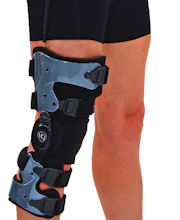
The company’s products are worn to support knees, arms and ankles. It also makes devices that send a small electrical signal to the body to stimulate bone growth. Another device uses electrotherapy to block pain signals from getting to the brain.
Unlike a lot of local medical device companies, VQ’s products aren’t made to be used during surgery or be implanted in the body.
“We don’t do anything that’s invasive,” said James Knape, the company’s founder and chief executive.
The products target conditions such as osteoarthritis, or de-generative arthritis, and others in what Knape called “the disease of aging.”
“The enormity of the market is staggering,” he said. “Just for knee osteoarthritis for the U.S. alone, $185 billion was spent to treat it last year.”
Knape said he hopes to see VQ grow as some patients pass on surgery and drugs.
Privately held VQ could end 2010 with $60 million to $80 million in revenue, according to Knape, who said the company is profitable.
“I expect us to be several hundred million dollars (in revenue) shortly,” he said.
Being acquired is a possibility, according to Knape.
“When the deal’s right, we’ll consider it,” he said. “But I started my own business because I didn’t like having a boss.”
Knape previously was a healthcare consultant with PricewaterhouseCoopers. He started VQ in 1989 with his wife, Dorian.
The company used to go by VisionQuest Industries and started distributing products before deciding to develop its own.
VQ has no outside funding, with the exception of bank financing, Knape said.
There’s been “lots of sniffing” around by potential investors, he said.
The company, which has 215 workers companywide, uses a direct sales force and distributors to sell its devices.
About 85% of sales are made to doctors, such as orthopedic surgeons and pain management physicians, ac-cording to Knape.
Doctors write a prescription for a VQ product. Patients are fitted for the device in their homes. VQ bills the patient’s health insurer.
VQ’s devices mainly are covered by workers’ compensation insurance and commercial health plans. Medicare, the federal insurance program that covers older Americans, makes up about 10% of revenue.
Most people come across VQ via its website, Knape said.
“We are inundated with consumer inquiries on how to get our products,” he said.
Competitors include San Diego-based DJ Orthopedics Inc. and Orthofix Inter-national NV, which has a tax-friendly headquarters in the Netherlands Antilles and op-erates from Boston.
The company has grown through deals, including a 2009 acquisition of Arthrowave LLC, a Maryland medical device maker that developed an arthritis treatment that combined knee braces with electrical stimulation.
Global Growth
VQ’s “been relatively weak” in global sales but is looking abroad for growth, according to Knape.
The company sells its products in Mexico, Japan, Germany and Singapore, among others.
