

The proliferation of online ordering and third-party delivery in Orange County has given way to the rise of so-called ‘ghost kitchens’ to support that demand.
Despite the name, it’s not the restaurant industry’s take on a Halloween costume store.
The term refers to commercial kitchens dedicated entirely to fulfilling digital orders. There’s no dine-in service and, in many cases, there’s no walk-ups.
While first gaining traction in denser metropolitan areas like Los Angeles, San Francisco and New York, Orange County restaurant operators and area real estate landlords that cater to them are increasingly taking notice.
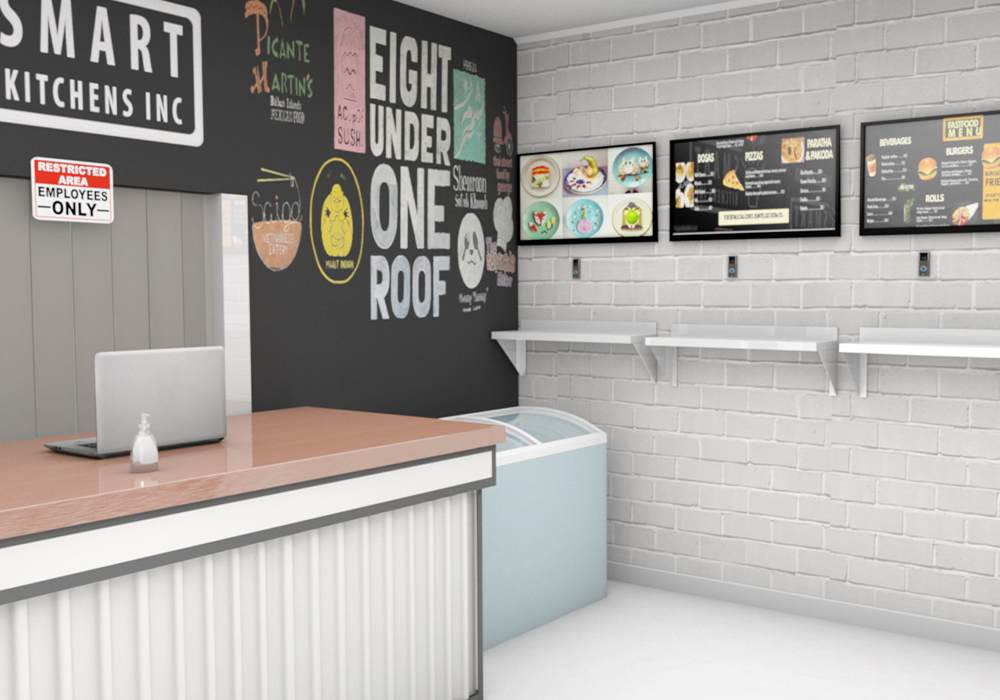
Irvine-based Smart Kitchens Inc., started by serial entrepreneur Nick Crane, bowed its first ghost kitchen in Irvine on March 23. The 10,000-square foot space, set in an unassuming business park not far from John Wayne Airport, houses eight different kitchens paying $2,500 a month on rent.
Some businesses, Crane reported, are generating over $40,000 a month utilizing the Smart Kitchens app alongside traditional third-party services such as DoorDash and Uber Eats.
Crane has two more ghost kitchens in the pipeline set for spring openings, with one near the Irvine Spectrum Center and another in Dana Point.
He’s hoping to have five built by the end of 2021, all in OC before expanding out to other Southern California markets.
It is one of several new concepts the entrepreneur is looking to bring to the local food scene. Crane also is looking into automation and the use of robotics.
“We do think the [industry] direction is going more into food delivery,” Crane said. “You’re always going to want to go out and have fine dining and the casual experience for the atmosphere, but we’ve seen meal prep explode with people picking up their weekly meals. Food delivery has become [common] in a lot of families where they’re ordering delivery two, three times a week as a substitute for cooking.”
Supply and Demand
For Irvine-based Pokéworks, a fast casual poke concept now with a total of 54 locations and more than 130 on the way, high rents in large urban centers where there’s big demand for delivery seemed a good place to begin its foray into the ghost kitchen world.
The company inked a deal with Chicago-based Epic Kitchens and in July is opening its first ghost kitchen in the Windy City.
“From a real estate perspective, rents are pretty high in city centers, so ghost kitchens made a lot of sense and the demand for off-premise or mobile orders is much higher in those areas, especially with cold winters,” said Pokéworks co-founder and Chief Development Officer Peter Yang.
Ghost kitchens allow for the company to also get away with having to use far less space, perhaps 250 square feet or even less, according to Yang. A normal Pokéworks can run upwards of 1,500 square feet.
It’s a modest size the company’s familiar with; its first spot, in Manhattan, was a 600-square-foot, narrow space with enough room for six stools for dining in.
“Rather than looking at the storefront, we look at where population densities are and where third-party platforms excel,” Yang said. “So, a lot of times that would be city centers, especially for millennials who are heavy users of the [Pokéworks] app.”
What Next?
The pandemic has increased the visibility of the ghost kitchen, and there’s plenty of money still being pumped into the industry by those expecting the model to only continue to grow in future years.
Uber founder and former CEO Travis Kalanick’s CloudKitchens’ parent City Storage Systems LLC has reportedly shelled out more than $130 million on real estate for ghost kitchens in more than two dozen cities, with the average deal size by investors for a ghost kitchen $15 million, according to PitchBook.
Southern California’s key to CloudKitchens, which lists Anaheim as an area of focus on its website. No real estate buys in OC have been disclosed to date.
With the reality that dining will eventually come back, it has many scrambling to figure out what model works best, with the online segment expected to grow 20% this year to $26.5 billion in the U.S., and to eventually reach $32.3 billion by 2024, according to researcher Statista.
In many cases, there’s no one-size-fits-all approach when it comes to future restaurant development, but more innovative kitchen concepts are here to stay, industry watchers say.
Population density is really the rub, said JLL Vice President Blake Kaplan, who pointed out cities such as Anaheim, Tustin and Brea might be better suited for the concept than others.
“The ghost kitchen model is really evolving,” said Kaplan, who works out of the brokerage’s L.A. office.
“OC is going to be a lot different than in Los Angeles, but in other ways they’re somewhat similar where the customer doesn’t want to leave the house and they just want something quick. It’s like another version of a food hall but the advantage is they don’t have to build out that nice kiosk area.”
Food Hall Evolution
OC’s also been on the vanguard of new types of food halls, with the latest entrant to the scene being Stanton’s Rodeo 39 public market, which opened last month.
Newport Beach-based Frontier Real Estate Investments considered the ghost kitchen concept for Rodeo 39, but what bore out was a public market-inspired concept integrated within a comprehensive online ordering system that it hopes will allow it to capitalize on online growth coupled with dining’s bounce back.
“We had looked at adding components of the ghost kitchen,” said Frontier Vice President and Partner Tom Carpenter. “When COVID hit and restaurants were doing takeout only, we started [looking at the possibility] to convert Rodeo 39 to a takeout and delivery-only model.”
“We spent a lot of time studying that, and it morphed into knowing that eventually things will go back to normal here, but there’s still large takeaways we can apply to Rodeo 39 to cater to both models—take the public market model, but then apply key components of the ghost kitchen model to help double the success of tenants.”
Part of the answer currently is in the Rodeo2Go program, which streamlines delivery across all Rodeo restaurants and creates easy ordering through a single online site.
The project has empty space that could always be reconfigured to a dedicated ghost kitchen if there’s need, Carpenter added.
Hybrid Approach
Among the first batch of tenants at Rodeo 39 is Oi Asian Fusion, a rice bowl spot that has locations across SoCal.
The co-owner and co-founder of the burgeoning restaurant chain, as well as the Nashville fried chicken-inspired Main Chick concept, is Eric Dela Cruz, a former Bank of America analyst. Dela Cruz has experience in the ghost kitchen business; he counts such a location at the Colony project in West L.A. where his two brands share a kitchen.
For Dela Cruz, the ghost kitchen at Colony was something they decided to try after declining an offer for a location with CloudKitchens.
“We turned it down because we didn’t believe in the concept, and then finally we decided to try Colony and it just worked out so well for us, being able to share one kitchen with multiple brands of mine,” Dela Cruz said. “It saves us money from having to get another kitchen and brick-and-mortar location and we pay one rent.”
It begs the question of how important allocating square footage to table and chairs is in the future, something he and his team think about.
“That is a really tough one to answer,” he said, pointing out Oi Asian Fusion in Canoga Park has not reopened its dine-in space since the start of the pandemic and the business there is actually doing better than it was pre-COVID.
“Human beings are creatures of habit and [customers there] got used to the convenience of having it delivered. They don’t mind the $7, $8, $9 they have to spend” for delivery.
That’s of course specific to Canoga Park, versus the newly opened Stanton Oi that’s doing more in-person business, proving the only certainty in the industry is that uniformity in business models will diminish over time.
“Just like with retail, where retailers are learning it can’t all shift online, there’s still got to be a brick-and-mortar presence,” said Frontier’s Carpenter. “It’s about how do you find a symbiotic relationship between the two. I think restaurants are finding that balance.”
