
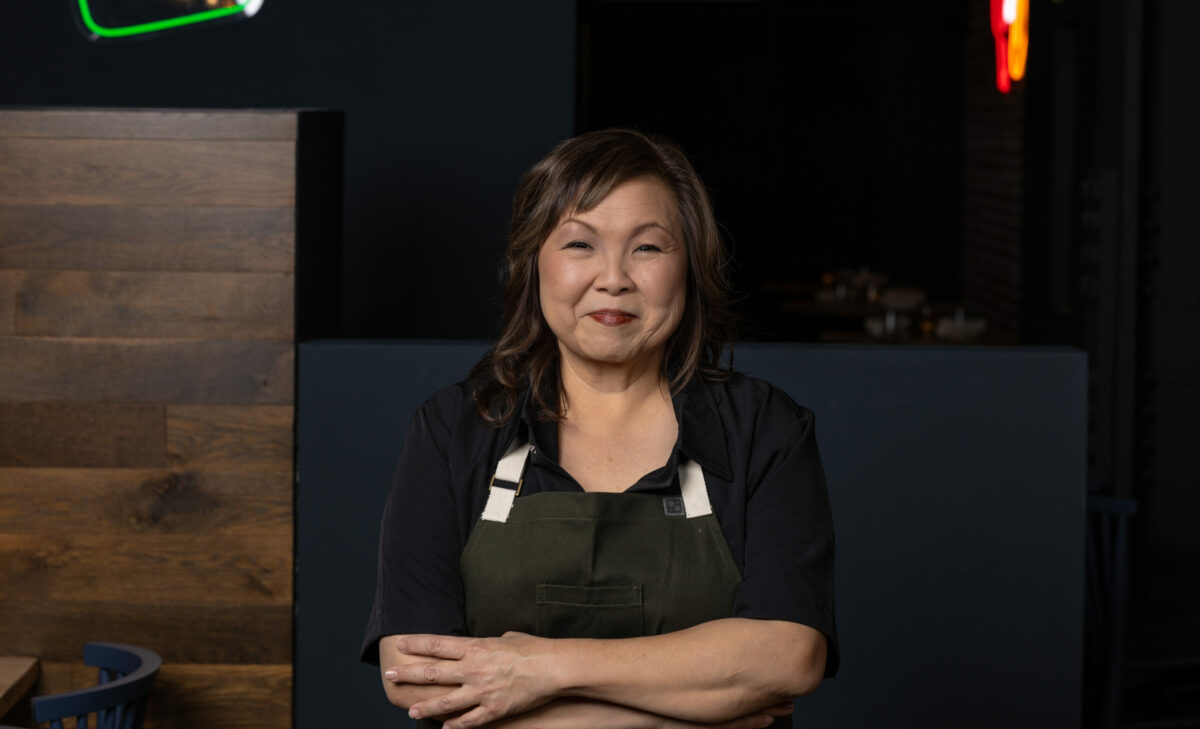
When chef Debbie Lee was approached to create a new culinary concept for the upcoming Market Hall eatery at OCVibe, she said it was unlike any restaurant project she’d been a part of before.
The vision presented to her through a virtual tour stood out as well-defined plan for a food hall that took years of R&D. She told the Business Journal the plan “was extremely attractive to me because it was something that I have never been privy to.”
In November, OCVibe revealed that Lee, a finalist from season five of the “Next Food Network Star” TV show, was the first culinary partner in the Market Hall lineup.
The Market Hall will span the first two floors of The Weave office building, which will open in the first phase of the $4 billion multi-use development in late 2026. The food hall will have 21 stalls of different foods and drinks that will be provided by both experienced and first-time chefs.
Chef Lee will open two food stalls: Pado, a Korean-inspired raw and seafood bar, and Mokja, a Korean bodega and snack café.
Her goal with the new concepts is to expand people’s knowledge of Korean cuisine beyond bulgogi or all-you-can-eat barbeque.
“When I come up with these ideas,” Lee said, “it’s about trying to share a part of the history and the culture of our food that I think people sometimes overlook.”
With Pado, the Korean-American chef chose to focus on seafood and was inspired by the fishing community of Jeju Island, which she referred to as the Hawaii of Korea. She wanted Pado to be “a love letter” to the Korean coast and Southern California.
The menu will include crudo, sashimi and other small coastal plates.
One of the signature hot dishes will be a deconstructed cod stew, which Lee said has been a crowd favorite for years: “It’s a pan- seared crispy black cod with an Asian yam, Daikon (radish) puree and a pimento glaze.”
At Mokja, which translates to “let’s eat,” Lee wants to bring the food of the highly visited Korean convenience stores to Orange County.
Mokja will not only be an introduction to Korean snacks and street food, but it will also be an economically accessible concept, Lee said—“something a little bit more inviting.”
Lee said she’ll be bringing her specialty dish—Korean fried chicken served with a mochi waffle—to the outpost. Mokja will also serve breakfast sandwiches and specialty coffee drinks.
‘Partnership, Not Tenancy,’ Says OCVibe
Lee said that 2025 marks 30 years since she first stepped into a professional kitchen and that she could not have imagined the trajectory of Korean cuisine in the U.S.
“Because when I entered that kitchen, I was just there to learn incredible modern French techniques and that area of culinary expertise,” she said. “To see Korean food, Asian food, evolve to this day, not just on a local level but on a national and global level, it’s so exciting to see.”
Lee noted that working with the OCVibe team on opening Pado and Mokja has been notably different from her past restaurant projects. She recently opened Yi Cha, a fast-casual take on a Korean pub, in Highland Park in October.
For most chef-owner operators, securing a lease, meeting financial requirements and covering capital and construction costs is “half the battle.”
She called the Mess Hall project 100% transparent and “a huge breath of fresh air” because those hurdles are lifted under OCVibe’s partnership-driven framework.
“Our vision for the Market Hall is one of partnership, not tenancy,” OCVibe Chief Operating Officer Morell Marean said in a statement. “By eliminating financial barriers and providing the critical infrastructure, we’re empowering chefs like Debbie Lee to take creative leaps that might not be possible elsewhere.”