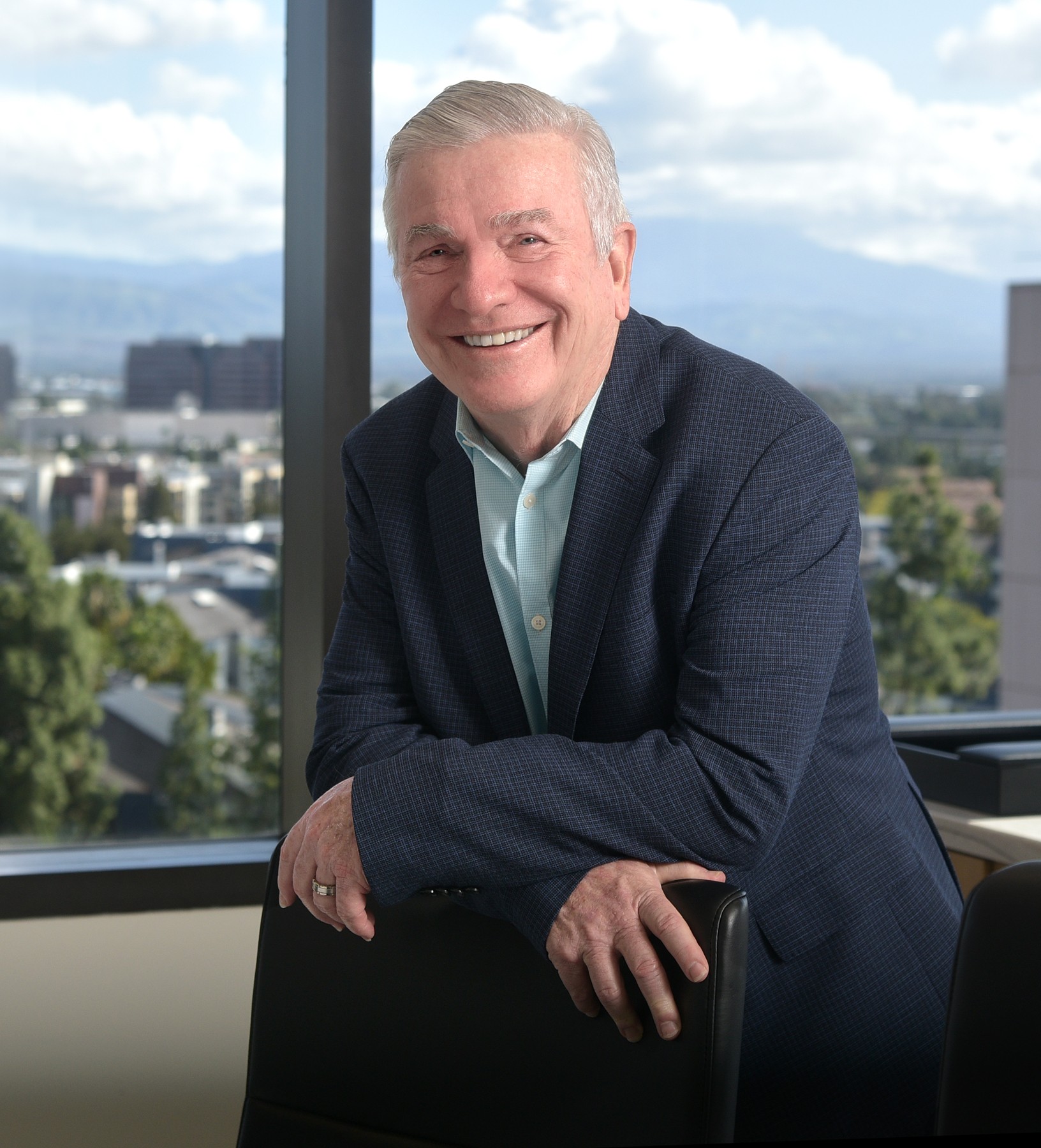

In a strip mall in Garden Grove, kitty corner from a Shabu Shabu restaurant and next to other small businesses, is the headquarters of the low-key US Metro Bank.
“The building is not very important,” Chief Executive Dong Il Kim told the Busines Journal last week during an interview in his windowless conference room.
“What is important is how you provide service for the customer.”
After almost failing in 2013, US Metro, which has been known for servicing Korean Americans, is booming. It climbed two spots to No. 9 on this year’s annual Business Journal list of locally-based commercial banks with assets growing 41% to $665.2 million as of June 30 (see list, page 22).
Its assets climbed even higher to $750 million as of Sept. 30, Kim said. That’s a nine-fold increase since Kim returned in 2013 to take over the then-troubled bank, which services executives and owners at small to medium size businesses.
Original Plan
Kim’s banking background dates to 1980 when he arrived in the U.S. as a student from his native South Korea.
“My original plan was to study here and then go back to Korea,” he said.
However, a week after he arrived, he went to a bank where his friend was working and the friend convinced him to work for six months there, a gig that extended into three years.
“I studied at night and got a degree in economics at Cal State Los Angeles,” he said.
Then it was off to State University of New York’s Stony Brook campus where he earned an MBA and then returned to Los Angeles “to make money.”
He worked at a variety of banks, eventually rising to chief credit officer at Hanmi Bank, a Los Angeles-based bank that also targets Korean American customers. It has a branch in the same strip mall along Garden Grove Blvd. as the headquarters of US Metro.
Founding CEO
In 2006, he became the founding CEO of US Metro, a position he held for a couple of years.
What are big differences in servicing Koreans?
“Most of our Korean customers have language issues, which is why they want to use us rather than American banks,” he said. “American banks do not understand small Korean businesses, cultural issues.”
Then in 2010 he jumped to Saehan Bank, where as CEO he helped it emerge from a regulatory order.
“They produced a lot of toxic assets,” he recalled. “It almost died, but fortunately they successfully raised capital.”
After he helped sell Saehan in 2013 for $105 million to Wilshire Bancorp, he considered moving to New York City as a CEO, when US Metro asked him to return.
At the time, the Federal Deposit Insurance Corp. and the California Department of Financial Institutions had issued consent orders to force the bank to reduce shaky loans and fix management weaknesses.
US Metro directors “knew me and believed in me,” he recalled.
He first raised $8 million in 2014 and then another $3.5 million a year later. In 2017, he raised another $21 million.
US Metro Bank was able to get the consent orders lifted in 2015 and paid back its Federal Reserve loan in 2016.
This fall, the bank originally planned on raising $10 million, but that was increased to $16 million due to increased demand.
“The value of the bank is demonstrated by that market acceptance,” Chief Financial Officer Ralph Wiita said.
The bank will be using the funds for expansion, both organically and possibly acquisitions in California or nearby states. It’s opening loan production offices in Dallas, Seattle, New York and Georgia. It’s branching into mortgage warehouse lending where it provides financing for mortgage originators.
Nowadays, the bank is thinly traded on pink sheets (OTC Pink: USMT). If it can get to $1 billion in assets, it might join Nasdaq, Kim said.
Even though its market cap is around $34 million, the bank in normal circumstances could be worth as much as twice that amount, Wiita said, based on the pricing of banks that were sold prior to the coronavirus.
Steller Metrics
The bank’s key metrics are stellar by most accounts. In the past five years, loans have grown at a compounded annual growth rate of 36% while deposits have climbed an even faster 38%. About 60% of loans are in commercial real estate, including multi-family complexes, gas stations and motels.
Its net interest margin topped 4% in 2018 and 2019 and thus far in 2020 stands at 3.38%. Kim has warned investors about declining profit levels amid declining long-term interest rates.
Even though the coronavirus has affected many of its clients, its non-performing assets were just 0.12% as of June, down from 0.17% in 2019. About 11% of its loans are in still in deferral because of the coronavirus, down from 24% initially.
It participated in the Paycheck Protection Program (PPP), approving 699 loans totaling $70.8 million, with an average loan size of $101,000. It generated $2.8 million in fees. About 70% went to existing customers while another 30% to new customers, who were turned down by other banks, Kim said.
“With the coronavirus, we have to help not only our customers but our community,” he said
Seeking HQ
It’s looking for a new headquarters to accommodate its expansion, possible in Garden Grove, Fullerton or even Los Angeles, where it has two existing branches.
“We have a couple of candidates, but it’s not easy,” Kim said.
Even though US Metro had a reputation as a bank servicing Koreans, Kim discovered upon his return in 2013 that only he and the human resources manager were of Korean descent.
He found that second generation Korean Americans are more willing to use other banks. He’s aiming to counter that by boosting its level of service and its technology. He said small business customers who go to larger banks learn quickly that “it’s much easier” to deal with a small bank.
“Larger banks do not provide the personal service,” he said.
He has diversified away from a focus on Koreans, saying that while 70% of its deposits are from Koreans, 40% of its loans are to Koreans.
“The number one resource for the banking industry is the human being. I always think with good people, we can go together.”