

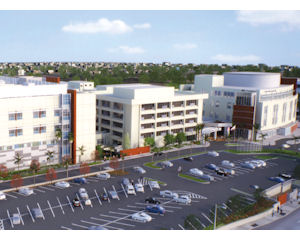
St. Jude Medical Center in Fullerton has started work on a $285 million patient tower.
The Northwest Tower will have 200,000 square feet of space, 120 beds and 14 operating rooms.
It’s scheduled to be completed in summer 2014 and open in the fall of that year. The addition will give St. Jude a total of 359 beds.
St. Jude is one of four local hospitals owned by Orange-based St. Joseph Health System.
The Northwest Tower is the second under a master plan St. Jude executives devised in 2004. The first, called the Southwest Tower, opened in 2009.
A third tower is expected in coming years under the plan, according to Karen Cannizzaro, the hospital’s vice president of facilities and construction.
St. Jude’s expansion has come in response to a California law passed after the North-ridge earthquake in 1994 that requires all acute-care hospitals to be able to withstand a major earthquake and continue operating. The deadline for the requirement has shifted to allow hospitals more time to comply. It’s now 2030.
The Northwest Tower is going up near Bastanchury Road and Harbor Boulevard.
$15M Less
It was first expected to cost more than $300 million. St. Jude’s contractor, the Newport Beach office of St. Louis-based McCarthy Building Cos., has been able to “shave off” about $15 million in costs, according to Cannizzaro.
“The cost of construction has done nothing but go down in the last two, three years,” she said.
Taylor, a Newport Beach architectural firm, designed the tower.
St. Jude is paying for Northwest Tower through a mix of cash, bonds and philanthropic support.
The hospital originally planned to build the Southeast Tower first, said Steve Mynsberge, executive vice president and Southern California healthcare business unit leader for McCarthy.
“Based upon the site logistics and the cost of construction, that didn’t pan out for us, so what we ended up doing was looking for a different location on the campus that made more sense,” Cannizzaro said.
Savings by Design
Mynsberge said St. Jude and other hospitals are viewing new construction projects in light of efforts to contain healthcare costs. That means designing them with efficiencies in mind, such as accommodating developments such as electronic medical records and more operating rooms for new kinds of surgeries, such as laparoscopic or laser treatments.
Other factors that affect construction include the economy, the expected doubling of the population 65 years or older by 2030, and the expectation that healthcare reform will bring more insured patients into the mix.
“But by the same token, part of that plan is to really constrict reimbursement to hospitals and doctors,” Mynsberge said, adding that healthcare providers would be looking for efficiencies in order to deal with lower payments.
The break on construction costs for the Northwest Tower came because “a lot of our major materials were locked in earlier because this was a design-build delivery where we had the subcontractors on board,” Mynsberge said. “If we were facing any material escalations, we went ahead and made the deal to go ahead and buy and lock in prices.”
Other features of the Northwest Tower include a new surgical floor with a hybrid operating room with equipment made by Germany-based Siemens AG. It also will include an interoperative magnetic resonance imaging machine made by Royal Philips Electronics NV of the Netherlands that’s directly connected to a neurosurgery operating room and allows surgeons to be able to have images sent without the patient leaving the MRI, Cannizzaro said.
Healing Garden
The expansion will also add a healing garden and 215 parking spaces to an existing 455-car parking structure that McCarthy built in 2004.
Another existing parking garage and medical records building have already been demolished to make way for the new tower.
St. Jude, along with sister facilities St. Joseph Hospital-Orange and Mission Hospital, have added new buildings on their campuses in recent years for various reasons.
Other Additions
In November 2009, Mission opened a $153 million expansion with a four-level, 94,000-square-foot building intended to treat patients with severe conditions and running diagnostic tests. Hospital officials said that most of Mission was already earthquake-compliant and that patient care shifts influenced its building.
St. Joseph-Orange opened a $203 million patient care center in 2007. That center added 150 beds and 248,000 square feet of space to the campus, and started out as a way to deal with the earthquake law and later evolved beyond that, officials said.
