

“When it comes down to it, the relationship between a nonprofit and its board is really a marriage,” said Stephanie McCormick, president and chief executive of the Orange County and Inland Empire chapter of the Make-A-Wish Foundation.
In the ideal nonprofit-board relationship, she said both sides are deeply invested and excited to bring their best to the table.
“It’s so important to find the right partner,” McCormick said. “The organization, the CEO and the board president walk hand-in-hand on the same path to move the organization’s mission forward.”
Orange County is home to 3,181 nonprofit organizations with combined annual revenues of $4.2 billion in 2010, according to the most recent numbers available through the Gianneschi Center for Nonprofit Research at California State University, Fullerton.
Each has a 501 (c)(3) designation that requires it to have a board of directors to guide its development.
That means finding people willing to serve on the group’s board—a volunteer position that requires commitment, time, money, intellect, creativity and passion.
Nonprofit boards also play a crucial role in securing the financial wherewithal to continue nonprofits’ missions, so it’s important that their members have networks to support organizations’ efforts, as well as strong financial backgrounds themselves.
“We need people who can open doors,” McCormick said. “We need people who are well-connected. We need mobilizers.”
She said companies throughout Orange County have executives and up-and-comers who have leadership skills, a long-term vision and a personal passion for a cause. It’s just a matter of finding them.
Finding Each Other
Executives at Orange County’s top companies fill many board positions at the county’s best-known nonprofits.
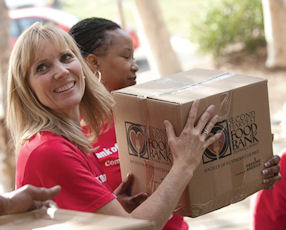
Among them are Mark Sederquist, managing director for Merrill Lynch’s Irvine office, on the board of Second Harvest Food Bank; Catherine MacIver, senior vice president and process design manager at Bank of America’s Santa Ana office, on the board of the Wooden Floor; and Michael Immell, a partner at Costa Mesa-based law firm Rutan & Tucker LLP, on the board of trustees for St. Joseph Hospital in Orange.
The process for recruiting a board member is multitiered.
Nonprofits’ governance committees submit names for consideration, frequently drawn from current volunteers but also sometimes from a list of people who have expressed interest in joining a board or from companies a nonprofit wants to partner with.
Jack Toan, vice president and community affairs manager for Wells Fargo’s Irvine office, said nonprofit groups frequently approach the bank with an interest in having employees serve on their boards.
“We look at the strength of the nonprofit organization and the impact they are making in the community,” Toan said. “This is important, because we tend to support the organizations where we have team member representation through our philanthropic programs.”
The “on-boarding” process can take months once an organization identifies a potential board member.
Sometimes a nonprofit will ask a prospect to serve on a subcommittee so the new volunteer can understand the commitment he or she is considering taking on in the governing board role.
There’s also the human aspect: Personalities are on full display in a board meeting, and if conflicts arise, members are challenged to overcome them by keeping their sights on the larger goal.
The nonprofit thrives and better serves its clients when there’s alignment between the organization’s leadership and the governance, or board leadership, she said.
Mutual Benefits
Dan McQuaid, president and chief executive of Santa Ana-based OneOC, which matches people and corporations with nonprofits that need their skill sets, said corporate executives’ strategic thinking skills and specialized knowledge of their fields of expertise are the top benefits of having businesspeople on nonprofit boards.
“Nonprofits are beginning to think strategically about their board composition and how the right combination of skills and personalities will help the organization reach its long-term goals,” he said.
The businesses whose employees serve on boards also benefit strategically, Toan said.
“Community support and engagement is part of our company culture,” he said. “It’s also a great leadership development opportunity. Everyone on our senior management team in Orange County serves on a nonprofit board and is very engaged in the community.”
According to Toan, at least 79 of the company’s executives serve on nonprofit boards, including United Way, PBS SoCal, Neighborhood Housing Services, Discovery Science Center, Leukemia Lymphoma Society and the Illumination Foundation.
McQuaid also said companies get fringe benefits from encouraging their employees to serve on nonprofit boards.
“Companies’ reputations and visibility are enhanced,” he said. “Plus, board involvement with nonprofits gives companies an opportunity to establish themselves in a new market.”
McQuaid said corporations support nonprofit involvement partly to help build a positive brand image and favorable media coverage as a good corporate citizen.
Shari Battle, a senior vice president at Bank of America’s Laguna Niguel office, said board service actually improves employees’ performance on the job.
“A side effect of this is better employee morale and loyalty,” said Battle, who serves on the board of the nonprofit Orange County Business Council.
Long-Term Relationship
Like marriages, board relationships can change over the years, creating strong bonds, and many former board members stay active with an organization in other capacities for decades.
Jeff Elder, president of Los Angeles-based Trojan Battery and an Orange County resident, has been a member of the local Make-A-Wish Foundation chapter’s board for a decade.
During his time of service, he and his wife, Karla, have also hosted Rolling for Wishes, one of the chapter’s most successful fundraisers. The event over the past six years has raised nearly $180,000 to benefit the children the organization serves, said Karla, the event’s co-chairperson.
The Elders and their committee work closely with McCormick and other employees to make the event a success. The couple said they plan to continue working on the event after Jeff’s final term with the organization’s board expires this year, and Jeff also plans to join the group’s advisory board, an adjunct of its governing board.
Such commitments make nonprofits thrive.
“We solve problems together,” McCormick said. “We go through the budget together, we communicate daily, and we event plan parties together. Just like in marriage.”
