

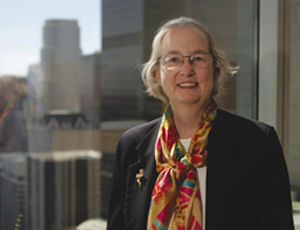
As new chief economist for the Los Angeles County Economic Development Corp., Nancy D. Sidhu may be a little more reserved than predecessor Jack Kyser. But she said she’s ready for the challenge of trying to explain Southern California’s economy to media and business leaders from around the world.
She began her career teaching at Northeastern Illinois University and jumped ship—despite tenure—for a job at a steel company.
Sidhu came to Southern California from the Midwest when her husband, Victor Sidhu, got a job with First Interstate Bank in downtown Los Angeles. She first worked as an economist at Toyota Motor Sales U.S.A., then signed on at Security Pacific Bank. Later, Security Pacific was bought by Bank of America Corp., and her job eventually was phased out.
Sidhu joined the LAEDC, which also tracks Orange County’s economy, as a consultant in 2000. A year later, Sidhu was in New York for a meeting of the National Association of Business Economics at the Marriott Hotel next to the World Trade Center when two hijacked planes hit the twin towers.
Sidhu and hundreds of other economists were evacuated before the South Tower collapsed onto their hotel. To this day, Sidhu is reluctant to talk about her experience, saying the pain is too deep.
She sat down with our sister paper the Los Angeles Business Journal at her office to discuss her career as an economist, her role filling Kyser’s shoes and her penchant for traveling to places most tourists wouldn’t pick.
How did your childhood inform your career?
My family was full of businesspeople. My father was a stockbroker and had interests in oil. My mother’s family also worked in the corporate world. So, from a very early age, I was interested in business and industry. I was the first of our family—I have three sisters—to make a career outside the home.
Why did you decide to become an economist?
I grew up believing that I would be teaching at the university level: college professor of finance or something like that. But when I went to Smith College, I signed up for economics and found that I just loved it. Economists look at the world the way it really works—and that’s what I love about it.
You’re now moving into Jack Kyser’s position, as the voice of the Southland economy. How does that feel?
I had worked with the media before, but nothing like what I’m going through now. The region is so complex and interesting: It’s difficult to explain it to different parts of the country or the world. I think it helps that I came to Southern California from somewhere else, so I have something to compare it to.
Are you going to make changes?
I don’t think the forecasts will be much different than what Jack did.
What’s your typical day like?
I’m spending most of my time in the office now. I’m not doing many speeches yet, although I expect that will change over time. I do find I enjoy getting out and talking to people. I’m spending a lot of time preparing the forecasts and various reports, and taking a lot of calls from the media. And, since we’re short one economist right now, I’m still doing my old consulting job and what had been Jack’s job.
How do you balance your work with your family and hobbies?
It definitely requires planning. But like everyone, I find that I need to make sure I get enough rest so that I can be refreshed in the mind.
You said you travel mostly in California. What are some of the most unusual places you’ve been to in the state?
I love to go to places where I can learn how things work. So, this past May, Victor and I went to Oroville Reservoir and Shasta Dam in Northern California. At Lake Shasta, the water was right near the top of the dam. I really learned about how the state’s water system works, which I found fascinating. We also went into the Bay Delta area and drove on top of some of the levees. It was really strange riding on this road and looking out on either side and only seeing the tops of trees. You really get a sense of how fragile the whole area is, and then you realize that most of the water we use here in Southern California has to pass through that area.
Have you traveled recently to any places outside California?
We went to Seattle a few years ago. My favorite part of that trip was visiting the Boeing plant in Everett and seeing how they were putting together the 787 Dreamliner plane.
What’s your next destination?
We hope to drive out to Boron in the Mojave Desert, where they mine borax. I believe it’s the largest borax mine in the world.
How did being at Ground Zero during the terrorist attacks of 2001 change you?
Prior to Sept. 11, I had always felt a certain sense of security in life. After Sept. 11, that sense of security has vanished. But maybe, in reality, it was never really there.
Why did you move from academia to a steel company?
After I earned my Ph.D., I started teaching at Northeastern Illinois University near Chicago. I earned tenure, so I had a secure job. But after a few years, I decided I wanted to go into the private sector, becoming an economist for a major corporation. I worked through the list of companies in Chicago and landed a job as a market analyst for Inland Steel, which at the time was the sixth largest steel company in the U.S.
How did you learn about steel?
In a six-month training program, I visited every department at the company and spent time at the main steel mill. I really got to learn about steel and how the industry worked. My favorite part was getting to drive a rail locomotive. It was only about 300 yards or so and ended up being easier than I thought it would be. But it made for a really fun adventure to tell my husband about when he asked me what I did at work that day.
You mentioned that the chief economist for Inland Steel at the time you joined was one of the most influential people in your life. How come?
Bernard Lashinsky viewed economics as the study of industries and the private sector. If you really want to find out what’s going on in the economy, you look at what’s going on within industries, especially industries like steel that are good bellwether industries. Even today, the economy isn’t going to recover until business sales pick up. I’ve molded my economic outlook on this approach.
Wasn’t it unusual to be a woman working at a steel company in those days?
When I arrived, that was already starting to change, at least at Inland Steel. The company was making a conscious effort to hire more women and I was a part of that. I was the only woman in the market research department when I came on board, but two more women were hired right behind me.
Was Southern California a big change from the Midwest?
I didn’t think I’d ever want to leave the Midwest, but by that time, in the mid-1980s, Victor really wanted to go to Southern California. It was a rough welcome, though. Four weeks after we arrived, the Whittier Narrows earthquake occurred—that was the first earthquake I’d ever experienced. Then, a year later, that famous fire occurred at the First Interstate Tower: Victor’s office was on one of the floors that completely burned.
Tell me about the job at Security Pacific?
I had to do monthly forecasts of interest rates—and believe me, that was a humbling experience. Some of my forecasts ended up being blown out of the water. But, since everybody kept encouraging me to try, I learned to pick up and try again. Soon, I really enjoyed the job.
What were your most memorable forecasts?
Back in 1990, when I was at Security Pacific, I successfully called the 1990-91 recession at a time when many economists were still talking about a soft landing. Then, at the LAEDC, we called the 2001 recession. I saw the slowdown coming, especially in the automotive sector, which I was very familiar with from my days at Toyota.
What’s your outlook for Orange County’s economy?
The progress of the county’s economic recovery will be measured by gains in employment. Job growth likely will be uneven and slow, continuing to decline in 2010, especially in several troubled sectors, before starting to improve in 2011.
What’s the best piece of advice you’ve ever received?
That was a long time ago, during my early days at Inland Steel. I went to Indianapolis with some of my colleagues to give a speech at a conference. Afterwards, I was starving and we went out to get hamburgers. Some of the folks were planning a night out on the town and I asked if I should join them. One man said, “No, you should go home. Nothing good happens after midnight.” That was a very nice piece of advice. If you just follow that piece of advice, you stay out of all kinds of trouble.
