


Orange County’s homegrown banks and savings and loans are showing more signs of recovery after years of heavy losses tied to problem loans and shrinking cash reserves.
Tom Meyer, president of Fullerton Community Bank, said he believes the worst is over but expects conservative lending standards to persist.
“Banks are still being cautious in new lending opportunities, particularly midsize and community banks,” he said. “Banks will still keep reserves at a very high level for a while.”
The continued caution comes as most local banks and thrifts return to profitability, even as a number of them still score poorly on the Texas ratio, a much-watched measurement that compares bad loans to how much shareholders would salvage in a failure.
The lower the score the better on the Texas ratio, which was devised by analysts at Royal Bank of Canada’s RBC Capital Markets while looking at banks and thrifts in the Lone Star state during the savings and loan meltdown of the 1980s and ‘90s.
A Texas ratio of 50% or higher typically draws extra scrutiny from regulators. A score of 100% or higher indicates a bank is teetering toward collapse.
According to an analysis provided to the Business Journal by Anaheim-based Findley Reports Inc., based on the period ending Sept. 30, 21 of the 27 local banks and thrifts scored below the 50% mark.
Ten scored 10% or lower, showing little risk of default. Six scored above 50%.
The average Texas ratio for OC banks and thrifts is a relatively healthy 44.3%. That number would be significantly better—25.7%—without recently sold Westminster-based First Vietnamese American Bank in the mix.
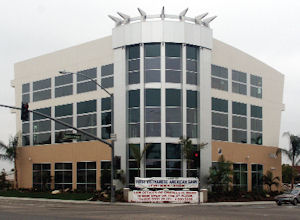
First Vietnamese had the highest Texas ratio, at 502.2%, prior to its sale earlier this month to Los Angeles-based bank holding company Grandpoint Capital Inc. and its subsidiary Grandpoint Bank.
Grandpoint acquired the assets and deposits of First Vietnamese in a purchase-and-assumption agreement with the Federal Deposit Insurance Corp.
First Vietnamese
First Vietnamese operated a single branch in Westminster, where it opened with fanfare in 2005 as the first bank to specifically target Vietnamese-Americans and their businesses in Little Saigon, which includes parts of Westminster, Fountain Valley, Huntington Beach, Garden Grove and Santa Ana.
First Vietnamese hadn’t posted a profit since it opened and was under regulatory scrutiny for much of its existence.
Another bank in Little Saigon is facing similar troubles and also is pushing up the local average on the Texas ratio.
Saigon National Bank in Westminster had the second highest score at 72.9%.
The bank lost $1.7 million in the third quarter, when it missed a payment on a Troubled Asset Relief Program loan from the Treasury Department for the seventh time.
Saigon National took $1.5 million in federal money in 2008. It is the only TARP recipient to miss so many payments.
In May, the federal Office of the Comptroller of the Currency ordered Saigon National to improve management, boost capital ratios, conduct an internal audit, examine its commercial loan portfolio and hold off on any increase in loans.
Roy Painter, executive vice president and chief financial officer of Saigon National, declined comment on operations.
On the other end of the Texas ratio scale, Costa Mesa’s Pacific Premier Bank scored 9.3%.
Chief Executive Steven Gardner said the strong score stems from the bank’s success at avoiding subprime and speculative real estate loans during the boom. That led to relatively small profits at the time, but also helped the bank avoid big losses in the downturn.
Premier Bank recorded a profit of $2.9 million in the third quarter.
The general improvement on Texas ratios fall in line with a prevailing theme among local banks and savings and loans as they reduce problem loans and improve capital levels.
The theme includes a slight dip in lending overall. Of the 27 banks and thrifts, 16 reported reduced loans from a year ago. Acquisitions, investor financings and deposit growth at several newer banks and thrifts provided lending capital for the 11 that saw increases.
The entire group reported $5.7 billion in loans through September, down less than 1% from a year earlier.
Capital levels also have become an increasingly important measurement for regulators in assessing the overall health of lenders.
Eighteen of the banks in the county improved capital levels in the last 12 months.
Grandpoint Bank led the group, boosting capital to $71.5 million from $6.8 million a year earlier. The infusion gave Grandpoint a score of 0% on the Texas ratio even with the absorption of a troubled bank it acquired prior to its deal for First Vietnamese.
Grandpoint Chairman Don Griffith, who raised $350 million in late 2008 to buy banks in Southern California, led a $75 million recapitalization of Santa Ana Business Bank, which Grandpoint acquired in June.
The Santa Ana bank—which started in 2007 by targeting the city’s dominant Hispanic population—now goes by Grandpoint.
Only a few OC banks have a substantial portfolio of bad loans remaining on their books.
Costa Mesa’s Pacific Mercantile Bank, the county’s largest homegrown bank with $1.1 billion in assets, had a score of 62.4% on the Texas ratio.
The relatively high score owes to problem industrial and commercial loans, according to Chief Executive Ray Dellerba.
“That’s been the toughest area,” he said, adding that Pacific Mercantile is working through them.
The commercial bank hired a specialist to sell off foreclosed properties before the financial crisis took hold, stemming further problems down the road.
Still, Pacific Mercantile had about $21.4 million in foreclosed properties at the end of the third quarter, up 54% from a year earlier.
Dellerba said he expects to sell off the foreclosures in the next two quarters.
Pacific Mercantile lost $10 million in the third quarter.
Earlier this year, Pacific Mercantile’s parent company agreed to a consent order with federal and state regulators to reduce problem loans and assets while strengthening capital reserves.
Pacific Mercantile’s loans were down 5% to $781 million as of Sept. 30.
Centennial
Fountain Valley-based Centennial Bank had the highest profit, earning $4 million in the third quarter. That reversed a $2.1 million loss a year ago.
The bank still has problems, though, with a Texas ratio of 58.6%.
Centennial lends to businesses, apartment owners and others. The FDIC issued a cease-and-desist order in February, telling the bank to shore up its management team, improve its capital position and reduce risk exposure.
Centennial officials did not return calls seeking comment.
The recent improvements on Texas ratios also fall in line with a trend toward profits for local banks and thrifts. Sixteen of the 27 local finance houses posted a profit in the third quarter, according to data reported to the FDIC. That’s two more than the last quarter and six more than a year ago, another indication most banks are righting the ship.
According to FDIC data, seven local banks reversed losses in the third quarter and only one, Orange Community Bank, fell into a loss. Orange Community posted a loss of $559,000 compared to a $584,000 profit a year earlier.
