

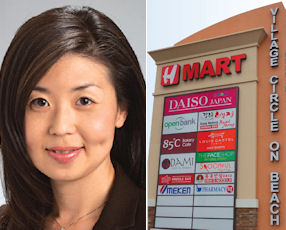
A special initiative under way in Buena Park by one of the largest banks in the U.S. is the latest reflection of the significant concentration of Korean-American businesses in Orange County.
Wells Fargo Bank has put a priority on inroads with various ethnic groups in recent years, and it’s made the most progress on the Korean front so far, according to Patty Juarez, regional vice president who heads the bank’s commercial banking in North OC.
A year ago, Wells Fargo tapped Sungsoo Han to spearhead the Korean initiative in Southern California overall while keeping a “particular focus” on North OC.
Han is a veteran of the banking scene in the Koreatown district of Los Angeles, with prior stints at Wilshire State Bank and Hanmi Bank.
“Last year was the preparation, and this year, we’re expecting to do more production and we anticipate a lot more visible outcome,” Han said. “The Buena Park and Fullerton areas happen to have a lot of Korean population and businesses, and they’re growing fast and economically very active.”
Village Circle
Han’s contention is borne out by the dozen or so new Korean businesses at the 7-acre shopping center dubbed Village Circle on Beach in Buena Park. The place is expected to fill out with 19 tenants and primarily target Korean-Americans, along with customers from other Asian ethnic groups. There’s been a round of store openings in the past couple of months, and others are expected to start operations soon, according to Bryan Sung, founder and head of Ace Realty Co., who oversees the leases for Village Circle.
The establishment of the predominantly Korean shopping center—at an intersection already anchored by Korean grocery stores, restaurants and other shops—points to North OC’s growing role as a residential center for the community and increasing opportunities for businesses that serve the population, Sung said.
About 97,100 Korean-Americans live in Orange County, according to a 2012 estimate by the U.S. Census Bureau. That’s roughly 3% of the county’s total population and an increase of 75% since 2000.
Los Angeles County has about 221,800 Koreans, up 24% from 2000.
There are about 1.5 million throughout the U.S., a 35% increase from 2000.
A handful of OC cities have outsized concentrations of Korean residents. Ethnic Koreans account for nearly 14% of Fullerton’s population of 138,589. The figure is 11% for Buena Park, whose total population is about 82,200.
“I think that Buena Park, Fullerton and La Habra, along with La Mirada, could make up one of the largest concentrations of Korean immigrants in the world,” Sung said. “The Korean population is increasing in this area. Going east from here, toward Yorba Linda, Koreans are active home buyers there. I think the number will continue to increase.”
The growth in population has come with changes in the development of businesses in Orange County over the years, according to Dayne Lee, civic engagement coordinator at the Korean Resource Center. Lee oversees the L.A.-based nonprofit’s Orange office, which opened in 2012.
“Before, it used to be professionals and business owners who worked in L.A. and lived in OC,” Lee said. “But now it’s different. OC is its own fully contained Korean-American business community.”
Korean-Americans can be found in various business industries in Orange County, ranging from construction to commercial banking, from law to medicine, and from mom-and-pop eateries to national franchises. The community also retains its hallmark of entrepreneurialism that produces a steady stream of startups, such as smallish coffee roasters and mobile application developers.
OC is home to an estimated 9,000 Korean-owned businesses—about 3% of the total here—that combined for $2.6 billion in annual revenue, according to a 2007 Survey of Business Owners by the census bureau, the most recent available.
Many Korean businesses are now becoming more “mainstream,” catering to and integrating with other cultures—perhaps a typical progression for an immigrant community over a generation or two, as the younger become more likely to penetrate the larger market, according to Phillip Chang, owner of Irvine-based Yogurtland Franchising Inc.
Boba Loca
Chang moved to the U.S. from Seoul, South Korea, when he was 21. He worked as a computer programmer before starting Boba Loca, a tapioca drink shop, in 2001. The franchise grew to more than 30 stores in four years.
“Still, I struggled with Boba Loca, because it was mainly [targeted at] the Asian community,” Chang said. “There was a limitation. Yogurtland is more mainstream.”
He introduced the frozen yogurt concept in 2006 as part of his Boba Loca menu at a Fullerton store and saw the “potential for it to take off by itself.”
Chang sold Boba Loca to concentrate on Yogurtland, opening a second store in Irvine in 2007. The brand now has more than 260 stores in the U.S. and abroad.
Chang recently stepped down from the chief executive seat to focus more on Christian mission work. Former Chief Operating Officer Huntley Castner was promoted to succeed Chang.
“Overall, the trend right now is that the first generation is about to retire,” Chang said. “Those who came here in the 1970s and 1980s, they’re exiting the stage, and the 1.5 and second generations are becoming more active and more stable. That’s the point where many of them think about what they can do to utilize their knowledge of both cultures, both languages.”
Such knowledge is a plus for professional firms here that serve Korean businesses locally while also serving as a conduit for South Korea-based companies eyeing overseas expansion, said Min Chai, principal at MKC Law Group in Newport Beach. She also is president of the OC Korean American Bar Association, or KABA, which was launched in 2005 to serve a growing number of Korean-American attorneys in the county, a number that currently stands at about 260. OC KABA has a membership of about 120 lawyers.
Chai, who grew up mostly in the Los Angeles area, has a client base about evenly split between Koreans and non-Koreans. She said she’s seen a solid shift in the Korean business community here from being retail-driven to more service-oriented.
“Also, there is a very sophisticated level of utilizing professional advisory services,” Chai said. “Before, a CPA would be it. Having an attorney was a foreign idea. That was only if you get sued or if you have to sue. But now, a lot of the first and second generations alike are seeing the benefits of getting legal services from the get-go from preventative and strategic perspectives.”
Chai said she’s also seeing more companies in Korea moving to set up operations in the U.S., joining a group that has long included big units of Korea-based parent corporations, such as automaker Hyundai Motor Co. The company operates through its Kia and Hyundai brands in the U.S. under Kia Motors America Inc. in Irvine and Hyundai Motor America Inc., which is wrapping up construction of its new, $200 million headquarters in Fountain Valley.
Another Hyundai offshoot, machine tool maker Hyundai Wia Machine America America Inc., based in Itasca, Ill., last year opened a technical center for customer training in Cypress, its first facility in the Western U.S.
CJ Foods Inc., maker of dumplings, marinades and other Asian foods, last year moved to La Palma from Commerce after investing in a dumpling factory in Fullerton. Tofu maker Pulmuone Foods USA Inc. also has a facility in Fullerton.
Chungdahm ReadWrite is an education provider with schools in Irvine and Diamond Bar. It is planning to open a center in La Habra later this year, according to Michael Kim, principal at the local branch. Chungdahm’s U.S. operations are tied to Seoul-based Chungdahm Learning Inc., which operates 200 or so locations in Korea.
Korean-Americans have become active in civic life here, too.
Steven Choi is the second-straight South Korean immigrant to serve as mayor of Irvine, following Sukhee Kang.
The growing interest from Korean enterprises to invest in operations in the U.S. has pushed city governments throughout OC to establish and reinforce relationships with municipalities and businesses in Korea. A host of OC cities, including La Palma, Garden Grove and Irvine, made trips to Korea at various times in 2013 to build relationship and explore investment and business opportunities.
For Garden Grove, the visit to sister city Anyang reflected its initiative to help “bring vibrancy back into the community” by strengthening relationships with Korean businesses and cities, according to Council Member Christopher Phan.
“In recent times, our Korean district has gotten older,” Phan said. “The Korean community has been an integral part of our city’s history, [and] we would like to strengthen ties to help our local Korean businesses and see if there are business opportunities our two cities may develop.”
Garden Grove began to build a significant Korean concentration starting with the 1965 Immigration Act, which opened the door for more immigrants.
A stretch along Garden Grove Boulevard between Brookhurst Street and Beach Boulevard was informally known as Little Seoul for decades before the city designated the area the Korean Business District in 2002.
“The Garden Grove business district has the longest and most colorful history,” said Francis Lee, chairman and president of the Orange County Korean Cultural Center.
Education
Growing interest among parents for higher-quality education and prospects of academic achievement drove families to other parts of the county, Lee said.
“Fullerton became popular since many high schools, like Troy and Sunny Hills, became famous for producing students who went on to many Ivy League schools,” he said.
Garden Grove, while it has become more of a hub for the Vietnamese-American community, still accounts for some 1,000 Korean-run businesses, largely in the restaurant industry and including many that were founded by first-generation immigrants.
Collaboration among various ethnic groups has been a solidifying trend in recent years.
OC KABA, for instance, “tries to support other ethnic groups’ signature events,” Chai said. “We go, and they come. We’ve become an integrated part of what’s called the mainstream community. We’re part of that fabric. We have to work with other ethnic groups.”
The Korean American Chamber of Commerce of OC heads the annual Asian Business Expo, a joint event that pools together nine ethnic chambers, according to Patrick Woo, president of the organization and head of BizTech Inc., an information technology consulting firm in Placentia.
The potential to reach non-Korean consumers in North OC was a key attraction that drew L.A.-based Open Bank to set up its first OC location in Village Circle in Buena Park.
“This is where Korean commercial businesses are concentrated and growing rapidly,” said Sunnie Chun, relationship manager who oversees the local branch. “You can also see the Chinese, Hispanic, Indian and other ethnic groups here. There’s competition with other banks, but it’s a good place for us to expand, especially as we target other ethnic groups beyond Koreans. We will focus on Buena Park first, but we have plans to expand into other OC cities if the initial feedback is good.” n
