

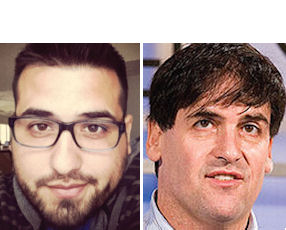
An Irvine startup backed by billionaire investor and Dallas Mavericks owner Mark Cuban is hoping to shake up the vending machine industry with a simple mobile payment system.
LikeUs Network’s prototype device allows users to make purchases with PayPal and Google Wallet using their smartphones.
“We’re still working on the distribution model,” said cofounder Ray Hernandez, who’s in talks with PepsiCo Inc. and Dr. Pepper Snapple Group Inc. on a possible deal to sell its devices to be used in retrofits of existing vending machines or the production of new ones.
Purchase, N.Y.-based PepsiCo owns more than 2 million vending machines. The company, which runs the Frito-Lay, Tropicana and Gatorade brands, among others, had sales of nearly $65 billion last year.
Plano, Texas-based Dr. Pepper, with a stable of brands that includes 7-UP, Mott’s apple juice and Yoo-hoo, owns more than 1.4 million vending machines. It saw sales of $1.4 billion in 2012.
Coca-Cola Co. has close to 3 million vending machines and plans to roll out thousands that take smartphone payments and track purchase information to offer discounts and free drinks to consumers.
LikeUs, which launched last year, hasn’t settled on a business model. It either will sell its device as a stand-alone unit after ramping up production or give it away for free and charge companies a fee for data storage and transactions.
“We’re having talks with different companies right now,” Hernandez said.
One of them is SAP AG, a Germany-based big-data provider and business software maker with more than $21 billion in sales in 2012. The company recently began showing a vending machine that was limited to accepting near-field communications, or NFC, payments. It was attracted to the LikeUs device because it can handle transactions from Apple, Android or mobile site operating systems.
Hernandez, 32, launched the company last year in San Francisco with fellow programmer Keyston Clay, 27, before moving to Irvine about five months ago to be closer to his wife’s family after their second child was born.
Hot Idea
The genesis of LikeUs began more than two years ago on an August afternoon when temperatures climbed to 105 degrees.
Not exactly ideal running conditions on the Katy Trail in Dallas, a 3.5-mile path that follows the defunct Missouri-Kansas-Texas railroad line.
“It was a real dumb idea,” Hernandez said. “I was out of shape already.”
Hernandez and Clay were chugging along, running short on breath and liquids, when they came upon a Gatorade vending machine. They had no cash—only their mobile phones. Hernandez lamented the fact he couldn’t buy a drink through some Facebook login or PayPal account.
“That’s when the light bulb went off,” he said. “That’s what was missing.”
That night he had his father call an old friend who had an old Dr. Pepper machine in his barn out in the country. The owner had owed Hernandez’ father $100 at the time, so they struck a deal. Hernandez rented a U-Haul, picked up the 1970s vending machine, and brought it to his apartment, where he set out to modernize it.
He had no idea how it worked, let alone how to convert it to a mobile payment system.
The technology inside older vending machines has remained relatively the same since the London debut of the first coin-operated version in the early 1880s, which spit out postcards.
Those machines, along with the first versions introduced in the U.S. at New York subway terminals in 1888 by Thomas Adams Gum Co., used magnets to handle tasks such as accepting money, returning change and dolling out gum.
Change didn’t happen until about 10 years ago.
Hernandez started his work on the 1970s Dr. Pepper model with a trip to a bookstore, where he bought an Arduino microcontroller that makes electronics projects easier to build and a Nexus 7 Android tablet. He installed a simple app on the tablet that Clay developed in a few minutes.
The duo wrote code that told the controller to power up the vending machine when someone logged into Facebook. The hardware essentially allowed the old software to talk with the new software. The device is basically a translator that plugs into the brains of a vending machine. It’s equipped with a subscriber identification module (SIM) card and a chip that powers 3G Internet connections.
Most of the vending machines in the U.S. today still only accept coins and dollar bills, one reason vending industry sales in the U.S. were about $19.3 billion in 2012, compared to $52.5 billion in tech-driven Japan, according to the latest figures released from the Japanese Vending Machine Manufacturers Association and VendingMarketWatch, a trade publication based in Wisconsin.
The LikeUs prototype was crude. The tablet was duct-taped to the the machine, but it worked.
Now the company needed money to get the project off the ground.
Enter Mark Cuban.
The high-profile entrepreneur and star of the ABC reality show “Shark Tank” was a member of the same upscale fitness club as Hernandez, who had heard plenty of stories of Cuban playing pickup games at the gym.
Hernandez went there every day at 11 a.m. hoping to catch him.
One late morning Cuban walked onto the court and was later matched up against Hernandez.
The two became acquaintances, but Hernandez couldn’t muster the courage to ask the question.
“I’d get scared and chicken out,” he said. “I knew I had one more chance to approach him.”
That moment came in January 2012, days before he was set to move to San Francisco.
Cuban was on a treadmill, and Hernandez was a few rows behind him. A runner stumbled on the treadmill between them and a few minutes later, went flying off of it.
Apparently his pacemaker went off, which prompted Hernandez and Cuban to check on the runner. The paramedics arrived and took the man to the hospital, leaving Hernandez with a chance to tell Cuban about his business idea.
Cuban said it was horrible, one of the worst he heard.
He added some constructive criticism, telling Hernandez that the key was the mobile phone, not social network logins through a tablet.
Hernandez found an electrical engineer in Canada and mapped out the changes in less than two weeks.
Cuban seeded the company with a $75,000 investment less than a month later.
“It was pretty amazing,” Hernandez said. “I’m just the guy who has a million ideas a day and always thinks he can build anything.”
