

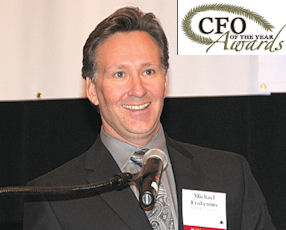
“Daring” is a fitting description of the leadership team that took Think Together from a relatively small youth-education program in Santa Ana to become the largest provider of Extended Learning Time programs in the state, according to Michael Frobenius, the nonprofit’s chief financial officer.
Santa Ana-based Think Together provides out-of-school academic programs for students living in “underresourced communities.” It currently has about $61 million in annual revenue, 2,500 employees, and 400 teaching sites for some 150,000 children statewide.
Smaller Numbers
Those numbers were far smaller when Frobenius joined the organization in 2007.
Revenue was about $13 million, and it had less than 100 employees. Think Together reached about 2,000 youngsters at 25 locations.
“Scaling up” came fast and required resources and resolve, according to Frobenius, who was honored in the Not-for-Profit Organization category at the annual CFO of the Year Awards presented on Jan. 29 by the Business Journal and the California Society of Certified Public Accountants.
Think Together, founded in 1997 by Chief Executive Randy Barth, had grown steadily during its early years, forming partnerships with a couple of school districts in Orange County. But a major growth spurt came in 2007 when California rolled out new after-school education grants under Proposition 49, which provided $550 million a year in funding for such programs.
That’s also when Frobenius joined Think Together, after wrapping up a nine-year stint as director of finance at Los Angeles Chemical Co. in South Gate. He heard about Think Together from Mike Kelly at Irvine-based advisory and outsourcing firm Beacon Resources, who put him in contact with Barth, who was looking for an interim CFO.
“It turned out to be not-so-interim,” Frobenius said. “I thought it was going to be a two-to-three-month role, but it was a great, exciting time to come on board.”
Risk-taking was part of his job from the start.
Think Together within months opened 150 new locations across 19 school districts in Los Angeles, Riverside and San Bernardino counties, and it added about 100 hires.
“It really took some risk,” Frobenius said. “Most programs are run on a smaller scale. But Randy and the board crafted a vision, and a key element was to take it to scale so that you can gain some efficiencies and economies of scale. It’s a great idea, not an easy thing to pull off.”
Academic Performance
Think Together has been measuring the outcomes of its students over the years, noting “significant improvements in the students’ average academic performance on tests administered by the state,” according to Frobenius.
Evaluation data involving Academic Performance Index scores for Think Together participants in the Santa Ana Unified School District show that the API score climbed 27% between 2002 and 2010, from 570 to 723. The increase for participants in the Baldwin Park Unified School District was about 25% to 735.
A roster of business partners who have consistently lent support includes Irvine-based Western Digital Corp., Pacific Life Foundation in Newport Beach and Broadcom Corp. in Irvine.
Think Together also has individual and family supporters who help fund their education initiatives.
“We raise $5 million to $6 million a year in philanthropy,” Frobenius said. “That private philanthropy really improves the program quality. Donald Bren of the Irvine Company has been our largest private [philanthropist] over the years. They’ve been a huge partner.”
Frobenius plays a key role when it comes to lining up support. He recently oversaw an agreement with the Children & Families Commission of Orange County that allowed the nonprofit to move into a new headquarters, which it will eventually own after fulfilling a 10-year service agreement.
“The commission oversees the Proposition 10 cigarette-tax dollars collected in California … [which are] distributed to counties by birthrates,” Frobenius said. “And a big chunk of that goes toward early-childhood initiatives. But with the cigarette and tobacco consumption on the decline, and this tax revenue certainly projected to decrease, the local commission [was] looking to figure out a way to deal with that and secure funding for the long term.”
The conclusion was to invest $5 million into Think Together to “front the money to buy us a building,” which will save the nonprofit about $750,000 annually in rent, Frobenius said.
“We’ll be able to funnel the savings dollar for dollar into the programs,” he said. “The commission is seeing the services continue for another 10 years for less money than they would’ve otherwise spent.”
Think Together’s key objective is to close the “achievement gap,” what Frobenius defines as “a tremendous disparity in the education outcomes between the haves and have-nots.”
The job has become more than grades and exam scores for Frobenius.
“For me, it’s personal,” he said. “I’ve got three young kids. I’m well aware of all the support they have gotten. But when you consider … the upbringing and environment [for] so many others, particularly in the Latino population in California, where English is not the first language, you can see what an uphill battle they’ve got.”
