

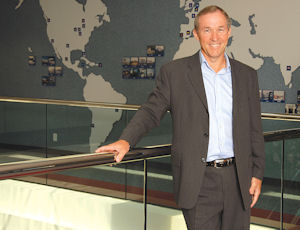
Greg Spierkel is the globetrotting chief executive of Orange County’s biggest company.
Spierkel, 53, spends most of his time on the road for Ingram Micro Inc., the biggest distributor of all things technology—computers, networking gear, software and consumer electronics.
The Santa Ana-based company is the biggest of any type here by revenue with yearly sales of more than $32 billion.
Much of the revenue comes from passing along products, which means Ingram runs on the slimmest of profits in its bread-and-butter distribution business. That’s reflected in the company’s market value, which was $2.5 billion at recent check.
The company moves products from manufacturers to stores, to the warehouses of online retailers and to technology consultants known as value-added resellers.
Ingram nets pennies on the dollar and counts its gross margins in basis points—hundredths of a percent.
That makes Spierkel, who has run Ingram for five years, big on saving money.
“We run the company really tightly,” he said. “While most companies talk about percentage margins, we talk in basis points. Frugality is part of our DNA.”
He practices what he preaches.
“I don’t have a corporate jet,” Spierkel said. “I fly commercial and I sit in steerage like everybody else. We have no company cars, no perks.”
He doesn’t even like to run the air conditioning on hot days, sticking to a fan instead, he said.
Ingram’s workers here, some 600 people, constantly are on the hunt for ways to eke out more profits by offering services to resellers that install and service technology for companies.
Ingram provides lines of credit, manages software licenses, warranties, inventory and marketing. It even offers logistics services such as warehouse space.
Global Expansion
Spierkel, a native of Quebec who’s lived abroad most of his career, has put a global stamp on the company since joining Ingram as president of the Asia Pacific region 13 years ago.
“When I came here, the company had 80% of its revenue from North America,” he said. “My bias was to go global. I was hired with that mandate.”
Spierkel took a big role in Ingram’s 2004 buy of Australia’s Tech Pacific Ltd. for $530 million and its 1997 buy of Singapore’s Electronic Resources Ltd.
“I got us started in Asia, and today it’s 23% of our business,” Spierkel said. “Before I came to the company we had no business there. We now are a truly multinational company.”
These days, sales in North America are about 35% of the company’s revenue.
Ingram’s top global executives look a bit like the United Nations—something Spierkel’s proud of.
“I have an Indian man who runs the Asia Pacific region, a French guy running the European operations, an Irishman running North America, a Brazilian running Latin America, and I’m Canadian,” he said. “Of all the operating executives in the company, we don’t have one American on the team, which is unique for a Fortune 100, U.S.-based firm.”
Even so, Ingram plays a big role here. The company is a bellwether for the U.S. technology industry.
The health of its business rises and falls with demand for technology products from corporations, which make up about 80% of Ingram’s sales.
The company got squeezed in 2009 when spending on technology ground to a halt.
“Last year was definitely a weak year for the whole industry,” Spierkel said. “Ingram Micro’s sales for the full year were down 14%. That’s a very big drop for us.”
Spierkel said he’s expecting this year to be better as companies upgrade their technology. It won’t be a full recovery, he said, until companies start hiring again.
“Companies are adding and upgrading technology, but they are not adding people, unfortunately,” Spierkel said. “That’s part of the bigger question that’s out there with the economic recovery.”
The company doesn’t give financial guidance. It is seeing double-digit sales growth across all of its operating regions, albeit from a lower base after a bad 2009.
“The good news is that we are more than offsetting that decline, and we are totally recovering the lost revenue of that one tough year,” Spierkel said. “We are very encouraged with how things are kicking back in.”
Wall Street analysts, on average, expect Ingram Micro to see 2010 profits of $291 million, up 40% from a year earlier. Sales are seen coming in at $33.8 million, up 14%.
“We still are seeing what I would characterize as very healthy growth,” Spierkel said.
Like Ingram itself, Spierkel has been shaped by globalization.
“I can tell great stories of different places that I’ve lived in and they go along with different phases of my life,” Spierkel said.
As a young man, he spent time in Hong Kong, Britain and Singapore.
He got his start at Bell Canada Enterprises Inc. working on one of the first e-mail systems in 1979.
Spierkel then spent 11 years at Canada’s Mitel Networks Corp., a maker of phone systems, software and electronics.
His longest stint abroad was in Belgium while serving as president of Ingram Micro Europe.
The tiny country ranks as his favorite spot to have lived so far for its proximity to the gems of Europe, Spierkel said.
“We enjoyed the ability to jump in a car and do a weekend skiing in Switzerland, or head to big flower festivals in Holland, or go to Paris in an hour and 15 minutes on a train ride,” he said.
These days, he’s settled into the suburban life of South Orange County with his British wife and two teen sons.
After living abroad, he said he finds OC “a little bit boring” but concedes “there isn’t a better place on the planet for weather.”
He’s a member of the business school advisory boards of the University of California, Irvine, and Chapman University in Orange. Spierkel also is a director at Bellevue, Wash.-based truck maker Paccar Inc.
His kids are active in lacrosse and hockey at their schools.
Skiing, Hockey
Spierkel takes his family on skiing vacations each year—he said he’s a double black diamond skier.
“Skiing is the love of my life,” Spierkel said.
A bad fall in northern Idaho that led to a broken collarbone two years ago hasn’t kept Spierkel from the slopes.
He also plays in a local hockey league with “a bunch of old timers,” including a handful of Canadians, he said.
