

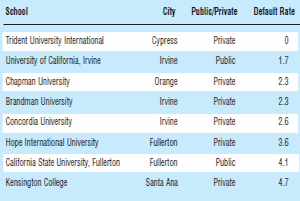
Default rates on student loans for graduates of Orange County colleges and universities offering MBAs are much lower than the national average, according to a recent report from the U.S. Department of Education.
Default rates for schools that are based here and offer MBAs ranged from zero to 4.7%, according to the federal agency (see chart, left).
The average default rate is 8.8% nationally and 8.4% statewide.
The data is based on all students with federally back student loans who entered repayment between October 2008 and September 2009 and had defaulted by the end of September 2010.
Individuals are considered in default if they fail to make payments for nine months.
The zero mark locally was recorded by Trident University International, which specializes in students from the military.
Kensington College in Santa Ana had the highest default rate among schools based here at 4.7%, half the statewide rate and less than half of the national figure.
This year marked the first time Brandman University in Irvine appeared on the Department of Education report.
The student loans issued to Brandman students had previously been considered along with others for Chapman University in Orange.
Independent Consideration
Brandman remains part of the Chapman University system but now operates independently and is considered separately by the federal agency.
Brandman Chancellor Gary Brahm called the default rates an “accurate gauge” of the value of a school’s education.
“As a result of your education, you were able to pay back the money you needed to borrow,” he said. “A lot of times, as a result of financial difficulty, the rates are big.”
A total of 49 colleges, universities and other schools based in Orange County—a group that ranged from the University of California, Irvine, to some that offer non-degree training in cosmetics— were listed on the Department of Education’s recent report.
The average default rate for all schools here was 8.1%.
Increased Scrutiny
Default rates on student loans have drawn increased interest in recent years, especially among students studying for two- and four-year undergraduate degrees or vocational certifications at for-profit colleges.
A wave of higher default rates that began to appear during the recent recession prompted federal regulators to bring new scrutiny to for-profit schools.
Federal regulators deemed that too many students at for-profit schools were taking on too much in loans compared to their prospects for graduation and employment.
A report by the Education Trust, a nonprofit research group, showed that at the onset of the recent recession, the median debt at graduation for bachelor’s degree recipients at for-profit schools was $31,190, compared with $7,960 at public schools and $17,040 at private, non-profit schools.
New rules on student loans are now in place, including new restrictions on how they are offered as part of efforts to recruit students.
Public colleges and universities have seen fewer problems in general, in part because many offer relatively lower tuition rates for residents of their states.
That has remained the general case despite significant increases on in-state tuition rates for students in the University of California and California State University systems as well as many community colleges.
