It was a good fiscal year for the endowments of many charities.
They’re reporting returns of 12% to 14% for the 12-month period that ended in June, according to Debashis Chowdhury, president of Canterbury Consulting Inc., a Newport Beach firm that advises many endowments.
Still, the charities aren’t popping champagne bottles and expanding their budgets. That’s because in prior fiscal years, many reported returns that declined 1% to 4%, he said.
“People are aware that market values are at all-time highs,” Chowdhury said. “It hasn’t led to euphoria and irrational decision making that you saw in prior economic cycles, which is a good thing.”
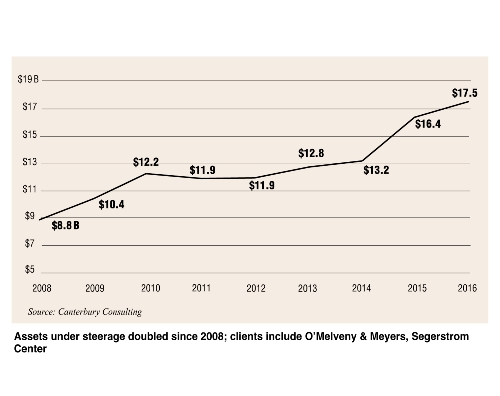
Canterbury Consulting itself is on a streak when its assets under advisement have doubled to $17.5 billion since 2008. The firm, which has an office at Fashion Island near bond giant Pacific Investment Management Co. and insurance giant Pacific Life, provides advice to charities and wealthy families on where to invest their money.
Clients include well-known endowments like the San Diego Museum of Art, the Roman Catholic Diocese of Orange and the Arnold & Mabel Beckman Foundation.
“Canterbury is clearly acknowledged as one of the leaders in their field, particularly for not-for-profit performing arts groups,” said Terry Dwyer, president of the Segerstrom Center for the Arts, which has $62 million in assets.
“They provide an exceptional level of consulting. They have a rigorous investment process that our investment committee is comfortable with.”
Focus on Investments
Canterbury was founded in 1988 by Bob Cluck, Al Beimfohr, Ken Krueger and Garth Flint. Cluck remains chairman, while Krueger left last year and is now on the board of directors at Terra Tech Corp., a cannabis-focused agriculture company. Beimfohr died in 2012. Flint, with his daughter Shannon Eusey in 2002 formed Beacon Pointe Advisors, a Newport Beach-based wealth manager that now manages $9 billion in assets.
The firm has 56 employees altogether, 16 of whom are owners.
Cluck, co-author of “Asset Management for Endowments & Foundations,” serves as treasurer for the United Cerebral Palsy Foundation of Orange County and as chairman of the investment committee at the University of California-Irvine Foundation.
Canterbury’s clients, which range from $10 million to $1 billion in assets, hire the firm because they may not have the in-house experience to find good investments, manage portfolios or know when to shift asset allocation, Chowdhury said.
“Our tagline is we focus on your investments so you can focus on your mission,” he said.
Chowdhury, who has been with the firm for 15 years, is on the boards of the Child Abuse Prevention Center of Orange County and the Mission Hospital Foundation. Canterbury has also benefitted when board members of hospitals and museums see its work and transfer their family wealth to the firm, he said.
$17.5B Attention Getter
The firm prides itself on providing only investment advice while other financial firms may offer their own products, like mutual funds, a practice that creates conflicts of interest, Chowdhury said.
“One of our unique features is being completely independent. “There is full transparency on what you own, what things cost and why we would recommend anything to the client. Those three features are not something consistently we hear from our clients when dealing with other firms.”
Canterbury’s fee is generally about 20 to 50 basis points of the typical 1% annual fee charged to manage an endowment or family office fund, he said.
It allocates $17.5 billion into about 100 different firms all over the world. Among its recipients are Robeco Group’s Boston Partners, Diamond Hill Capital Management Inc. of Ohio, Dodge & Cox of San Francisco, Aberdeen Asset Management PLC of Scotland, and Capital Group and TCW Group Inc.’s Metwest, both of Los Angeles.
“We’re more than large enough to get the attention of virtually every investment manager in the world,” Chowdhury said. “Most investment managers love our types of clients. Family office and foundation clients are the good, high-quality, sticky type.”
Then there is neighbor PIMCO; Canterbury has about 6% of its assets there, about $1 billion. That percentage is “considerably less” than five years ago, as Canterbury has diversified away from bonds due to concerns about rising interest rates, Chowdhury said.
Follow the Talent
In his role as president, Chowdhury oversees the firm’s strategy, consulting, investment research and business development.
When he’s looking for a portfolio manager, he wants to see performance of three to five years or more in all types of environments, such as an oil shock or a credit crisis. He particularly keeps his eye on talented portfolio managers who can move from firm to firm.
“We tend to follow the talent, figuratively and literally. If the talent moves, chances are we recommend the clients move their capital with them.”
He is cautious about trends, such as passive investments that have lower fees and have beaten active managers.
“When someone says active management is dead, it’s not. It had a tough go for a long time, particularly if you were a large-cap equity manager.”
He said about 90% of active managers have beaten passive indexes in the first six months this year. It’s why he recommends passive investments for large-cap U.S. stocks and active managers for other investments, like bonds, small cap and emerging markets.
Allocation Strategy
He recommends allocating 50% to 70% to equities, 15% to 30% to fixed income, and zero to 20% to private equity.
Since U.S. stocks have climbed so much in recent years and are trading at multiples higher than normal, Chowdhury advises cutting U.S. stocks from as high as 80% to about 55% of an equity sector, and boosting stocks in other developed nations to around 30% and emerging stocks to around 15%.
“We have become wary about these historically high valuations” in the U.S., he said. “That led us to allocate to the rest of the world, which if nothing else, is trading at much lower valuations.”
He suggests bond holdings be one-third core U.S., one-third global, and one-third “opportunistic” sectors, like mortgage-backed securities, high-yield bonds and bank loans.
He is cautious about private equity because there has been “a herd” stampeding into this sector in search of higher returns.
Challenging Conversations
A difficult discussion is to temper expectations of clients who are accustomed to annual growth near 10% and instead should plan for around 6.5%, he said.
“The days of getting to that 8% to 10% return scenario are academically difficult to pencil,” he said. “It leads to very challenging conversations with clients.”
For now, the solid fiscal 2017 returns haven’t made clients euphoric because they realize the returns may not last, Chowdhury said.
“People aren’t doing stupid things. They’re not indiscriminately buying assets and levering things up. Behaviorally, things are much better than the euphoria of 2006-07 or the late 1990s.”