

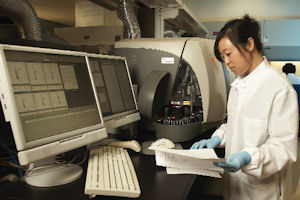
The chief executive and operations of Clarient Inc. are set to stay in Aliso Viejo after General Electric Co. wraps up its $587 million buy of the cancer testing company.
“I’m going to stay and be the head of the business unit,” said Ron Andrews, who has been with Clarient since 2004 and oversaw its transformation from a microscope maker to a provider of cancer diagnostic services.
GE Healthcare, a Britain-based unit of Fairfield, Conn.-based GE, is expected to wrap up its buy of Clarient by the end of 2010 or early 2011.
After the deal closes, Clarient is set to be known as Clarient, a GE company.
GE Healthcare, which has annual sales of about $17 billion, is buying Clarient to help it build a $1 billion-plus yearly diagnostic business centered on cancer and other conditions.
Clarient provides cancer testing to pathologists, oncologists and drug makers. Hoag Memorial Hospital Presbyterian in Newport Beach is a client.
The company wasn’t looking to sell itself, according to Andrews.
“You never know when the right time to exit a business is,” he said. “But we knew that we wanted to exit with a partner that would keep Clarient intact and that had a vision similar to Clarient’s vision that would allow us to advance the science of managing cancer.”
The sale to GE creates “amazing stability for my employees” and “a great exit for my shareholders,” Andrews said.
The deal wasn’t a surprise, said Matt Dolan, an analyst with Newport Beach-based Roth Capital Partners LLC.
“We believe the company has generated a fair amount of strategic interest recently,” Dolan said in a note after the deal announcement.
Dolan said he believed Clarient had other undisclosed potential suitors, “but we expect the deal to go through at this valuation.”
GE’s offer values Clarient at 34% more than it was worth before the deal was announced.
Andrews said he couldn’t address whether Clarient had other suitors until Securities and Exchange Commission documents on the deal are filed.
Analyst Bruce Jackson of New York’s Morgan Joseph LLC said in a report that the deal was valued at about 3.6 times Clarient’s projected 2011 revenue of $141 million, “which we believe is about right for a company with 22% revenue growth.”
A Clarient competitor, Genzyme Genetics, recently was sold by Cambridge, Mass.-based Genzyme Corp. to North Carolina’s Laboratory Corporation of America for $925 million, or about 2.5 times its 2009 revenue of $371 million.
Profits
Clarient recently became profitable, which Andrews said led to interest in the company.
It posted a profit of $942,000 in the second quarter on sales of $28.7 million. Third-quarter results are due soon.
“When we got profitable, we got popular all of a sudden,” Andrews said.
Clarient should benefit from being part of GE Healthcare, according to Andrews.
The company plans to start operations on the East Coast, in Europe and maybe in Asia, he said.
“Those are realities now that probably would not have been realities for three to five years had we not done the deal with GE,” Andrews said.
Clarient also plans to “populate its pipeline” of cancer test candidates with GE’s backing, according to Andrews.
The company is looking to grow in the breast, colon, lung, prostate and ovarian cancer testing markets.
Clarient stands to see minimal job cuts, Andrews said. The company now has 405 workers, nearly all of whom are in Orange County.
Clarient was founded in 1993 as ChromaVision Medical Systems Inc. and made laboratory instruments that doctors used to help manage breast cancer cases.
ChromaVision came close to running out of money in 2003, prompting a business shift.
At that time, Safeguard Scientifics Inc., an investment company in suburban Philadelphia, took a majority stake in Clarient and brought in Andrews, who previously worked for Hoffman-LaRoche Ltd.
His team oversaw the evolution of the company, including the name change to Clarient.
Safeguard now owns about 26% of Clarient and is set to see $145 million from the sale.
