

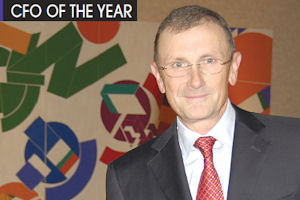
Charles Slacik of Beckman Coulter Inc. pulled off one of the largest deals by an Orange County company last year, in the wake of a financial crisis nonetheless.
Slacik, Brea-based Beckman’s chief financial officer, lined up financing for the company’s $800 million buy of Olympus Corp.’s medical diagnostic unit, a deal that closed in August.
He oversaw a $750 million bond and stock offering and a refinancing and expansion of Beckman’s $350 million credit line at a time when investors and banks still were nervous about any type of financing.
Beckman’s stock and debt offerings were among the largest locally in the wake of Wall Street’s meltdown of late 2008 and early 2009.
Investors first balked at the stock offering, slamming Beckman’s shares. But Wall Street soon warmed to the idea with a steady rise in Beckman’s shares after.
Beckman, which makes machines and chemicals used by medical testing laboratories and researchers, had a market value of $4.5 billion last week.
The bond offering was pulled off with no impact on Beckman’s investment-grade credit rating.
“For mid-cap companies like us, it wasn’t easy to either issue debt or stock,” Slacik said.
He called the Olympus deal the most challenging of his career for several reasons, including “uncertain financial market conditions.”
But even that wasn’t the hardest part, according to Slacik. Beckman was “always worried it wouldn’t happen because of the complexities of negotiating with a Japanese company.”
Cultural differences and worries about what would happen to employees of the Olympus unit were nuances that took months to negotiate, he said.
Slacik’s role in the deal earned him the Public Company Award at the Jan. 27 CFO of the Year awards presented by the Business Journal and the Orange County and Long Beach chapter of the California Society of Certified Public Accountants.
Slacik has been Beckman’s financial chief since late 2006 and oversees the books of a global company with more than $3 billion in yearly revenue and 10,000 employees. He’s also in charge of the company’s information technology.
Slacik played a big role in selling the acquisition to banks, rating agencies and investors. He said he stressed that buying the Olympus unit was a “tuck-in acquisition.”
“The business that we were buying from Olympus was a lot like our own,” Slacik said. “As a result, we could take all the additional revenue—half a billion dollars—and tuck those products right into our current portfolio.”
Pulling off the deal after the financial meltdown may have seemed dicey, but Slacik said the buy was low-risk for Beckman.
“We weren’t going into a new business that we were unfamiliar with,” he said.
Beckman’s sale of about $250 million in stock did rattle Wall Street when announced in May. Investors usually balk at stock sales since they tend to water down Wall Street’s favorite number, profits reported on a per share basis.
Slacik and other members of Beckman’s financial and investor relations teams did road shows in New York, Boston and Chicago, talking to investors, analysts and money managers.
“In those uncertain times a year ago, it was important for them to understand that it was not a high-risk acquisition,” he said.
During meetings, Slacik said he and others used the similarities between the businesses and the deal’s likelihood to add to profits to convince them to support it.
Beckman did manage “to convert just about everybody,” he said.
“We were able to hold on to all of our most important shareholders, the big fund managers,” Slacik said.
Slacik’s road trips also included visits to debt rating companies Moody’s Corp., Standard & Poor’s Financial Services LLC, a subsidiary of McGraw-Hill Cos., and Fitch Ratings Inc.
Cash Flow
Beckman had to show that the cash flow from the Olympus deal would be adequate to pay back debt, Slacik said.
During the meetings, Slacik outlined how Beckman’s cash flow had changed since 2005, when it altered the way it accounts for leases of its instruments to spread revenue over the life of a lease, rather than recognizing the value all at once.
That got rating agencies comfortable with the deal, according to Slacik.
He said Beckman also got high marks from ratings agencies and bond buyers because of what he called a “conservative view of financing.”
“We weren’t just borrowing all of the money,” he said. “In our case, we were using our own cash, plus we were issuing shares for another $250 million.”
About 60% of the deal was financed with debt, according to Slacik.
Slacik took the wheel at Beckman when Chief Executive Scott Garrett and others were in Japan working on the deal, according Bob Hurley, Beckman’s senior vice president of human resources, who now is overseeing the integration of the Japanese operation.
“Charlie Slacik was more the guy who was kind of holding down the home fort while we were doing the negotiating,” Hurley said.
Hurley, Paul Glyer, Beckman’s senior vice president of business development, and senior vice president and general counsel Arnold Pinkston were the primary negotiators of the Olympus deal.
“Their job was negotiating the deal, and my job was finding the money to pay for it,” said Slacik, who said he’ll be going to Japan for the first time in March.
Garrett’s job was “quarterbacking the whole thing,” he said.
Slacik, 55, is a University of Connecticut alumnus who came to Beckman after serving as senior vice president and financial chief with Watson Pharmaceuticals Inc., a drug maker in Corona that was founded by Allen Chao, an Anaheim Hills resident.
Watson finished a $2.5 billion deal for drug maker Andrx Corp. of suburban Miami just when Slacik left for Beckman.
His career also includes a stint at drug maker Wyeth, now part of Pfizer Inc., where he helped work on a $9.4 billion deal for New Jersey-based chemical maker American Cyanamid Corp.
