

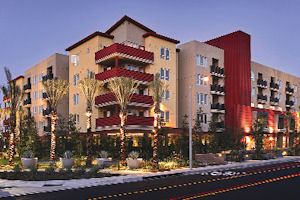
Granite Court in Irvine is a modern looking, four-story, ecofriendly building with 71 apartments.
It has underground parking, a computer lab and a staffer who helps kids with their homework at the community center.
Rent for a three-bedroom apartment at Granite Court: $1,050 a month, or about 20% less than the county’s average apartment rent of $1,350.
Granite Court, which opened last year, is an affordable housing development for families earning 30% to 60% of the county’s median income of about $60,000.
Complexes such as Granite Court are the hallmark of Irvine-based Jamboree Housing Corp., one of the largest nonprofit housing developers in California.
“Our construction and our quality is just as good as a for-profit building,” said Mark Hoover, a Jamboree board member and a vice president and sales manager for Santa Ana-based First American Corp., a provider of title insurance and business data.
Jamboree has developed 6,000 apartments and condominiums at 70 complexes valued at more than $2 billion. It is the No. 2 affordable developer after San Francisco-based Bridge Housing Corp., which has built about twice as many homes.
Jamboree builds and manages affordable housing for cities and developers, such as Aliso Viejo’s Shea Properties, part of Walnut’s J.F. Shea Co., and Miami-based Lennar Corp., which runs much of its day-to-day operations from Aliso Viejo.
Under state law, cities—and developers by extension—have to provide affordable housing. They often turn to nonprofits such as Jamboree Housing to handle projects.
Jamboree has to propose, push through and build its projects just like any other developer.
“If you don’t build high-quality housing, you’re not going to get your next development approved,” said Laura Archuleta, president of Jamboree Housing. “If you don’t manage it well, you’re not going to get your next development approved.”
Jamboree’s board includes executives who have day jobs in development, banking and title insurance, as well as an interest in affordable housing.
The board is in the process of expanding from 10 to 12 members. There’s also a new advisory board.
The board isn’t “high-profile,” Archuleta said.
Members, who include Union Bank NA Vice President Richard Amerian and Patrick McCalla of Costa Mesa law firm Rutan & Tucker LLP, aren’t tapped to raise money.
“They keep us conservative,” she said. “Development is always going to be risky. They oversee our financial investments.”
The difference between Jamboree and a for-profit developer is in the way projects are financed.
“The financing is the most complicated,” Archuleta said. “But it makes it affordable forever.”
Because of the complex financing, for-profit developers often hire Jamboree to handle the affordable housing portion of a larger project.
“Over the past 20 years, we’ve gained experience leveraging funding sources,”
said Michael Massie, housing development manager.
Jamboree taps a combination of federal, state, city and county funds, and commercial loans. It starts by applying for the federal Low-Income Housing Tax Credit, in place since the mid 1980s, Massie said.
“It’s a hugely successful vehicle for the production of affordable housing,” he said. “It’s responsible for the vast majority of affordable housing that goes on in the country.”
Public support accounts for about $4 million of Jamboree’s $14 million in yearly revenue.
Jamboree operates more like a social enterprise—a business set up to support a charitable or social cause—since it doesn’t solicit donations.
Instead, Jamboree makes money from business operations, collecting rents and fees for managing and developing.
The bulk of Jamboree’s revenue comes from rents, which are about $8 million a year. Rents support the operation of a complex and pay for long-term debt.
Once a complex is built, “the property sustains itself,” Massie said.
Since 2004, Jamboree has operated a more typical charity, Housing With Heart Inc., which now employs half of its 60 workers.
Housing with Heart provides a variety of onsite services for residents.
At one senior complex, a staff member helps arrange transportation, food delivery and doctor appointments. Other sites have English as a second language tutors.
“It’s as important to what we do as sticks and bricks,” Massie said.
Projects
Jamboree has projects in the works across California, including in San Bernardino, Comp-ton, Sacramento, Irvine, Brea, Buena Park and Huntington Beach.
Projects take two to eight years to finish, depending on how quickly financing can be secured.
“We do soup to nuts project management,” said Massie, who oversees nine people.
Teams are assigned projects that they see through, start to finish, he said.
Jamboree hires contractors, such as Irvine-based architect KTGY Group Inc., designer of Granite Court.
Founded 20 years ago, Jamboree’s growth has been fueled by housing prices that have put apartments and houses out of reach for many here, even with the downturn of recent years.
Government leaders see an economic benefit to keeping working people within a city, rather than having them commute from two hours away.
“The cities get it,” Archuleta said.
People shop where they live, boosting local tax revenue. Shorter commutes cut down on smog and traffic.
“It’s good to provide housing for your local workforce so they don’t have to be imported or bused in,” said Scott Riordan, redevelopment manager for Buena Park.
Demand for what’s known as workforce housing is high.
At Granite Court alone, the interest list is 4,000-people deep.
“Everybody is affected by it, especially living in Orange County,” said David Wood, board member and cofounder of Irvine-based Stratus Development LLC, a developer of apartments and commercial space.
Wood said his in-laws live in an affordable housing complex.
“The cost of housing is so high as a percentage of all your expenses,” Wood said.
But affordable housing isn’t always an easy sell to surrounding residents.
The biggest resistance to affordable housing development is the perception that it is welfare housing.
“This is for working people” such as teachers, firefighters and childcare workers, Buena Park’s Riordan said. “Often times, people don’t realize they qualify for affordable housing.”
Irvine, which lost a court challenge over the way the state allocates affordable housing last year, plans to have 10% of its 97,000 planned homes affordable by 2025. Irvine now has about 4,000 affordable homes.
Irvine also requires that its affordable housing projects be green, said Mark Asturias, housing manager for Irvine and executive director for the Irvine Community Land Trust, in charge of the city’s affordable housing.
Jamboree and Irvine are working on an $18 million, 60-apartment complex called Stone-gate, expected to start in November.
The city is loaning Jamboree Housing $2 million, contingent on it securing state funding.
Jamboree has expanded across the state, opening offices in San Diego and Sacramento, where its latest project is the renovation of an 80-year-old downtown hotel as single-resident apartments. It’s done 11 deals in Sacramento.
Jamboree received $20 million in federal stimulus funding for three of its projects.
“It literally took three projects that weren’t feasible and made them feasible,” Massie said. “These are the very definition of shovel ready.”
Founding
Jamboree, founded by Lila Lieberthal, started conservatively and took off about eight years ago.
Lieberthal, a housing advocate from the East Coast who came to Jamboree in her mid 50s, hired Archuleta 11 years ago and retired a year later. Lieberthal since has died.
When Archuleta took over, there were three employees, no accountant and $300,000 in the bank.
“We kept our checkbook in my right hand drawer,” said Archuleta. “We were a very small company.”
Archuleta grew the company by hiring people, who wanted flexible, part-time hours, typically women.
“We’ve grown by hiring very qualified wo-men who were looking for part-time work be-cause they were raising their children,” she said.
Its top three officials are women.
The pay is competitive, but still less than at a for-profit, she said.
“But we have a higher happiness level,” she said. “People come to work for Jamboree because they believe in the mission.”
