The fintech is also showing that a simple idea can become worth billions in just a few years.
The Irvine-based micro-investing app maker on May 27 revealed its intention to go public later this year, saying it has a $2.2 billion valuation.
That’s nearly three times its reported valuation from 2019, when it landed a $105 million Series E funding round and was approaching unicorn status.
The company is still very much in growth mode, company officials said last week.
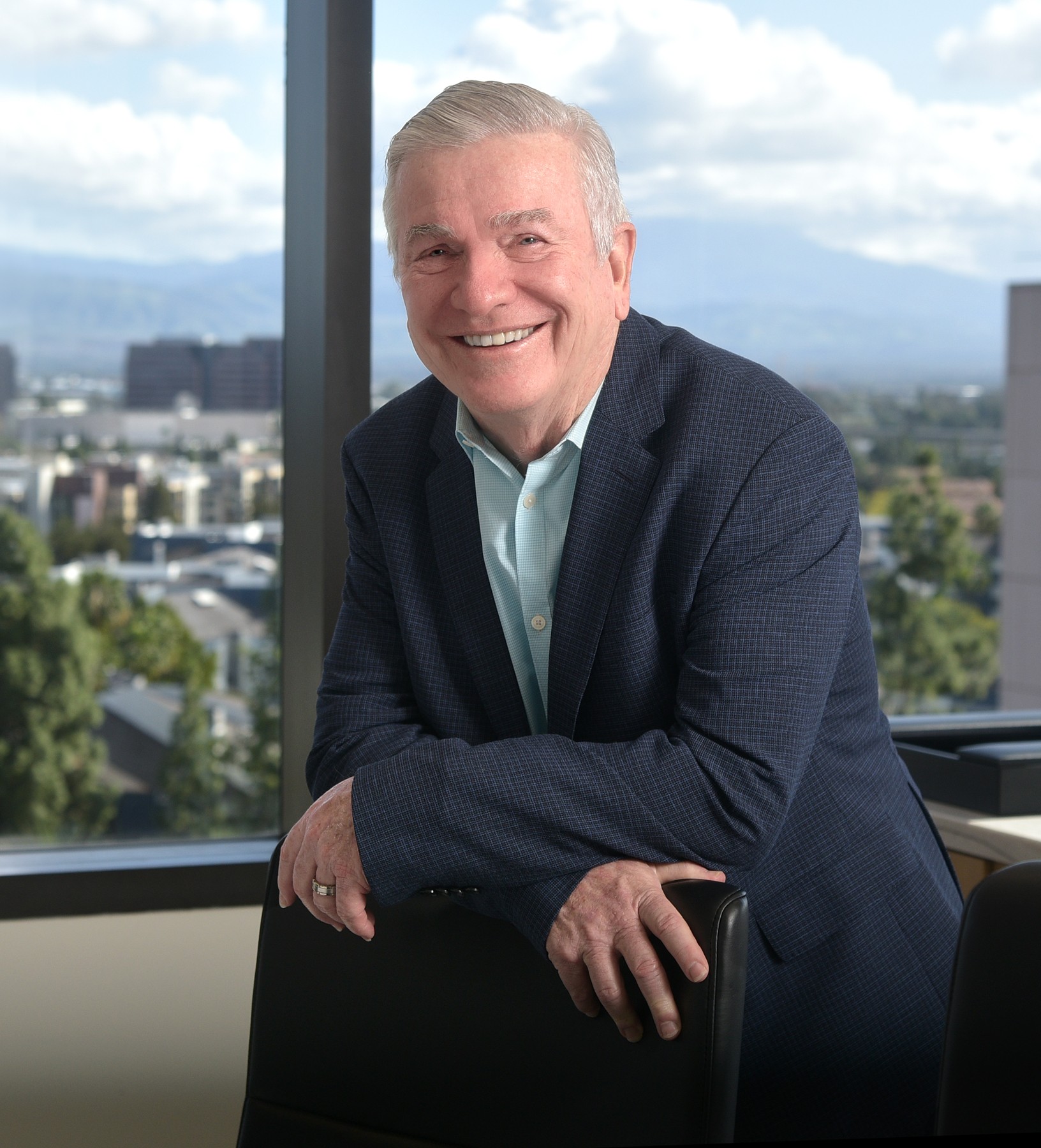
“We have to take the steps to get Acorns into the hands of as many people as possible,” Acorns Chief Executive Noah Kerner told the Business Journal.
“Going public will help spread Acorns.”
Public Co. Bonanza
Acorns joins a list of almost a dozen Orange County companies that have recently found success in the public marketspace, such as loanDepot Inc. (NYSE: LDI), Alignment Healthcare Inc. (Nasdaq: ALHC) and Vizio Holding Corp. (NYSE: VZIO), all of which now have multibillion-dollar valuations.
It also marks Orange County’s increasing influence in financial markets. Newport Beach’s United Capital Financial Partners Inc., which Joe Duran began in 2005, was sold for $750 million to Goldman Sachs in 2019. Both venture capital Toba Capital and private equity investor Carrick Capital have climbed to more than $1 billion in assets under management, adding to the ranks of local finance powerhouses.
It’s also the latest hit from well-known local finance entrepreneur Walter Cruttenden, the founder of the predecessor of Roth Capital, Orange County’s largest investment bank.
Cruttenden and his son Jeff Cruttenden created Acorns and launched its first product in 2014.
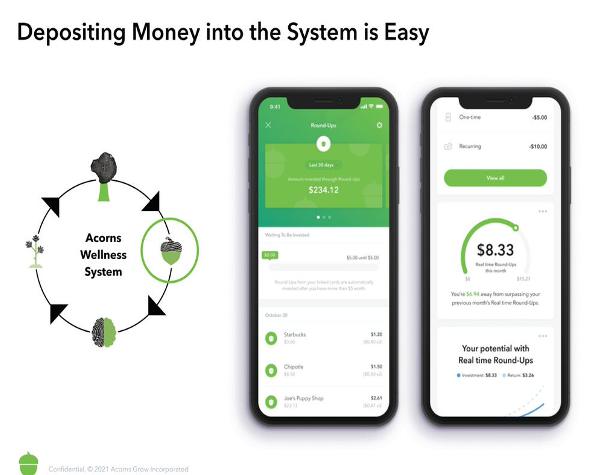
Its initial products helped consumers automatically invest spare change from everyday purchases into diversified exchange-traded fund portfolios. It’s since expanded its suite of products to offer advice, education and other banking tools.
“Being public opens new growth opportunities and allows for more ways to serve and reward our customers,” Walter Cruttenden told the Business Journal. “Just as a Goldman Sachs or a Schwab provide a unique investment service so does Acorns provide a remarkably easy way to get started with a professionally managed account.
“Big hats off to Noah and his team. Looking forward to the next chapter.”
4M+ Subscribers
Paperwork filed with the Securities and Exchange Commission late last month reveals that Acorns is on a hot streak.
It currently has $4.74 billion in assets under management with more than 4 million subscribers.
Wall Street investors will like its growth rate and gross margins, as well as its ability to retain customers, Kerner predicted.
“We’re the largest consumer financial subscription service today,” Kerner said. “Our customers are very sticky.”
The company predicted revenue will grow from $71 million last year to $126 million this year and then almost triple to $309 million by 2023.
It’s also aiming to double the subscription base to 8 million subscribers by 2023 and then 10 million by 2025.
The company has three membership levels: Lite, $1 per month, which includes basic investing, education, and earning tools; Personal, $3 per month, which adds retirement, banking, and smart deposit tools to invest and grow more; and Family, $5 per month, which includes all individual products plus Acorns Early—investing, education, rewards, and gifting for the family.
The SPAC Route
Acorns is going public through a process known as special purpose acquisition company, or SPAC, which is considered an easier way to go public than traditional IPO methods. It’s a hot sector where about 260 so-called blank-check companies with about $87 billion are searching for merger candidates over the next two years, according to data from SPAC Research.
“We were approached by a lot” of SPAC representatives, Kerner said.
It will combine with Pioneer Merger Corp. (Nasdaq: PACX), which is affiliated with the hedge funds Falcon Edge Capital and Patriot Global Management.
Kerner said a big reason for picking Pioneer was its chairman, Jonathan Christodoro, who has experience taking about a dozen companies public and has served on the boards of notable companies like eBay, PayPal and Lyft.
“Acorns is a rare opportunity to change the long-term financial trajectory of millions of people with a strong platform, a trusted brand, and compelling operating metrics,” Christodoro said on a conference call late last month.
Pioneer has some local ties. One of its board members is Mitchell Caplan, 63, who is president of Tarsadia Investments, a multibillion-dollar family office that invests in hotels and other sectors with headquarters on Newport Center Drive. Previously, Caplan was CEO at E-Trade, where he led approximately 15 strategic acquisitions and subsequent integrations.
Walter Cruttenden founded and previously served as CEO of the investment banking arm of E-Trade.
Another Pioneer Merger director is Todd Davis, the co-founder and former CEO of identity protection firm Lifelock, and the current chairman of Newport Beach’s Kadenwood LLC, an upstart firm which sells a variety of cannabidiol-based consumer products.
Acorns has impressed investors such as BlackRock Inc. and Comcast Corp., which has brought along a partnership with business channel CNBC. The company’s raised about $277 million in funds to date.
Other investors and advisers include two Nobel Prize winners, the wife of the publisher of the New York Times and Hollywood stars like Jennifer Lopez and Dwayne Johnson.
“It’s basically a tip jar for your spending,” said another actor-investor in the company, Ashton Kutcher, when describing Acorns.
The company plans to trade on the Nasdaq under the ticker symbol “OAKS.”
Cash Flow Negative
It hasn’t yet generated positive cash flow and expects to lose $71 million this year on an adjusted EBITDA basis, which should fall to a $41 million loss next year. Cash was $41 million in 2020, which should rise to $471 million this year after going public.
Its prospectus says it’s priced “attractively” at 7.7 times its 2022 estimated revenue. Among its peers are Square, Afterpay and MoneyLion.
Acorns will use the proceeds from going public for marketing and hiring. Kerner said he has no plans to expand its current Irvine office as the company is working a hybrid model that includes continuing to allow employees to work from their homes.
He said part of the funds raised may help acquisitions. Earlier this year, it acquired Pillar, which helps students manage loan debt, and Harvest, which shows consumers how much they pay in interest payments and fees to financial institutions and helps them renegotiate lower rates.
The acquisitions are “a vision to accelerate the development of our higher tiers” that provide more services, Kerner said. “Ultimately, we want to take Acorns global.”
He also plans to donate 10% of his personal stake in Acorns to fund a program to give shares to its customers. He declined to say how much that 10% is worth, except to say it’s a significant amount.
“I believe deeply in ownership—I love the idea,” he said. “Our goal is to become the largest retail-owned investment company. I want to lead by example.”