

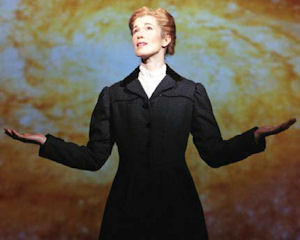
“Silent Sky” is a small production about a very large subject—the universe.
It is a biography of Henrietta Leavitt, a brilliant young astronomer who labored as a “computer” at 25 cents an hour charting countless stars from photographic plates taken by Harvard University’s telescope. Then she made an amazing discovery: Her “period luminosity relationship,” which helped scientists determine how to measure distances to stars.
Who would write such a play? Lauren Gunderson, a bright and talented young playwright who revels in discovering and bringing to life unknown women of science.
“Lauren finds these women who played important roles in science and reveals not just the work they did but who they were as people,” said South Coast Repertory Producing Artistic Director David Emmes. “She’s brought them back to life as fully formed characters that we care about and want to follow on their journeys.”
South Coast Repertory’s world premier of “Silent Sky” tells the tale of how a young Massachusetts pastor’s daughter with a burning desire to be a scientist leaves her home and family in 1895 to accept the tedious job at Harvard’s observatory.
While mapping the skies at night, she meets and falls in love with Peter Shaw, the head apprentice to the renowned professor Edward Charles Pickering. Leavitt and two other women working as “computers” become known as Pickering’s “harem” and bond together in a male dominated world.
Monette Magrath stars as Leavitt with a mix of South Coast Repertory newcomers and veterans. She well captures the burning fire and torments of our heroine. Her love interest is an affable Nick Toren (“The Elephant Man” on Broadway) as Shaw.
Pickering’s first “computer,” is wonderfully played by South Coast Repertory veteran Amelia White as someone who seems just as comfortable topping off a pint of Guinness as mapping the heavens.
Annie Cannon, played by Colette Kilroy (“The Profiler”), is the leader of this scientific suffrage society. Erin Cottrell (“The Giving Light”) plays Leavitt’s talented musical sister, who remains home and serves as the counterweight between a life of science and the more traditional one of home and family.
Director Anne Justine D’Zmura neatly orbits the cast around Leavitt and keeps the story illuminating and humorous. The Spartan set, created by John Lacovelli (recently of the sci-fi series “Babylon 5”), creates a dome-like motif offering a glimpse into the heavens, much like the observatory itself. With Leavitt’s discoveries finally recognized and her place in history secure, fate takes a harsh turn and removes her from this planet like a white dwarf before her time. Prior to her departure, she finally is able to do what few women had done before—gaze into the heavens through the university’s magical telescope in a closing sequence reminiscent of Stanley Kubrick’s “2001: a Space Odyssey.”
—Robert Palmer is a lawyer with Gibson, Dunn & Crutcher LLP in Irvine and an arts buff.
