

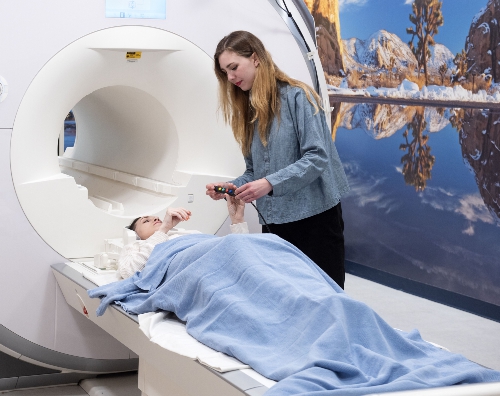
University of California-Irvine in 1964 was the first department of neuroscience in the U.S., which meant it was first to be studying the brain in an academic setting.
Now, the university has launched the UCI Brain Initiative to become a global leader in brain science.
The school describes UCI Brain as a “moonshot” that builds upon its neuroscience-related efforts over the decades. A stated goal of the initiative is “to define and expand the horizons of brain research.”
It’ll be an interdisciplinary academic effort, bringing together researchers who may not be aware of the research going on in other departments at the university, which has about 25,000 employees and 37,000 students.
“We have so much neuroscience spread out throughout the campus” that UCI needs more centralization, according to Michael Yassa, director of the UCI Brain Initiative.
UCI already has many million-dollar projects involving the brain. Its researchers in 2019 received about $40 million in federal funding in addition to the $60 million it received in 2018.
Among its brain research is $10 million to study Alzheimer’s disease, by Dean Frank LaFerla; a $16 million renewal of a psychiatric study on childhood adversity by Tallie Baram, and $5.6 million for research into Huntington’s disease by Leslie Thompson. Daniele Piomelli, chairman of the Center for the Study of Cannabis, received a $9.5 million grant to study the effects of cannabinoids, including in the brain, on teenagers.
700 Attendees
Rather than being in a certain department, the Brain Initiative is in the Office of Academic Planning, which reports to the provost.
Each year, the provost selects projects that address some of the world’s “grand challenges” and awards them $150,000 a year for up to three years.
A signal of the seriousness of the Brain Initiative was that about 700 faculty, students, and community members attended its launch event held in November.
UCI Brain will use some of its funding to sponsor interdisciplinary teams with early-stage and proof-of-concept projects. At the launch, it announced $25,000 in pilot grants for these teams, which must include at least two disciplines.
The themes of research are as broad as the applications of the brain itself, such as how illnesses and sleep affect the brain.
Another theme is called the computational brain and it has to do with artificial intelligence.
“The Brain Initiative was this idea that we can bring all these things under one umbrella,” Yassa said.
Yassa, who is also the director of the school’s Center for the Neurobiology of Learning and Memory, has been working on improving the graduate curriculum and renovating the department’s labs.
Yassa noted that the social brain is of unique interest to him, including a theme of leadership. The research may help employers more accurately predict employees in lower-level positions who would be most suited to upper-level leadership, he said.
Heart-Brain Connections
Researchers are studying how heart rate variability (HRV) interacts with specific types of brain waves.
Yassa said his team has successfully created an HRV wrist monitor capable of discerning those measurements for their research on creativity for this project.
“The neuro basis of creativity—how do you understand and appreciate works of art? How do you use that information from neuroscience to improve the artist’s craft?” The research project hopes to provide a foundational basis for the process of creativity and how to better express it. UCI’s Claire Trevor School of the Arts is involved.
The Brain Initiative is also looking into memory and cognition, sleep disorders and function of memory in sleep.
Alzheimer’s Work
Yassa, who was trained in psychology and neurobiology with degrees from Johns Hopkins University, as well as UCI, has also worked on a project that studies the effects of exercise on Alzheimer’s disease.
The result was that moderate exercise—not over-exerting or intense fitness regiments—will improve the health of the brain and heart.
One of the best things an aging individual could do is go for a daily walk that’s longer than fifteen minutes, according to Yassa.
