

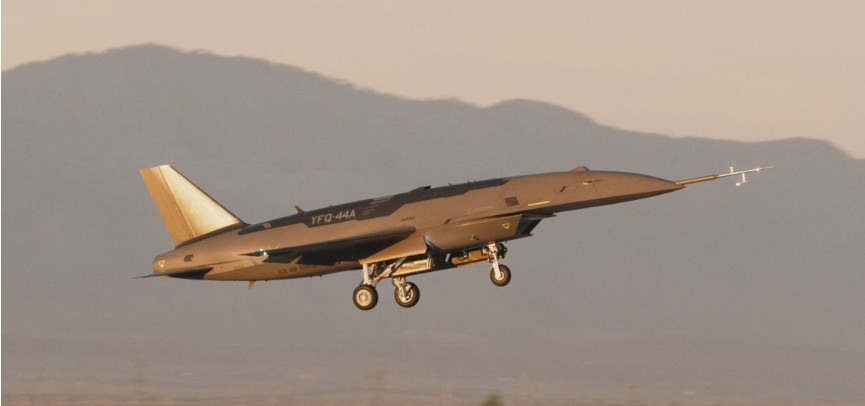
Defense company Anduril Industries says the first weapons to be built at its Ohio mega-factory will be prototypes of its unmanned combat jet, while the company is also developing high-tech attack vessels with South Korean shipbuilding behemoth Hyundai Industries.
And in yet another corner of the world. Anduril said on Nov. 13 that it will be building a new type of military drone for the United Arab Emirates.
It’s all just another step in Anduril’s weapons production ramp-up to meet the goals of the Trump administration, U.S. allies and the country’s defense partners.
Anduril’s autonomous, fighter-like aircraft, internally dubbed Fury, is designed to fly alongside traditional manned fighters, such as the F-22 Raptor and the F-35 Lightning. Anduril programmed it to make its own attack moves.
“Our investment in this aircraft is the driving force behind Arsenal-1, the 5 million square foot production facility that we’re building in Columbus, Ohio,” Anduril Senior Vice President Jason Levin said in a post on the company’s website on Oct. 31.
$2B Ohio Factory
Anduril said in January it planned to invest nearly $1 billion of its own money into Arsenal-1, though the total cost of the project over the coming years is expected to be far higher, possibly closer to $2 billion.
It is designed to eventually produce tens of thousands of weapons each year.
Construction of the factory comes at a time when military experts are increasingly sounding the alarm about the lagging U.S. defense industry. The Trump administration has promised to expedite the procurement of weapons.
Anduril’s leaders say the new aircraft—officially designated as YFQ-44A—is designed to secure a spot in the Air Force’s Collaborative Combat Aircraft (CCA) program. Its first test flight took place in late October.
“YFQ-44A will be the first program to move into the factory when its doors open, and we are on track to begin production of prototype CCA at Arsenal-1 in the first half of 2026,” according to Levin, senior vice president of engineering at Anduril.
As of early November, the U.S. Air Force was still evaluating flight test results of the Anduril aircraft and a rival CCA program candidate being developed by General Atomics of San Diego.
“Today, the U.S. Air Force made continued progress in our CCA program with the first flight of the YFQ-44A developed by Anduril,” the Office of the Secretary of the Air Force said in an Oct. 31 comment on the X platform. “This milestone shows how competition drives innovation & accelerates delivery.
“It also gives us the hard data we need to shape requirements, reduce risk and ensure the CCA program delivers combat capability on a pace and scale that keeps us ahead of the threat.”
It’s not clear when the Air Force will make a final decision on which company will receive the contract to start full-scale production. Neither the U.S. Air Force nor Anduril answered queries from the Business Journal.
Industry website DefenseScoop said on Oct. 31 that a decision is expected in 2026.
Hyundai Shipbuilding, UAE
In its quest to cover all possible defense areas, Anduril last week announced it is partnering with HD Hyundai Heavy Industries of South Korea to design and produce a new class of dual-use Autonomous Surface Vessels that will combine HD Hyundai’s legacy in shipbuilding with Anduril’s software.
“Together, the companies are developing a modular family of surface vessels for commercial and defense use, including a variant designed to meet the U.S. Navy’s needs under its Modular Attack Surface Craft (MASC) program,” Costa Mesa-based Anduril said in a statement.
The size of the vessels and expected entry into service were not announced.
Also on Nov. 13, Anduril said it is partnering with Edge Group of Abu Dhabi to develop a new autonomous drone known as Omen for the United Arab Emirates.
The UAE will acquire the first 50 uncrewed Omen systems, said Anduril.
“For Anduril, the joint venture creates a trusted production base in the Middle East, allowing systems conceived in California and built in Ohio to be designed, adapted, and manufactured in Abu Dhabi for regional customers,” according to Anduril.
Palmer Luckey May be Going Nuclear
Palmer Luckey, the OC mega-entrepreneur, is investing in a new type of small-sized nuclear energy reactor.
Startup Valar Atomics announced earlier this month that it had raised $130 million, with participation from various investors, including Anduril Industries co-founder Luckey and Palantir Chief Technology Officer Shyam Sankar.
The Series A round was led by Doug Philippone at Snowpoint Ventures and co-led by Day One Ventures and Dream Ventures, according to Isaiah Taylor, founder of El Segundo-based Valar, as stated on the company’s LinkedIn site.
Taylor said he expects at least one such Small Modular Nuclear Reactor SMR with advanced technology to be in operation by July 4.
“We want to pump these things out, like they’re a car, like they’re a bus,” Taylor told Bloomberg television as he envisions mass manufacturing.
Valar is one of several nuclear startups that hope to benefit from President Trump’s push to deploy new reactor technology in the U.S. by cutting regulations and accelerating approvals, according to CNBC television.
The U.S. Department of Energy selected Valar and 10 other developers in August to participate in a pilot program that aims to deploy at least three advanced test reactors by July 2026.
Valar’s business plan calls for the deployment of hundreds of small reactors at a single site, according to CNBC.
