

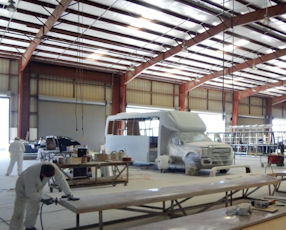
Newport Beach-based startup Green Automotive Co. has been plenty busy lately, thanks in part to recent orders for hundreds of shuttle buses to be delivered in two years.
The buses in production are designed to run on diesel and compressed natural gas, but Green Automotive has its longer-term sights set on becoming an electric vehicle maker.
Newport Coachworks
Meanwhile, the company has pushed along plans to move its headquarters by year-end to Riverside, home to its Newport Coachworks Inc. subsidiary and a 20,000-square-foot manufacturing facility.
Two people work out of the parent company’s Orange County office, while a team of four occupies the administrative office in Riverside, along with a workforce of 20 at the bus plant.
Newport Coachworks designs and manufactures limousine buses and shuttle buses, ranging in size from 14- to 52-seaters. Green Automotive acquired the unit in October for about $13 million following its $20.8 million purchase of U.K.-based Liberty Electric Cars Ltd. in July. Liberty Electric makes car parts, including products for converted vehicles.
Green Automotive said it’s counting on last year’s buys to help boost its profile in the niche vehicle sector, as well as to make headway in its efforts to manufacture and market all-electric and other “eco-friendly” vehicles in the U.S.
Newport Coachworks is working on orders from Johnstown, N.Y.-based Don Brown Bus Sales Inc. that call for 432 vehicles for delivery roughly by the beginning of 2015.
“Pleased”
“We’re pleased from the start,” said Ian Hobday, a director of Green Automotive and chief executive of Liberty Electric. “To meet these orders, [Green Automotive] has invested heavily in the most technically advanced machinery … [including] a full-length spray booth and oven for painting even the longest buses.”
The company delivered the first bus for Don Brown last month at a Greater California Livery Association meeting in San Diego. The Los Angeles-based nonprofit is an advocacy group for private limo and bus companies.
Hobday said Newport Coachworks is “in the phase of building molds for the rest” of the buses and expects “building in earnest” to kick off in June.
The Riverside facility has a production capacity of 500 buses a year, or potential revenues of $37 million, according to the company.
Shares of Green Automotive are traded over the counter, and the company has yet to report revenues from operations. It described itself as a development-stage company, with “negative working capital [and] negative stockholders’ equity,” on its latest quarterly financial document, which reflected operations for the three-month period through September. The company lost $10,441 that quarter.
Next Report
The next financial report is expected to show “significant” changes from a year earlier, the company wrote last month in a notification to the Securities and Exchange Commission. It said the company will file its 2012 full-year financial results late, in part because of the string of mergers and acquisitions in the second half of last year.
Deals also included a December merger with Matter of Time I Co., which had previously served as a shell company for Green Automotive.
In February, the company bought U.K.-based Going Green Ltd., an electric-vehicles retailer that bills itself as the largest in Europe. It also recently got $3 million in funding from Newport Beach-based institutional investor Kodiak Capital Group LLC.
Green Automotive has a market value of about $65.7 million.
The company looks to use sales of “normal-fuel” vehicles as a springboard to help fund its “electronic future,” Hobday said.
“We are a survivor in a marketplace where there have been a number of casualties in the electric car arena. We have … the requirements to develop zero-emission vehicles. And at the same time, for the company to be stable, we sell normal products.”
Makers of electric and hybrid vehicles have been subject to ongoing controversy over government funding that has played a role in the development of the sector. Some believe it’s a waste of money, while the Obama administration has invested about $2.4 billion to push its goal to put a million electric vehicles on the road by the end of 2015.
Fisker Automotive Inc. in Anaheim, for instance, recently drew nationwide attention with talk of its financial and production problems, and the U.S. Department of Energy recently seized the troubled automaker’s $21 million reserve account. Fisker got $192 million out of a $529 million loan the energy department granted in 2009 before the department suspended additional funding in 2011.
Newport Coachworks, though treading carefully, is hopeful on its development of all-electric vehicles, according to Hobday.
Shuttle Buses
It’s already working with Liberty Electric to build its line of all-electric shuttle buses. Construction of the first model, using “local suppliers,” is expected to start in Riverside soon and be completed by September, Hobday said.
Shuttle buses are “perfectly suited to be electrically powered,” he added. “By default, a shuttle bus is only going from point A to point B. As long as you can charge from A or B, you can operate this. The market for electric shuttle buses is … targeted at those …doing regular routes, like airport to hotel, or car-hire companies. In addition, as the technology becomes proven, we can imagine a strong demand from the school bus sector.”
