
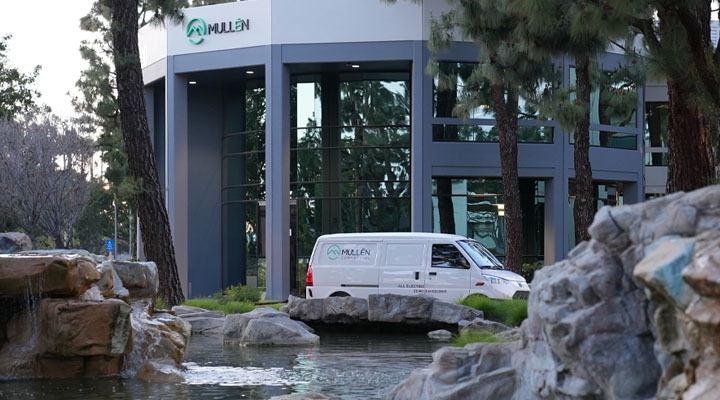
Mullen Automotive has tried for years to crack the code on manufacturing electric vehicles.
It introduced sporty models, then SUVs and eventually trucks. It went public in 2021 through a reverse merger when its market cap touched $300 million.
It announced deals like a battery factory in Fullerton and an agreement to sell its vehicles in the Middle East. It said it would accept payments in crypto currency.
Last year, it promised investors its revenue would jump from less than a million to $75 million within a six-month span while at the same time cutting its headcount. Short traders have long smelled blood and pushed down the shares 99%, forcing the company to issue seven reverse stock splits in the past two years.
The Brea-based EV maker has decided a new name might juice sales. On July 28th, it began operating under what was once its subsidiary, Bollinger Innovations Inc.
“Our transition to Bollinger Innovations goes beyond a simple name change,” according to David Michery, who was Mullen’s longtime chief executive and chairman and now has those titles at Bollinger.
“We are bringing our products and brands together under one strong and unified identity, ready to service the commercial vehicle industry.”
The company, which intends to keep its headquarters in Brea, said its name and stock symbol change have no effect on its legal structure or business operations.
A day after the name change, the company said it eliminated all warrants and $25.3 million of convertible notes to strengthen its balance sheet. The company said it entered into agreements with existing noteholders to exchange convertible notes and warrants into newly created preferred stock. It had total cash of $2.3 million on March 31.
On July 31, Bollinger announced another reverse stock split—1 for 250, effective Aug. 4. At press time, the shares traded at 61 cents and a $930,000 market cap (Nasdaq: BINI).
The Bollinger Name
Michery, who previously told the Business Journal that he spent decades in the entertainment industry, decided to enter the “eco-friendly car industry” by acquiring Mullen Automotive in 2012. The company went public in 2021 via a reverse merger with a share price of $12.
In 2022, Mullen bought a 60% controlling stake for $148.2 million in Bollinger Motors, another maker of EV trucks that was headquartered in Oak Park, Michigan.
“Mullen shares a similar dream to build the best EV cars and trucks,” Founder Robert Bollinger said at the time. “This partnership will bring us closer to making those visions a reality, as it allows us to ramp up production on our end and get Mullen’s EV programs to the market faster.”
In June, Mullen acquired additional interest in the EV truck maker bringing its ownership to 95%. The subsidiary had just exited a court-appointed receivership after founder Bollinger filed a legal complaint in March alleging a breach of contract related to a $10 million secured promissory note which was eventually resolved.
At the time, the parent said that “Bollinger will continue to operate as an independent majority subsidiary, maintaining its own brand identity and focus.”
The company will now be moving all Mullen commercial vehicle operations to Oak Park to eliminate redundancy and streamline operations, according to executives.
Founded in 2015, Bollinger Motors was also building Class 3 sport utility vehicles before pivoting to commercial truck development. Prior to the merger, Bollinger made its first customer delivery of B4 chassis cabs valued at nearly $500,000 in late 2024. These were also the company’s first finished vehicles to go to market.
“These essential measures position the company for growth in a challenging environment while working towards becoming cash flow positive,” Michery said in the statement.
Split Adjusted Share Prices
The long-promised revenue has been slow to materialize. For fiscal 2023, it reported $366,000 in sales and a $1 billion loss. Revenue climbed to $1 million in fiscal 2024 and a $506 million loss. It had an accumulated deficit of $2.3 billion as of Sept. 30, the end of its fiscal year.
At one point, the manufacturer had plans to make a passenger vehicle dubbed the Mullen FIVE Crossover but eventually eliminated the program in late 2024 to cut expenditures.
Its annual report showed 388 employees as of Sept. 30. It reported last month that since January, it had “eliminated 155 positions and reduced overall operating expenses by a minimum of $35 million annually.”
The company, which has seven commercial dealers, now builds electric Class 1-3 cargo vans and commercial trucks. It is also focused on developing battery technology at its Fullerton facility; production is slated to begin in early 2026.
The former Mullen One vans and Mullen Three chassis trucks will be rebranded as Bollinger vehicles next year. Bollinger is also planning to introduce a Class 5 truck in 2027.
In May, it posted fiscal second quarter results of $5 million in revenue compared to $33,000 a year ago driven by new customer activity. Orders ranged from one van to 20 trucks.
“This growth underscores the effectiveness of our strategic initiatives and increasing demand for our vehicles despite challenging market conditions,” Michery said.