

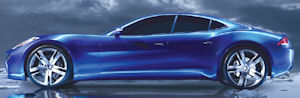
All roads lead to Anaheim-based Fisker Automotive Inc. when it comes to the electric- and hybrid-vehicle industry in Orange County.
The maker of hybrid luxury vehicles accounts for the lion’s share of employment, venture capital investment and manufacturing growth for the fledgling industry here, according to a report released last week by San Francisco-based advocacy group Next 10.
The report analyzed data from Orange County, Los Angeles, Silicon Valley, San Diego and the Bay Area.
The electric-and-hybrids market includes electric and hybrid cars, batteries and components, and charging infrastructure.
Fisker is the dominant entry in a field of vehicle makers, suppliers of vehicle components and venture capital firms investing in the industry here.
Others
The roster of other local companies includes powertrain supplier Quantum Fuel Systems Technologies Worldwide Inc. in Irvine and Costa Mesa-based T3 Motion Inc., which makes three-wheeled cruisers. There’s also a roster of niche players such as Electric Cyclery in Laguna Beach and Tustin-based armored-vehicle maker Mil-lenWorks Inc.
The sector here attracted more than $175 million in venture capital in 2010, according to the Next 10 report.
“The bulk of that [went to] Fisker,” said analyst Brian Kremer of Roth Capital Partners LLC in Newport Beach.
Fisker has secured an estimated $1 billion-plus in private equity investments, government loans and grant funding to date. It’s considered a candidate for an eventual initial public offering despite recent delays on delivering the debut edition of its Karma sports car (see Year in Review, page 9).
Fisker could be the next Tesla Motors Inc., according to Kremer.
Tesla
Palo Alto-based Tesla raised $226 million in an IPO last year, when it became the first U.S. automaker to go public since Ford Mo-tor Co. in 1956. Its share price has climbed more than 29% this year to a market value of about $3.6 billion (see related story, page 4).
About 1,800 people worked in the electric-vehicle industry statewide in 2010, up 142% from 1995. OC’s 200 industry jobs last year represented a 32% rise from 2004.
Car-part manufacturers marked a 75% rise in the six-year span, while employment at electric-car companies climbed 25%, according to the Next 10 report.
“Orange County is highly concentrated in motor vehicle components,” said Tracey Grose, vice president and director of research and strategic development at Collaborative Economics, a San Mateo-based consultancy that developed the report for Next 10.
The reports finding on OC employment has already been lapped by Fisker, which has added jobs steadily this year, employing about 600 full-time and contract workers in Anaheim, up from 150 at the beginning of the year.
The company began delivering its first model—the Karma luxury hybrid sedan—in October after some production delays. The Karma is built in Finland and totes a $96,895 starting price.
Quantum
Quantum—a big supplier of hybrid powertrains to Fisker—reported $13 million in quarterly revenue through October, up 233% from the year-earlier period thanks to in increase in orders from Fisker for hybrid drive systems. Quantum added 18 employees in the last year for a total of 123 workers, a spokesperson said.
Electric vehicle maker T3 earmarked most of the $12 million it raised earlier this year from investors for growth and expansion purposes.” The company employs about 55 people in Costa Mesa.
T3’s low-speed, three-wheel cruisers are used by security guards, police officers, dock workers and others.
The company has raised about $40 million through private investments, venture capital and public offerings.
Massachusetts-based Vectrix USA, part of Vectrix International Ltd. in Hong Kong, shifted its sales team to Lake Forest this year for proximity to OC’s talent pool and car-tech concentration. Vectrix also makes three-wheel electric vehicles and scooters for consumers, law enforcement and security personnel.
“Orange County is great place to hang our hat,” Vectrix marketing manager Jeff Simpson said. “There’s a tremendous amount of talent.”
Obstacles
The electric vehicle market still has obstacles to overcome including high costs for battery production, slow adoption rates, limited infrastructure and price points.
“I’m still fairly bullish, but people are a little more pragmatic, realistic now,” Roth Capital’s Kremer noted.
