

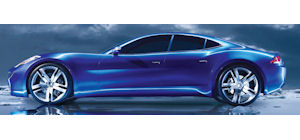
A battery defect that led to a testing failure last month in Fisker Automotive Inc.’s flagship luxury sedan will likely affect most existing owners and future buyers, the company said last week.
“We believe it will be the majority of customers’ cars,” said Roger Ormisher, global communications director for the Anaheim-based automaker.
Fisker had sold about 640 Karmas—a hybrid that’s priced at about $107,000—through last week. Another 1,000 or so models in the works are likely to be affected by the defective batteries, according to Ormisher.
Only a “handful” of cars have experienced the decreasing durability and performance that caused the problems during a test run of the Karma with Consumer Reports, a well-known national magazine.
Fisker last week said it would replace defective batteries for new and existing models if and when the problem occurs.
“It’s a long-term thing rather a recall issue,” Ormisher said.
The automaker also extended Karma’s warranty in the U.S. to five years, or 60,000 miles. That’s an increase of about one year and 10,000 miles.
Fisker has pulled back on any sales projections for this year. It had set a goal of 12,000 prior to the start of production on the Karma.
Critical Frenzy
The problem with the battery surfaced last month when a Karma died after 200 miles of drive time during the test run by Consumer Reports, sparking a frenzy of criticism from industry bloggers, company watchers and some politicians bemoaning government subsidies to the clean technology sector.
The “latent manufacturing defect” that apparently has caused the troubles was traced to a Livonia, Mich., plant run by A123 Systems Inc., Fisker’s lithium-ion battery pack supplier.
Not all of the Karmas that have been sold are equipped with a battery from the Michigan plant, according to Ormisher. He said about 15% of models sold so far, or some 96 vehicles, received A123 batteries from the Waltham, Mass.-based company’s plant in South Korea.
Fisker said it doesn’t believe batteries made at the South Korea plant are defective. The company hadn’t completed a check of how many of the batteries used in Karmas came from the South Korea plant as of press time, according to Ormisher.
Fisker was one of five customers that have been affected by the faulty battery, A123 Chief Executive David Vieau said in a conference call with analysts last week. The mishap will cost A123 about $55 million to replace battery modules and packs that may be defective, according to Vieau.
The mea culpa, coupled with a disappointing fourth quarter earnings report, sent A123 shares to a record low last week.
This is Fisker’s second manufacturing problem associated with A123’s batteries. In December the supplier warned of a potential coolant leak from misaligned hose clamps that led to the recall of 239 Karmas—and more bad press.
That problem has been fixed, according to the automaker.
Fisker chose A123 as its battery supplier in January 2010, ending a one-year deal with New York-based Ener1 Inc., which filed Chapter 11 bankruptcy earlier this year. Ener1 received a $118.5 million grant from the U.S. Department of Energy in August 2009.
Fisker’s latest snafu comes amid increasing fundraising efforts and the planned debut of its next model, a lower-priced midsize sedan that’s been estimated at $50,000.
The company was set to introduce the car last weekend at the New York Auto Show. It will be released sometime in 2013, cofounder Henrik Fisker told the Business Journal earlier this year. The new car will lose its Project Nina name—inspired by Christopher Columbus’ voyage from the old world to the new—before it goes on sale.
Fisker said in February it would seek alternative funding and temporarily delay work on the sedan as it renegotiated a loan from the Energy Department after missing sales and production goals.
A holdup on a portion of the federal loan spurred about 40 layoffs at its Anaheim headquarters and cutbacks at a plant it owns in Delaware.
The company employed about 650 workers in Anaheim prior to announcing the cuts.
Fisker has received $193 million of a $529 million loan from the federal agency, according to the company, with the remaining $336 million subject to renegotiation.
The company has raised more than $890 million in private funding to date, including a $23 million investment from A123. Other backers include Menlo park-based Kleiner Perkins Caufield & Byers, and Palo Alto Investors LLC.
Fisker also has raised more than $260 million in a current $400 million funding round.
