
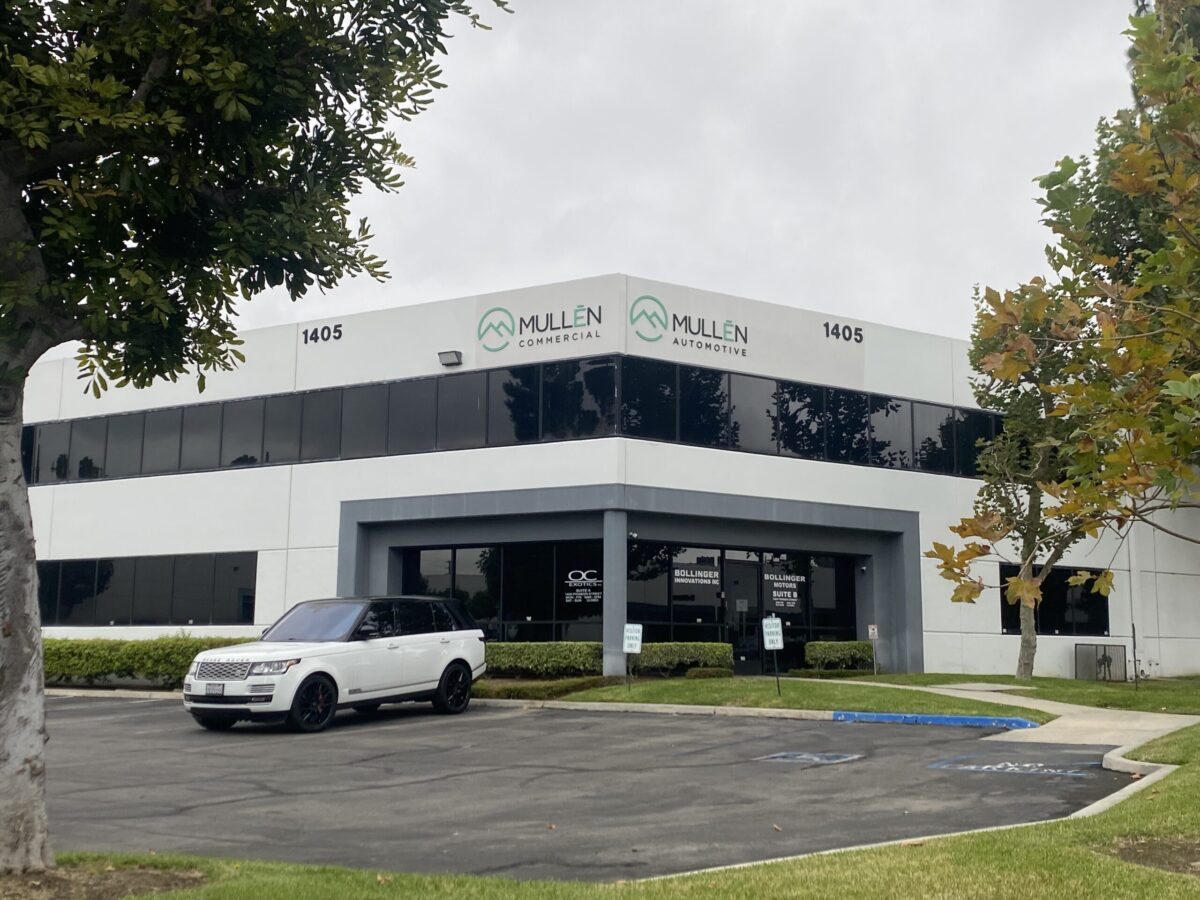
Despite a cascade of financial setbacks and a report last year that its Michigan facilities had ceased operations, electric vehicle maker Bollinger Innovations, formerly known as Mullen Automotive, is still open for business in Brea.
The company went largely silent following its announcement late last year that it had “initiated a cost reduction plan intended to streamline operations and preserve liquidity.” The restructuring included layoffs and plans to close its office in Troy, Michigan, according to a November regulatory filing.
At that time, The Detroit Free Press said the company’s subsidiary, Bollinger Motors, had also ceased operations in Oak Park, Mich., citing an email from its human resources director.
As for its local headquarters, Brea city officials told the Business Journal that Bollinger Innovation’s business license remains “active,” indicating the parent company is still registered to do business in the city.
The executive management team, including Chief Executive David Michery, remains based in Brea and manufacturing operations are continuing. A Bollinger employee confirmed that while the company is up and running, the automaker has been trimming and scaling down operations to “refocus.”
It’s the latest update from a company that once promised a slew of electric vehicles and whose market cap reached as high as $645 million in 2023. Since then, the stock has undergone numerous reverse splits as it plummeted to a market cap below $50,000 and moved from Nasdaq to Over-the-Counter (OTC). Its most recent filing for the quarter ended June 30, 2025, showed an accumulated deficit of $2.6 billion.
The company, which once employed more than 100 at its Brea offices in 2022, promoted a variety of vehicles such as a crossover called “The Five” that would go from 0 to 60 mph in 3.2 seconds and be available for delivery in 2025. Company officials wanted to follow in the footsteps of Tesla and Elon Musk.
“Elon Musk said, ‘I’m not going to worry about price, I’m going to make a sexy, high-performance vehicle,’” Chairman and CEO Michery told the Business Journal in a 2022 interview. “He charged a lot of money for it, and everybody bought it. They didn’t buy it originally because it was electric. They bought it because it was sexy, and it had performance.”
Delisting From Nasdaq
In 2014, Michery purchased Mullen Automotive, which was founded in 2002 and combined it with the assets of Los Angeles-based Coda Automotive Inc. which had gone bankrupt. Mullen originally went public in 2021 via a reverse merger with a share price of $12.
At one point, the company had an estimated 300-plus employees in Brea and its two U.S. vehicle plants in Tunica, Mississippi, running 120,000 square feet, and Mishawaka, Indiana, spanning 650,000 square feet.
Bollinger has reduced its workforce by about 65%, to around 150 employees, according to the company’s representative. Bollinger also said it consolidated all manufacturing to its Tunica plant and closed the factory in Indiana, which was transferred last year to a creditor to settle a legal dispute, according to the Automotive News website. As for closing the office in Troy, Mich., the Bollinger employee said the company is currently looking for new, smaller offices to lease.
Mullen became known on Wall Street for issuing press releases that made many promises that weren’t kept. In 2024, the company promised investors that its revenue would jump from less than a million to $75 million within a six-month span while cutting its headcount by 20%. It never reported reaching that revenue goal.
Between 2023 and 2025, Bollinger issued eight reverse stock splits to remain compliant with the Nasdaq rule that stock must be above $1 each. Its final split, 1 for 250, went into effect last September and was expected to be the last reverse stock split for at least the next three years.
“We understand the concerns that can arise from such corporate actions,” Michery said in a statement at the time. “However, this move was crucial for ensuring the long-term viability of the company and our ability to remain a publicly traded entity on Nasdaq.”
It took only 13 trading sessions for shares to fall back below $1.
Last October, the EV maker delisted from the Nasdaq stock market and started trading on OTC markets.
“Moving to the OTC Markets allows the company to continue maximizing the value of its assets versus the regulatory requirements, the time management must dedicate to compliance and reporting, and the costs involved in maintaining a listing on the Nasdaq Stock Market,” the company said in a statement.
“The OTC Markets are also a far more flexible and cost-effective platform for public companies offering a range of reporting standards with less stringent requirements than the other major U.S. exchanges,” the company said in October.
In its most recent filing for the quarter ended June 30, 2025, the company reported revenue of $474,000 with a net loss of $131.8 million.
At that time, it had under $1 million in cash and $28.1 million in inventory with total current liabilities of $186.5 million.
The Bollinger Connection
Mullen in 2022 decided to expand into bigger trucks by acquiring a 60% controlling stake in Bollinger Motors, a Michigan-based maker of heavy-duty chassis cabs; last August, Mullen increased its ownership to 95% and changed its name to Bollinger Innovations.
Bollinger Innovations said the name change would allow “the operational flexibility necessary to execute its overall business strategy expanding its commercial EV market footprint.” The Bollinger Motors unit ultimately decided to shut down and cease operations last year, the automaker confirmed.
Days before Bollinger transitioned to the OTC markets, The Winvest Investment Fund Management Corp. announced on Oct. 10 its interest in acquiring a majority stake in the company.
Winvest CEO Jourdan Matthews said that the Seattle-based firm acquired its current stake of 9.9% to open board discussions with Bollinger about “numerous proposals for growth.”
Ideas included securing $15 million or more in new funds, acquiring another Nasdaq-listed company that could generate funds to reduce debt and spinning-off or winding down Bollinger’s least profitable segments.
“The company has absolutely vast potential — only if it uses its most valuable asset, which I am proposing the company unleash immediately,” Matthews said in a statement. “Short interest is almost 1,500% right now and retail investors are furious; things have to change immediately, which is possible if the board manages its best asset correctly and uses it right away.”
Winvest did not return a request for comment.