

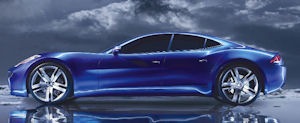
Long running speculation about a public offering from Irvine’s Fisker Automotive Inc. has been goosed by a big funding round and a competitor’s move to go public.
Last week, San Carlos-based electric automaker Tesla Motors Inc. announced plans to raise up to $100 million in a public offering, according to a filing with the Securities and Exchange Commission.
The offering would be a first among electric auto companies, which have sprung up in recent years in response to high oil
prices and a national movement toward greener automobiles.
Telsa’s announcement to go public reignited speculation that Fisker—which is looking to launch its luxury hybrid this year—might be next in line.
The automaker is developing a luxury sedan, the Karma, and a sports car, the Sunset, which run off a combination gas and battery engine developed with Irvine-based Quantum Fuel Systems Technologies Worldwide Inc.
Fisker doesn’t have plans to go public anytime soon, according to Chief Executive Henrik Fisker.
“We are concentrating on building a great American car company and getting our cars out on the road,” he said. “We haven’t had time to put too much thought into anything else.”
An offering could be possible down the road, he said.
Fisker has raised about $200 million in private financing, including from Silicon Valley venture capital firm Kleiner Perkins Caufield & Byers.
In September, Fisker received approval for $528.7 million in federal loans to develop its autos.
The loans are part of a $25 billion fund approved by Congress in 2007 to spur automakers to build electric and fuel-efficient autos.
The automaker had to raise an additional $115.3 million in private equity funding to satisfy a Department of Energy condition to gain access to the loans.
“Raising any money in these times speaks volumes about the value of our business model and the vast potential of plug-in hybrids,” Fisker said.
Part of the funds will allow Fisker to close an engineering and sales center in Michigan and move it to Irvine. Beginning in March, Fisker’s Irvine headquarters will house all design, engineering, sales, marketing and administrative operations, Fisker said last week. About 20 to 30 Michigan workers are set to relocate to Irvine. The automaker is planning to hire more, it said.
Like many in the auto industry, Fisker has seen its share of ups and downs in the past year including a delay in production for its debut auto, the Karma.
Karma, which will be sold for about $90,000, originally was scheduled to arrive at dealerships in May.
Due to delays in parts and battery supplies, the automaker expects to only ship demonstration autos to dealers later in the fall.
The automaker doesn’t expect to see any Karmas on the road here until late November at the earliest.
“We want to get them out on the road, but now it will happen sometime at the end of the year, rather than sooner,” Fisker said.
Fisker’s dealer network has taken the delays in stride, according to the company.
“We have a very strong stable of dealers with strong balance sheets,” Fisker said. “They are selling other brands so they aren’t depending on us only.”
Dealers
The company’s current roster of U.S. dealers includes Irvine-based Shelly Automotive Group, which was one of the first investors in Fisker Coachbuild, an early version of Fisker Automotive; Sullivan Automotive Group in Beverly Hills; and Oregon’s Ron Tonkin Family of Dealerships.
Thirty-two dealers across the U.S. have signed on to sell the autos. Fisker is shooting for 40 worldwide.
The automaker also has been concentrating heavily on Europe, where it sees the Karma having a large draw.
“Considering a gallon of gas in Europe is between $6 and $8, many Europeans are interested in our Karma,” Fisker said.
It signed distribution deals with Nellemann Holding AS in Copenhagen and GP Supercars in Italy last year.
The automaker also partnered with Switzerland’s Emil Frey AG, which has dealerships in Switzerland, Germany, France, the Czech Republic, Hungary and Poland, to import, market and service the Karma.
“We want to export more than 60% of our cars,” Fisker said. “The European market has long been neglected by U.S. automakers.”
Fisker plans to use its federal loan and recent funding to advance the Karma and to develop a lower-cost plug-in hybrid the company is calling Project Nina.
Project Nina is expected to be built in Wilmington, Del., at a former General Motors Co. assembly plant starting in 2012.
General Motors shut down production at its 3.2 million-square-foot Boxwood Road assembly plant last July.
Fisker plans to spend about $18 million to buy the plant. and then spend an additional $175 million to retool it.
Currently, the Karma is being assembled in Finland by custom automaker Valmet Automotive OY using mostly U.S. parts.
Fisker anticipates full-scale production to start late next year, with a target of 15,000 autos annually.
Ultimately, Fisker says he would like the Karma to eventually be built in the U.S.
Fisker expects the Delaware plant would employ at least 1,500 workers and produce up to 100,000 autos annually, once it’s operational.
The company has worked out an agreement with a new battery supplier for its hybrid autos.
Watertown, Mass.-based A123 Systems Inc. signed a multiyear deal with Fisker to supply batteries for the Karma. A123 also has invested in Fisker.
The battery maker is expected to supply batteries for Fisker’s Nina, too.
A123 was one of two contenders to provide batteries for the General Motor’s 2011 Chevy Volt, though it ultimately lost out to South Korea-based LG Chem Ltd.
The deal with Fisker appears to have ended a 2009 pact with the automaker and New York-based Ener1 Inc.
Competition
The hybrid plug-in automaker is facing some more competition from mainstream automakers that have aggressively entered the “green” auto market.
Japan’s Toyota Motor Corp. is testing a plug-in version of its Prius hybrid. Ford Motor Co. announced that it would build an electric version of its Focus sedan. Nissan Motor Co. plans to start selling its Leaf electric auto later this year for about $30,000 and General Motors has set sales of its $40,000 Volt electric auto for this fall.
