

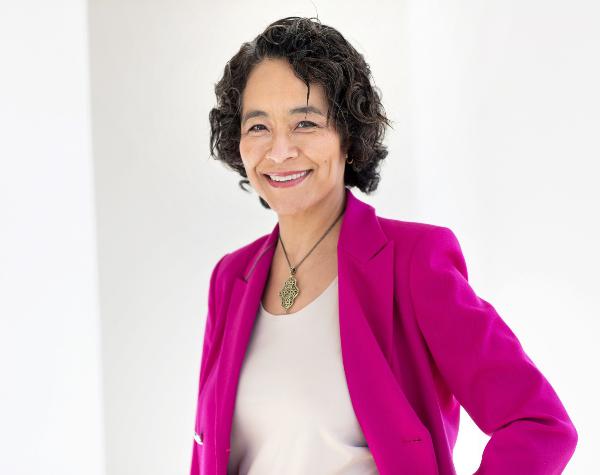
Richardson, who in December accepted a position as president of Colorado College in Colorado Springs, Colo., will depart UCI at the end of June; an interim dean of UCI Law has yet to be announced.
“I’ve been lucky that incredible opportunities have been placed in my path,” Richardson told the Business Journal last week.
“The same is true about becoming president of a liberal arts college is that it wasn’t something I sought. The opportunity simply came at the right time, and Colorado College has values and a mission that match my own.”
Though Richardson will trade her home in Irvine for one in Colorado Springs, she said much of her personal goals will prevail, as she continues to pioneer conversations about improving race relations.
Richardson’s Legacy
Richardson, whose career has spanned partnership at a boutique legal practice to federal public defender to academia since 2005, joined the law school in 2014 and was appointed interim dean in 2017, after its founding dean Erwin Chemerinsky left to lead the University of California, Berkeley School of Law.
At the time of her permanent appointment in 2018, she was the only woman of color to lead a top 30 law school. To rectify that, she established the UCI Law Committee on Equity, Diversity and Inclusion, among other efforts.
Subsequently, UCI Law was ranked the No. 1 most diverse law school among the top 30 schools in the U.S. News & World Report law school diversity index. It is No. 27 overall.
Through it all, Richardson said, “a strong sense of shared values and purpose was critical to achieving success,” which included a focus on inclusive excellence and public service.
The law school excelled through innovative programs that integrate cutting-edge technologies and artificial intelligence into its curriculum. For example, Richardson oversaw the launch of a new graduate tax program at the law school led by top-tier tax scholars.
UCI Law also increased its relationships with foundations and established eight new endowed student scholarships during Richardson’s tenure. It continues to fundraise for its $65 million campaign as part of UCI’s $2 billion Brilliant Future initiative.
Race Relations, Actions
Richardson is a leading legal expert on “implicit bias,” or unconscious bias that influences judgments about race and gender, and brings a unique voice to conversations on race as the daughter of a Korean mother and an African American father who was a lieutenant colonel in the U.S. Army.
While Richardson has studied race relations for many years, she said she’s seen the topic met with renewed interest since the death of George Floyd last summer, which makes her optimistic of meaningful change.
“It’s not only our students and faculty who are committed to a more diverse, anti-racist and inclusive world,” Richardson said. “Conversations around the world are happening about race that are far more open than they were before.”
Still, Richardson acknowledged challenges remain in improving race relations in the U.S.
“It’s uncomfortable. That’s the whole point,” Richardson said.
“People have to embrace being comfortable with being uncomfortable, because if we don’t have these difficult conversations, how can we move forward? Progress requires conversation, then understanding, and then change.”
Richardson offered an additional tip for taking part in these difficult conversations: “Be forgiving of mistakes that people will make when having these conversations.”
Future Projects, Goals
Richardson said part of the reason she was attracted to Colorado College was because of its shared values of diversity and inclusion.
“It aspires to be the most diverse, anti-racist liberal arts college in the nation,” she said.
In addition to her new leadership role, Richardson said she will continue to work on her upcoming book, “a timely project about dismantling ventures of racism and anti-blackness in America.”
She also expects to take up cross-country skiing again and host a piano concert in the next year or two, health and safety regulations permitting, she said. Richardson played with the Boston Symphony Orchestra twice in the 1980s.
Richardson said her departure from UCI is bittersweet.
“I will miss the remarkable and incredibly supportive OC community,” Richardson said.
“Part of the reason the law school has been so successful is because of the support the broader community has provided to our students, our faculty, and me. I will miss it immensely.”
Students at the University of California, Irvine School of Law are continuing to provide pro bono service hours even amid the pandemic.
While the law school transitioned to largely online classes, about 90% of students participated in public service in 2020, which matches participation levels since the law school opened its doors in 2009.
“I’m so proud that our students, faculty and staff continued to represent people in need through clinical work and externships, despite the challenges going on in their own lives,” said Dean L. Song Richardson.
Richardson said she is optimistic this “high level of understanding and desire to serve” prevails after the pandemic, for students, faculty and staff.
Current circumstances have contributed to greater flexibility and recognition of personal challenges, such as navigating Internet access, child care, food insecurity or other pre-existing issues, she said.
As the world returns to more in-person activities and events, Richardson said she expects UCI Law to take advantage of a mix of in-person lessons and online learning modalities.
In addition, “I imagine the legal profession itself will be transformed,” she said.
“We have all learned during this time. I believe that as a result the law practice has become more efficient and will be better able to serve clients because more options are available to them.”
—Jessie Yount
