

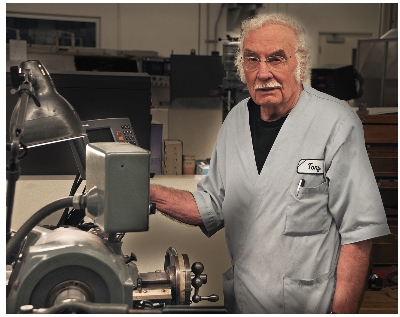
The last time Anthony Maglica took a vacation was more than 20 years ago. He went to Hawaii.
The Anaheim Hills resident and founder/president of Mag Instrument Inc.—maker of the 40-year-old Maglite flashlight—likes to work. He’s in the office before 8 a.m. Monday through Friday, leaving no earlier than 6 p.m. Saturdays he lets himself sleep in a bit, reporting to Ontario around 9 a.m., and Sundays he works from his home office, constantly tinkering away on product development.
“Basically, I’m pretty busy,” said Maglica, who placed No. 35 on the Business Journal’s latest OC’s Wealthiest ranking this July with a net worth estimated at $640 million.
As Maglica’s 90th birthday approaches next year, the maker of what is now a ubiquitous piece of equipment is working to effect a turnaround at his Ontario-based company, which was at one time positioned as a premium brand, the so-called “Cadillac of flashlights.”
Former Apple Chief Executive Gil Amelio once famously said he wanted his firm to be “essentially the Maglite of computers.”
Changing Landscape
A lot has changed since the company’s start and peak years of popularity in the 1980s and 1990s, including competition from Asia, more regulations and a new generation of consumers that’s never really had to resort to a flashlight, instead relying on an app built into most smartphones.
How to turn the attention back to Maglite is Maglica’s current challenge.
“Everyone knows that Maglite has the biggest name recognition across the globe and, really, across the U.S. and because we were largely popular in the late ’70s and into the ’80s and ’90s, the people you would consider Maglite fans are now an older generation and there hasn’t been quite an outreach to the younger generation,” said M.D. Chau, a partner at Irvine-based Apogee United, the creative agency now working with Maglite to refresh and recharge its image.
Advertising Boost
That corporate refresh means new packaging—it hadn’t changed in 15 years—and plenty more movie and TV placements, in addition to partnerships next year that will help solidify its long-standing place among tactical users in fields such as law enforcement.
Promoting the utility of the product is still important, but it’s been the main focus for too long, Chau said.
A separate website for the law enforcement user base at maglitetactical.com recently launched.
“Somewhere along the lines, they went really strong into utilitarian marketing and focused on the utility aspect of the flashlight. They got away from the things that mattered to the general consumer,” Chau said.
“If you have someone who’s a techie or a gearhead, they’re all about the utility and ‘what’s the new innovation?’ If you look at the general consumer, they look at convenience, style and what they have as an expression of themselves.”
The other challenge Chau and Maglica acknowledged is in the distribution channel.
The company has long enjoyed relationships with many mass retailers, including Walmart, Lowe’s, Home Depot, Ace Hardware and Sears. It’s now focusing on building up its direct-to-consumer strategy.
Wholesale will remain, but the company is also pushing more premium product that it’ll sell exclusively through its own web store, which is expected to relaunch this week with a fresh look on Black Friday, after several months of testing and digital advertising.
Fierce US Pride
The question is: Will the plans be enough to soothe broader challenges that have been taking place in the marketplace for some time now? Maglica pursed his lips a bit when asked how the business is faring.
“It’s tough,” Maglica said. “We’re trying to make everything in this country. Nobody does that.”
Mag Instrument occupies a 705,000-square-foot building on Hellman Avenue in Ontario, employing some 400 workers. At its height, the workforce was about 1,000 people. Part of the reduction in worker headcount is attributable to the low cost of imports, but the other aspect of that are advances in automation. Competition from overseas, lack of a skilled workforce to draw from, copycat products and California’s regulatory environment have combined to serve as longtime hurdles for a company whose founder is adamant about making product in the U.S.
Maglica, of Croatian descent but born a New Yorker, moved to Europe at 22 months old and lived there during World War II.
“It was a very nasty war, I’ll tell you. As a kid, I was hungry, barefoot and never knew if I’m going to live tomorrow or get killed,” Maglica said.
“Everybody coming here, they all want to come here and, yet, everybody complains how horrible it is. They need to live overseas. They need to live where you have no rights.”
Maglica, while still in Europe, went to school to learn to be a machinist before coming back to New York. His training as a machinist later took him to Denver and then eventually California where he was able to earn $3 an hour.
He spent $125 on a lathe, working at his job in the evenings and in his garage with a side business during the days, with the latter eventually evolving into Mag Instrument.
“Little by little bit, the company grew,” Maglica said.
Prolific Inventor
The inventor, with over 200 patents to his name and more in the works, has spent years staunchly defending his intellectual property. Just ask the law firm Jones Day, Maglica said.
The firm, which is no longer the company’s outside counsel, he pointed out certainly got its piece of the roughly $150 million in legal fees Mag Instrument has paid out over the years to fight infringers.
The company continues to do its machining, manufacturing springs, plastic parts and many of its printed circuit boards out of Ontario—and can market its products as “Made in the USA” in every state but California due to some of the electronic components coming from outside the country.
The limitation on what constitutes U.S.-made is another source of annoyance to Maglica.
“You get treated like [an] enemy of the country instead of creating jobs for people,” he said.
The company has considered moving outside California a number of times and been wooed by various areas—Colorado, Texas, Tennessee and many more—with tax credits, discounted land and other incentives to do just that. But Maglica is conflicted, saying if he moved the business, he would see it as a betrayal to the workers still with him who helped build the business from scratch.
Many of those workers have been with the company for decades, including Jim Zecchini, Mag Instrument’s vice president of corporate, who has been with Mag for 36-and-a-half years. He’s seen the transformation of not just the business, but also Southern California manufacturing.
“Tony’s always tried to give everyone a path, if you’re willing to work and you’re dedicated to your job,” Zecchini said. “I saw an ad [for Mag] in the paper, actually, and the rest is history. Thirty-five, forty years ago you had General Dynamics plants here [in the Inland Empire]. You had General Electric plants. Lockheed [Martin] plants. This was really a beehive of Southern California manufacturing.”
“What’s happened is everything started offshoring to China and then pretty soon you lose your talent pool for labor. You lose a lot of your suppliers and things change over time, but Tony’s always been a leader in trying to bring America back.”
Hard Work Pays Off
Asked if he ever sees himself retiring, Maglica admitted that would be a difficult task, perhaps even harder than turning around a business.
Certainly, he can go back to the Croatian island of Zlarin, where he said he owns a third of the island. But then what?
“I can read a book when I fix my eyes and get up in the morning and walk down the pier. The pier is only 50 feet away from my house. I can go on a boat and go fishing. I suppose I can go for a swim. It sounds like a boring [life] to me in a hurry, you know?”
In all likelihood, if forced to retire, he said he would no doubt start another company.
“I’m going to be 90 years old next year and I have no problem working,” he said.
“And that’s habit. The harder I work, the luckier I get.”
