

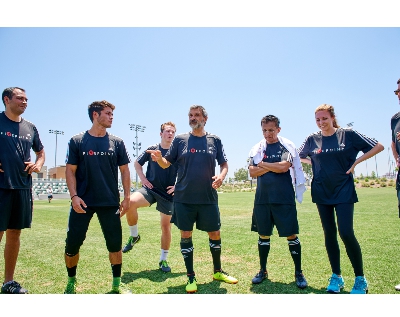
You don’t need much to play soccer—a ball, a flat patch of land and anything to serve as goal posts.
But despite the simplicity of the “beautiful game,” you get a lot out of it, according to Orange County-based executives who spend their free time playing in local adult leagues.
For Craig Boundy, chief executive of Experian PLC’s North American region, based in Costa Mesa, it’s about the egalitarianism and the inclusive nature of the sport.
“I like the camaraderie of being on the team,” he said.
“We all put our uniforms on and everybody’s the same. It doesn’t matter what you do outside of work. It doesn’t matter what your background is or who you are. You play your position and you try your hardest to win.”
Boundy grew up in London, where soccer, or football, is “part of the playground rules.”
His love for the sport got a second wind when he moved to the U.S. in 2011.
“Soccer in Southern California is very well-organized, both for the children and adults, and the facilities are amazing,” Boundy said.
“And of course, the weather helps—in the evening it’s not really that cold.”
The local head of consumer credit reporting giant Experian often joins pick-up games at TOCA, an indoor training facility near his office. He also plays on a “seven-a-side” team in a league in Newport Beach, at a “very nice facility with artificial grass just around the back of Bison [Avenue].”
“I actually have two colleagues that play on my team,” Boundy said. “They are great guys, and in the course of work I’m the CEO, [but] when I’m on the soccer field with them they get to yell at me the same way they get to yell at other teammates or congratulate me the same way they do others.”
“I think this parallels the way that we try to organize and run Experian—inclusion is incredibly important, as is the diversity of backgrounds. Everybody brings an individual skill and bringing that together in the way that you run a company, that’s truly how you make a successful company.
“I make certain decisions at work, but that doesn’t mean that I’m any more or less valuable than anybody else. Actually, my job is to make everybody else’s job easy, and help them be successful at work like it is on the soccer team.”
Corporate Game
Soccer also inspires Emile Haddad’s approach to business. The chief executive of FivePoint Communities in Irvine grew up in Lebanon, where he played on several club teams before moving to the U.S. and venturing into real estate.
“A lot of what I apply in my day-to-day business comes from lessons that I learned while playing soccer—lessons that were very humbling, that allow you to really keep your ego in check,” Haddad said.
“Even when you have a win you celebrate for a little bit, but [then] you’re thinking of the next game.
“There were also lessons about the importance of practice and training, and more importantly, the fact that it’s a team effort, and how hard you actually play with the team is much more important than how you play,” Haddad said.
“When you think about the corporate world today, a lot of things either lead to success or lead to failure because one of these lessons doesn’t get applied.”
Haddad’s playing days are now limited to the occasional match with his team at FivePoint. They celebrated his 60th birthday last June with a contest between the company’s executives and the interns.
“I hadn’t touched the ball since 1985, and so we played the game and I didn’t stretch, and I actually hurt myself,” he said.
“But I stayed the whole game and we won.”
The rematch was held right before Christmas break, which paved the way for a new company tradition—FivePoint will hold one game in June, and one in December; as fans of teams in the Mexican league would say, it’s the real estate developer’s own Apertura and Clausura.
Stadium Center
The FivePoint matches will be played at Irvine’s Great Park Championship Soccer Stadium, an amenity-rich soccer facility the company funded and built that can hold more than 5,000 people.
The stadium is arguably the biggest commitment any company has made to OC’s soccer scene. It’s definitely the most expensive.
The stadium—estimated to cost between $10 million and $15 million—is the centerpiece of the 175-acre sports park that FivePoint has spent the past few years building out at the former El Toro Marine base site.
It’s one of several standout properties at the Orange County Great Park’s growing collection of sports-related facilities, which includes dozens of soccer fields, tennis courts and other fields, including a recently opened $110 million community ice skating facility, known as Great Park Ice & FivePoint Arena.
“We got unbelievable feedback from everybody—from parents, teams, and the hotels, who are basically telling us they are filling up rooms over the weekend because of a lot of tournaments,” said Haddad, whose company is selling homes at the adjacent Great Park Neighborhoods.
“We are very proud and very happy. We build every one of these amenities to try to create the place that we always envisioned—all of these elements are the elements that connect the community.”
The stadium also serves as a home field for Orange County Soccer Club, an Irvine-based team that plays in the second division of the country’s hierarchy of the sport, the United Soccer League.
OC Soccer Club made it to the semifinals of last year’s league playoffs.
The team is helping organize an inaugural Corporate Soccer Cup, which is scheduled for the end of May and early June, and will include 16 teams from OC-based companies.
“It’s set around our home game, and we are also using it as a fundraiser for United Way,” said Oliver Wyss, the team’s Swiss-American general manager.
The “two top teams will play the final right after our game,” he said.
Count on Haddad and the folks from FivePoint to be there.
“I pray not to get injured,” he said.
“I learned from the first time that I need to spend a little bit time stretching, and I make myself disciplined not to think that my body can do what it did back in the day.”
Fever Pitch
Frank Ripullo II, a managing partner at Excelerant Consulting in Laguna Hills, returned to soccer after the risks exceeded his passion for motorcycle riding.
“When I’m playing soccer I don’t think about anything,” said Ripullo. “I don’t think about work, I just compete. It’s a beautiful, beautiful thing. And that’s what I was doing on a motorcycle. I was riding around, and it got my mind off everything.”
He used to spend an entire day at the tracks at Laguna Seca in Salinas or Fontana, and his friends stored their bikes at the office of his healthcare consultancy, to avoid “wives nagging” or “kids playing on it.”
He wanted to get into an activity that was more family-friendly and convenient—everything except for golf that is.
“I’m kind of anti-golf,” Ripullo said. “To me, when you give up on everything you love, then you find the way to justify golf. I’m not there, nor do I ever want to be there.”
The Michigan native started playing soccer as a child and continued through high school and college. He struggled to find a competitive league that was well-organized until a friend recommended he join the OC Warriors.
“We are a very supportive team, but if you’re not pulling your weight, you’re going to be called out and possibly replaced,” Ripullo said.
“It’s not like you show up and you just get some exercise and have fun,” he said. “We play every Sunday and it’s very competitive. Just about everyone is ex-college and a good percentage of players are former pros. A couple of times I saw Jürgen Klinsmann.”
Klinsmann, the World Cup-winning German footballing legend, recently served as the head coach of the United States national team while living in Huntington Beach. He gained lore locally for playing in OC leagues after his professional retirement under a pseudonym, Jay Goppingen.
Ripullo said he stays away from pick-up games, where “you get that one guy who’s out there to hurt people, you’ve got people not trying and then you don’t have anybody to hold people accountable after getting a little too aggressive. I like being aggressive and I like being competitive, but if I foul someone I got to be held responsible for that.”
“At pick-up games, everyone is getting in arguments because everyone thinks they’re right … We have three refs at every game, and we’re playing at the highest level like we’re back in college again.”
Soccer Sundays
Pick-up games work just fine for Nick Joutz, who co-founded WaterMark Home Loans, an Irvine-based direct lender that funds about $1 billion in home loans each year and employs about 100 people at its branches in seven states.
At least once a week he’s at Vista Hermosa Sports Park in San Clemente early in the morning, joining a pick-up game with “kids coming back from college that want to get a run in” or “people in their 50s and 60s out there just playing.”
His friend, Bill Rams, principal at Cornerstone Communications in Irvine, will join him on occasion as well.
Joutz also plays with SoCo on Sundays, a team that’s “pretty relaxed.”
“Sometimes they’ll even do beers and barbecue after the game,” he said. “Everybody wants to get out there and play competitively, but then everybody’s got to go to work on Monday. So nobody wants to get hurt.”
Soccer has enabled Joutz to connect with people from all walks of life.
“It’s great because everybody gets to know each other, and lean on each other for advice and information,” he said, adding, “even guys from other teams, you end up having a conversation with and it’s great for networking.”
The soccer field also provides an opportunity to “get a feel for someone’s temperament,” depending on how they interact with the other players and referees, he said.
“Sports and business or work are very similar in that sense,” Joutz said. “You want people that know how to communicate with others, that are dedicated to something, that have a common objective, that play nice with others.”
For Joutz, a son of a German immigrant, “soccer was very much part of the fabric of our household and my upbringing. We would always watch the German team play and root for Germany in the World Cup.”
He likened the sport to “a fast-paced chess match, with all the pieces on the board, and you’re constantly shifting them either in a defensive or offensive posture. And when all those pieces are working together, that’s when you’re able to achieve success.”
Ego Watch
Haddad agreed that “there’s a lot of strategy,” but added that “chess is one player strategizing on his own, and even the coach cannot be that chess player because the coach can give you directions, but the variables on the field cannot be controlled by the coach.”
“It’s really about how in sync are you with your team members, and how quickly can you react to any condition as a team, and how do you cover each other as a team, and how you support each other as a team, and how you make sure that if the safer play is for somebody else to get the credit of the goal, you don’t let your ego stand in the way of that moment,” he said.
“To me, it’s about people on the field knowing what the strategy is, but reacting in real time to shifts because that’s what happens in real life—you go in with a strategy, but the market conditions shift, and how you act as a team, and have each other’s back, and also make sure that at the end of the day you don’t lose sight that as a team you either win together or the team loses together.”
