

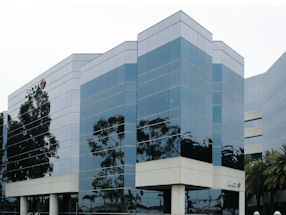
Korean food company CJ Foods Inc. plans to move its corporate headquarters from Commerce to La Palma this summer.
The company, which began its U.S. operations in 1978 and has steadily grown sales here, expects to move to 4 Centerpointe Drive in July. It has leased 18,000 square feet of office space there, with about 60 employees expected to initially make the move.
The La Palma headquarters is the latest shift to OC by CJ Foods.
Fullerton
The company paid $8.2 million in March for a Fullerton manufacturing plant it plans to renovate. The 68,000-square-foot facility is expected to double CJ Foods’ dumpling production, with an additional 9,000 tons of its signature item annually.
CJ Foods expects to have about 50 employees there once renovation is complete in early 2014.
Its five-year outlook projects the Fullerton unit could bring in about $96 million in annual revenue, which is estimated to account for about 20% of CJ Foods’ total revenue, according to Senior Vice President Randy Bartter.
Fullerton also is home to a new CJ Foods warehouse, which has about 20 employees. The company said it’s working on consolidating its three other California distribution centers there by June.
The Fullerton initiatives inspired thoughts about moving the company’s main office to OC, primarily for potential improvements in logistics and cost-saving measures, according to Han Jong Kim, chief financial officer of Los Angeles-based CJ America Inc., which operates as CJ Foods.
CJ America is the U.S. arm of CJ Cheiljedang, the largest food company in South Korea, with more than $6 billion in revenue in 2012.
Kim said CJ Foods considered Fullerton, along with a handful of neighboring cities, before settling on La Palma for its new headquarters.
“50% of the employees at the Commerce office live more west of OC, like in Torrance or L.A.,” Kim said. “Fullerton, being too ‘east,’ might not have been the best commute for a lot of our people.”
La Palma surfaced as a good midpoint, he said, where the company and its employees could take advantage of the proximity to the Santa Ana (I-5), San Gabriel (605), and Riverside (91) freeways.
Convenience in transportation is an aspect La Palma considers an “attractive” asset, according to Mayor Steve Hwangbo.
“We are at the border of Los Angeles and Orange County, close to all business communities and … close to freeways, seaports and airports,” Hwangbo said. “Businesses realize that La Palma is a very clean and well-maintained city.”
Roughly 2,600 Koreans live in La Palma, about 17% of the total population of some 15,800. They make up the largest racial minority group in the city, according to data from the U.S. Census Bureau.
“[Korean-American businesses] historically felt that they needed to be in the downtown Los Angeles area,” said Hwangbo, a Korean-American. “I’m sensing that they are migrating, coming to OC and especially North OC. With the free-trade agreements, you’ll see more and more companies coming to Orange County and [have a presence here], like Hyundai and Kia.”
The two automakers—based in Costa Mesa and Irvine, respectively—are part of Seoul-based Hyundai Kia Automotive Group. The parent is the third-largest Korean “chaebol,” a large conglomerate often controlled by a wealthy family.
Samsung Tie
The largest of the country’s conglomerates is the Samsung Group, to which CJ Foods ultimately is tied.
Samsung founder Byung Chull Lee started CJ Cheiljedang in 1953 as a sugar refiner. It separated from Samsung in the 1990s and eventually became a unit of CJ Group, a Seoul-based holding company that operates in various industries, including food, pharmaceuticals, and entertainment and media.
CJ Group’s 2012 revenue is estimated to top $15 billion. The company is run by Miky and Jay Lee, grandchildren of Samsung’s founder.
CJ Foods keeps an eye on Korean-American consumers here, but it’s also aiming to capture more market share in the mainstream American food market, including by using the Annie Chun’s brand of food products it acquired in 2005, according to Kim of CJ America.
The products include frozen soups, noodles and sushi wraps.
“We have two sides of sales, one focusing on the Korean market and the other on the mainstream,” he said. “The Korean-American audience is important, of course, but there’s a bigger market out there. Regarding the move to OC, we felt we needed a location that could help our business expand, not just in the Korean market, but overall in the U.S.”
