

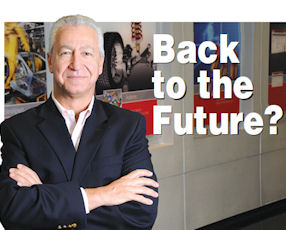
MSC Software Corp.’s move from Santa Ana to Newport Beach later this year will be the latest step by Dominic Gallello to cut costs and improve efficiencies at one of the industry’s oldest companies.
MSC came into prominence in 1965 with breakthrough simulation software that helped the Apollo 11 spacecraft land on the moon four years later. It now is amid a multiyear turnaround plan to regain lost customers, rebuild its image, and shed unneeded real estate and assets acquired more than a decade ago.
It occupies about 52,000 square feet at its headquarters in Santa Ana, where about 160 employees are spread over four floors. The company has another five floors either subleased or empty.
Its new headquarters at MacArthur Court next to John Wayne Airport will total 36,000 square feet “at just a fraction (of what) we’re paying here,” said Gallello, who took the helm in late 2009 after MSC was taken private in a $390 million cash deal by Palo Alto-based private equity firm Symphony Technology Group LLC.
The glut of space at headquarters is a hangover from a lost decade that left MSC’s reputation battered by several strategic and product missteps. Distractions from several government probes, acquisitions that didn’t pay off, and failed turnaround attempts spelled the end for an independent MSC, which went public in 1983.
“This company, when I got here, was $200 million-plus in revenue and acting like a $1 billion company,” said Gallello, who has spent more than two decades in the industry. “The strategy was all wrong—we got away from our core.”
MSC has made strides since Symphony took it private.
“The company was shrinking, and now we’re growing,” Gallello said.
MSC saw about $220 million in sales last year. It employs about 1,100 people across the globe.
Automotive customers use its software for vehicle dynamics analysis, ride and handling simulation, noise vibration, and crash testing. Aerospace companies use it to perform flight load simulations, landing maneuvers, acoustics, and structural analysis.
Engineers in the consumer segment use it to reduce sound and damage through product drop tests.
On the medical front, the software can simulate a cardiovascular stent inserted into an artery using a balloon catheter and guide wire. In orthopedics, biomechanic simulations study the performance of joint replacements inside the body during movement.
Machinists use the software to decipher how much load an earth mover can withstand and how long a component or assembly will last.
Customers
Its customers, which include Boeing, BMW, Airbus and Samsung, pay from the low to high 10 figures for the company’s core products. Only about 25% of annual sales are generated in the U.S., a rarity in the industry.
Competitors include Ansys Inc., Altair Engineering Inc. and Dassault Systèmes SA.
MSC’s new headquarters matches a newly minted production process for its simulation software. The company spent $1 million on upgrades intended to streamline workflow. The goal: tighter schedules based on two-week deadlines rather than six-month goals.
“The pace is unbelievable,” Gallello said. “There’s more transparency.”
It’s an approach that speeds up production in part by bringing flexibility to the process, allowing for quick changes.
The assembly line wasn’t the only thing that needed to change by the time Gallello arrived four years ago. MSC’s software hadn’t been updated in years.
Customers were alienated and uninspired, and the assembly line had “big problems,” he said.
“The magic was gone but the affection for the company was still very strong,” said Gallello, who cut some $28 million in costs his first year on the job.
He’s since replenished the ranks of doctoral engineers to more than 40, reversing a long-running trend of departures.
MSC had built a strong name in the industry through its pioneering product and decades of experience.
Richard MacNeal and Robert Schwendler in 1963 established MacNeal-Schwendler Corp., now known as MSC, in Pasadena.
The company’s big break came two years later when it joined a team of private and government engineers developing software for NASA. Its debut product, dubbed Nastran, enabled engineers to anticipate the effects of heat, vibration and pressure on the Apollo spacecraft.
The software has played a role in designing nearly every NASA spacecraft since then. The federal agency in 2003 said the software’s value to society eclipsed $10 billion.
Expansion in the early 1970s took the company into Germany and Japan, where it still has a deep customer roster and significant sales.
MSC’s products became some of the most widely used simulation and analysis applications in the world over the next two decades.
The company moved from Pasadena to Costa Mesa in 1994, taking up space at 2975 Redhill Ave., the former headquarters of PDA Engineering, which it acquired in 1994.
It moved to its current headquarters at 2 MacArthur Place in Santa Ana in 2001.
MSC entered 2012, its 50th year in business, with an appreciation for its past success and a forward focus.
Its software is currently being used by Lloyd’s Register during construction of the world’s largest vessel, the $1.7 billion Pieter Schelte, which measures more than 1,200 feet long, 380 feet wide and weighs some 240,000 tons; of BMW’s new “i series” line of electric cars in development; and of the James Webb Space Telescope that will be launched in 2018 to explore the outer reaches of the universe.
Auto, Aerospace
Its two main business segments, aerospace and automotive, are the fastest growing in the industry. Simulation software has a role to play as automakers strive to meet new standards on carbon emission and noise reduction. It’s also a key to bids for lighter, more fuel-efficient vehicles of all sorts.
Its Newport Beach headquarters will be the company’s hub for all next-generation technology development.
Gallello said, “Now is the time to talk about the future of simulation.”
