

The markets for stocks, bonds and initial public offerings are back.
So where are the venture capitalists?
They’re around, according to funding trackers and others. They’re just not funding startups—a role venture capitalists traditionally have played.
Instead, they have emerged from the financial meltdown of late 2008 and early 2009 focused on existing investments, and little else.
“We’re seeing a dearth in early stage deals by venture capitalists who are concerned about having enough money to exit companies they’ve already funded,” said Stu Roberts, president of Tech Coast Angels, a group of early stage investors across Orange County and the rest of Southern California.

The numbers bear this out.
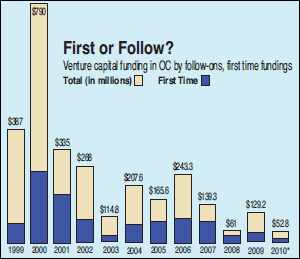
Through mid-April, $53 million was invested by venture capitalists in OC companies, according to Thomson Reuters Corp., PricewaterhouseCoopers and the National Venture Capital Association. About 12% of that was for first-time investments in startups, according to Thomson.
The vast majority, $47 million, was for follow-on rounds for companies in which venture capitalists had made prior investments.
In 2009, first-time investments made up 12% of $129 million invested in companies here. In 2008, they made up 19% of $61 million in funding here.
In 2007, first-time investments were about a third of venture capital invested in the county.
The trend reflects what’s happening nationally, according to Matt Toole, research director for New York-based Thomson Reuters.

“Throughout the U.S., we’re seeing venture capitalists running into a lot more trouble exiting their existing companies,” he said.
A resurgence in initial public offerings this year holds hope for venture capitalists after more than two years of little investor interest in new offerings during the downturn.
Acquisitions also became harder to come by in the past couple of years as financing got tougher and potential acquirers turned attention to restructuring their businesses.
“Recently we’ve started to see an uptick in IPOs and mergers and acquisitions,” Toole said. “But it’s going to take time to wind through the system and impact first-time VC deals.”
In the meantime, entrepreneurs here are scrambling for financing.
“This has to be the most difficult period for startups to get funding since the dot-com crash,” said John Dunn, chief executive and founder of Irvine startup Passionate Pet Inc., an upscale kennel, daycare, grooming and veterinary services provider. “It doesn’t matter whether you’re looking for funding from VCs or angels—this is a very tough period for startups to get money.”
Dunn said he has put nearly $1 million of his own money into Passionate Pet and got a $500,000 loan through the Small Business Administration’s Santa Ana office.
A former Petco Animal Supplies Inc. executive, Dunn said he’s hoping to raise up to $15 million to open another dozen or so stores.
Venture capitalists “only want to see business plans with multistore strategies and strong growth projections,” he said.
As venture capitalists have become more like private equity firms—sitting on investments for longer—that’s left angel investors to fill their historical role of funding startups.
Smaller Funding Rounds
But that means smaller funding rounds for startups.
Traditionally, venture capitalists have funded larger startups or early stage companies needing a few million dollars or more, according to Tech Coast Angels’ Roberts.
Angel investors have been the go-to source for local entrepreneurs trying to raise $1.5 million or less, he said.
But even angel investors are getting more selective, according to W. Scott Griffiths, an Irvine-based businessman who has interests in three local small businesses.
Two of those, 18/8 Fine Men’s Salons Inc. and Outside Labs Inc., are raising money, he said.
“The filter for both angels and VCs is more selective these days, and that’s causing a terrible problem for Orange County entrepreneurs,” Griffiths said. “It’s bound to hurt innovation.”
Startup consultant Stephen Silver, who runs Irvine-based SproutStart LLC, said he warns entrepreneurs looking for funding that the process has changed.
Raising money now takes nine to 18 months, up from three to six months a few years ago, said Silver, who used to run the local chapter of the Keiretsu Forum, a group of 750 angel investors.
“Entrepreneurs are going to need to scale back their expectations,” he said. “They need to work on boot-strapping their budgets. Investors are looking now to help companies gain scale, not start them from scratch as much as in the past.”
Signs of an easing in funding are starting to show, according to some.
“The IPO market, which has been largely nonexistent in the past 18 months, is showing signs of a revival,” said William Link, a managing director at Menlo Park-based Versant Ventures, a healthcare venture capital firm with a Newport Beach office. “M&A activity is also starting to improve.”
Early-Stage Deals
Versant has about $300 million to $350 million to invest in early-stage deals, according to Link.
“The percentage of investments to mid- and late-stage companies has increased during this slowdown,” he said. “But our primary long-term focus continues to be early-stage investments.”
Okapi Venture Capital LLC of Laguna Beach also is looking to make more deals, according to cofounder Marc Averitt.
The firm has $30 million available to put into early stage tech and healthcare companies.
“If you look at past downturns, both VC and private equity funds migrated to later-stage deals as times got more difficult,” Averitt said. “It’s a classic supply and demand scenario. As the economy improves and more startups appear, we’ll see a shift in demand and a more classic VC market.”
